Fast food workers and the international double standard – National Consumers League

Did you know that Burger King pays its Copenhagen employees $20 an hour? That’s the BASE wage for fast food workers throughout Denmark and 2 ½ times what many fast food workers earn in the US. The spokesman for the International Franchise Association, Steve Caldeira,  that represents big businesses that have many franchises, gave a fairly pathetic defense in the New York Times (Fast Food in Denmark Offers Living Wages U.S. Workers Long For”) of why American companies  can’t pay these wages in the US. 

“Denmark is a small country.”  So what does that have to do with paying decent wages?  “with a far higher cost of living.” So that means Burger King and other fast food outlets can pay more when they have to. “Unions dominate and the employment system revolves around that fact.” So they have to pay more because of unions in Denmark but without unions, which they fight to the death in the US, they can get away with paying minimum wage. 

The average wage for fast food workers in the United States is $8.90/hour. According to a recent study from the University of California at Berkeley, half of American fast food workers have to rely on public assistance to make ends meet.

NCL sent a letter to the companies paying their European workers 2 ½ times what they pay those in the US in which we said “We believe it is both callous and unpatriotic for Burger King to shortchange the wages of your workforce, while paying more than double those wages in other countries where unions are more powerful.” We asked them to close this wage gap immediately!

The obvious conclusion is that Burger King and its fast food competitors also mentioned in the story can and do pay a living wage and decent benefits in other countries, but refuse to do so for your very own American workforce. The National Restaurant Association, an industry trade group, regularly opposes increased wages and benefits fast food and other workers in the restaurant industry.

Hamburgers in Denmark might cost a bit more — 80 cents or so according to the Times – they sell there as they would here. If doing the right thing requires raising the price of a Whopper by 80 cents, so be it. Consumers will pay that in the United States, as they do in Denmark.

We expect to see the usual excuses if we get an answer at all to our letters. They will respond by telling us how good Burger King is to its workforce or try to defend this behavior by explaining why things are different in Denmark. The reality is that consumers and workers support companies that treat their workforces with respect and pay them a living wage. This revelation about Burger King paying $20 and myriad benefits to your workforce across the Atlantic calls out for a company response.

NCL has also offered to work with the companies and support serious efforts to close the wage gap.

Where’s enforcement of the Pregnancy Discrimination Act ? – National Consumers League

Early in my career, I worked as a staffer in the House of Representatives. During my time there, the Supreme Court ruled in Gilbert vs. General Electric and handed down a decision that was so absurd and insulting to women that Congress swiftly passed a bill to overturn the decision. The Court said in Gilbert that pregnant women didn’t have the right to be treated similarly to people with disabilities i.e., not forcing them to lift heavy objects or stand for hours. They rules that this was not sex discrimination but discrimination against pregnant people, and that’s not sex discrimination. Uh huh. Right. 

I worked on passage of the Pregnancy Discrimination Act, enacted in 1978, which prohibits discrimination against pregnant workers. Pregnancy has to be treated like any other disability and given proper accommodation. However, that hasn’t worked out very well for pregnant women. Thirty six years after the PDA, employers are flouting the Congressional intent of that legislation and the lower courts are letting them do it. 

Peggy Young vs. UPS will be heard by the Supreme Court December 3. Young asked UPS to excuse her from lifting heavy objects; they refused. She is one of many pregnant women whose employers won’t accommodate their need to reduce heavy duty and hours worked during pregnancy. 

Another victim is Angelica Valencia. She brought a case against her New York City employer – Fierman Produce Exchange – where she sorts potatoes –under the city’s Pregnant Workers Fairness Act. Valencia is 39 weeks along; she has a high-risk pregnancy and makes $8.70 an hour. Her husband drives a bus; she needs the job, but was told by her doctor not to work overtime. When she asked for accommodation, her company let her go because her “at-risk” pregnancy didn’t work with their need for someone who could keep up with the “fast pace”. Really? The woman’s having a baby, she has an at-risk pregnancy, and your company policies are so lacking in flexibility and humanity that you fire her. I hope she wins big against Fierman.

And on the national stage, we need once and for all to give pregnant workers the same accommodations that those with disabilities receive. It’s so sad that we have to revisit Gilbert all over again, but that’s the reality and low-income women are paying the price.   I’ll be at the Peggy Young argument in the Supreme Court and cheering her on.

Happy Food Day! – National Consumers League

Food day is an annual celebration of healthy, affordable and sustainable food aimed to motivate Americans to change their diets and our food policies. That’s why we’ve chosen Food Day to release a report, Wasted: Solutions to the American Food Waste Problem, examining ways retailers and consumers can minimize America’s food waste problem.

The report details the ethical, environmental and financial costs of food waste, demonstrating how far reaching and severe the problem is. In the past year, 49 million Americans were unable to consistently put food on the table, a shocking number considering some 40 percent of food in the U.S. goes uneaten.  American’s aren’t just throwing away food, they are throwing away 35 MILLION tons of food every year. This costs a family of four somewhere in the ballpark of $1,350 to $2,275 each year. When wasted food finds its final resting place in the landfill, it decomposes releasing methane, the second most common greenhouse gas with twenty times the global warming potential of carbon dioxide.

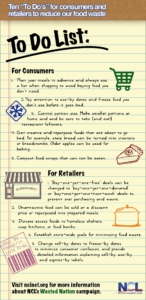
Worldwide, 35 percent of food waste takes place at the consumption level, making retailers and consumers responsible for the largest portion of food waste along the supply chain. NCL’s report addresses behaviors and actions that promote waste by both retailers and consumers, providing concrete actions to minimize food waste.   We’ve assembled a “To Do List” for stakeholders with the top 10 food waste reducing behaviors.

So this Food Day take a moment to consider how you can have a positive impact on food waste through your own actions and requests made to your favorite restaurants and grocery stores. Events like the National Geographic Harvest Festival with cooking demonstrations and taste testing are happening nationwide.

The Other Dirty Paid Sick Days Secret – National Consumers League

Psst…here’s a dirty little secret that might be playing out in your workplace too.

Colleagues are coming to work while sick. We’re lucky enough to have paid sick days but they’re not being used.

This is a problem. While my office has paid sick days, a large percent of American private sector workers don’t get any paid leave. Meaning they have to decide between a paycheck and their health. 

Nearly 40 million people don’t have a single paid sick day. Do you?

It’s astounding, isn’t it? Nearly four in ten private-sector workers—and 80% of low-wage workers —don’t have a single paid sick day to recover from the flu, or cold, or stomach-bug, i.e. short-term illnesses.

Our nation’s failure to establish a basic workplace standard of paid sick days has never been so apparent and it’s costing workers, families, and the public health.

While some cities and states have taken up the mantle of paid sick days and passed laws giving workers the right to have them, what’s the benefit of these new laws if there is a work culture that prevents people from actually using them?

This problem affects children too. Sick kids are going to school and infecting their classmates. In a recent Washington Post article, one parent describes receiving an email from their child’s teacher explaining that four students have come down with strep throat that week and asks that if their child has a sore throat to please keep them home.

For those of us lucky enough to have paid sick days, we need to use them. Yes, there is a culture in many of today’s offices and workplaces that look down on employees who use their sick time. This warped way of thinking needs to change! 

How is it more productive to have someone sick with a cold or flu come into work, cough and sneeze all over the place thus infecting their colleagues than that employee staying home and getting better? In a Staples 2013 survey, it was reported that 90 percent of workers go in while they’re ill and contagious.   

Not only do we need to have universal paid sick days for all workers, not just those in white-collar jobs, but we need a change in attitude and culture that has sick people – workers and students – staying home to rest and recuperate.


New study once again questions artificial sweeteners – National Consumers League

A new study forces us to once again question the safety of consuming artificial sweeteners. A study published last week in the journal Nature provides evidence suggesting diet soda could negatively impact gut microbes leading to glucose resistance and ultimately Type 2 diabetes. The results of the study add weight to the theory that artificial sweeteners might trick the brain, confusing how the body processes sugar.  

In the study, mice fed artificial sweeteners (sucralose, saccharin and aspartame) developed glucose intolerance. The researchers then tested their theory on humans. They found that some individuals showed changes in blood glucose levels after a week of exposure to artificial sweeteners, with a few reaching pre-diabetic levels in just days. If this research is demonstrated in other studies, it could impact how we perceive diabetes risk.

The experiments showed that artificial sweeteners altered gut bacteria possibly leading to glucose intolerance.  Each person’s microbiome is different so artificial sweeteners likely will not have the same effect on everyone. It remains unclear exactly how bacteria in the gut react to artificial sweeteners and why they affect some people more than others. Researchers suspect bacteria that regulates glucose may be pushed out by artificial sweeteners explaining why some individuals weren’t as able to process glucose.

While these are striking findings, it’s important to remember one study alone does not yield enough evidence to prove a theory. Science moves slowly and takes time to establish accepted conclusions. This study does, however, open the door to future research about the effects artificial sweeteners have on bacteria in the gut. Our microbiomes have been the subject of quite a bit of fuss lately, see here and here and here. When indulging in soda, diet or otherwise, do so only occasionally opting instead for unsweetened tea or water.  

A SNAP snapshot – National Consumers League

The good news is participation in the Supplemental Nutrition Assistance Program (SNAP) is down.  The bad news is that it isn’t even close to pre-financial crisis participation levels.  Since December 2012, the number of Americans receiving SNAP, formerly known as food stamps, has gone down to 46.2 million from a record high of 47.8 million.

Right now any decrease in SNAP is significant because of the steady rise in participation rates since the economic crisis. SNAP is one of the many federal assistance programs, others include Women, Infants, and Children (WIC), Temporary Assistance for Needy Families (TANF) and Supplemental Security Income (SSI) that provides assistance to many Americans in need. Seventy percent of SNAP recipients are families with children and over a quarter are seniors or individuals with disabilities.

SNAP provides food benefits to households with a “net income” (or income adjusted for high housing and other permitted deductible costs) at or below 100% of the federal poverty line or for households with a “gross income” (meaning they have no deductions) at or below 130% of the federal poverty line.  The federal poverty line is based on the Poverty Income Ratio, or a threshold set at three times the cost of a minimum food diet in 1963, adjusted for inflation.  This measure of poverty is criticized for its definition of family (people related by blood or marriage), lack of geographic adjustments, and, most importantly, its “head count” approach that only takes into account people who fall below this threshold instead of the actual economic need of U.S. citizens.

A family of four must have a maximum annual income of $23,492 to qualify and the maximum benefits of $632 a month.  Anyone who’s fed a family of four knows that this sum likely will not cover all of the food expenses for a month. This is especially true when feeding children or infants who require more. Despite this, those benefitting from the program stress its importance in maintaining a sense of stability in their life, ultimately lifting them out of financial duress.

Not only do SNAP benefits act as an aid for individuals in financial crisis, but they rejuvenate the economy, generating as much as $9 in economic activity for every $5 spent on SNAP benefits.  With advancements in the job market and SNAP participation declining, the vital role SNAP benefits play in bettering American lives and improving the economy must not be forgotten.

new season – National Consumers League

LifeSmarts, NCL’s national competition for middle and high school students, launched its 21st season this week. This program teaches students the skills they need to be successful adult consumers in the real world. Every year the national championship is hosted in a different city around the country. In April we will travel to Seattle, Washington to crown a new LifeSmarts champion. This blog was written by Lisa Hertzberg, LifeSmarts program director. 

I love that it’s September and the competition is open for the year!

I love when students tell me how much LifeSmarts means to them.

I love when educators come back year after year – then I know we’re doing something right!

I love writing questions, creating new content, and developing fun new learning activities.

I love the LifeSmarts team – what a nice group of colleagues. We work hard but we enjoy doing this work because we’re lucky – we know our work makes a difference.

I love the opportunity to work across the country – we have wonderful state coordinators and competitors from many different states, and we also get to travel to new cities each year for the National LifeSmarts Championship (Hello, Seattle!).

I love the teams – it is great to watch students come together each year for competition but learn so much about themselves and how fun it is to be a part of a LifeSmarts team.

I love that we work with partners and sponsors who believe in this program and support our work.

I love when students apply what they have learned to their real lives and when they realize, “Hey, I learned that in LifeSmarts!”

I love the personal stories:

  • A coach told me she recruited a boy to her LifeSmarts team who was apathetic about school and talking about dropping out.  LifeSmarts (and a teacher who noticed) got him to graduation instead
  • One competitor told me she was able to help her family save money because she learned they didn’t need the extra insurance they were purchasing for their credit card
  • One student told me he knew to use baking soda on a grease fire that flared up at home
  • And students love to tell me, “my parents didn’t even know that!” when they bring LifeSmarts knowledge home

I love that we make learning fun and that we’ve been doing this now for 20 years.

And I love hearing from you – please drop me a note if you want to tell me what you love about LifeSmarts:  lisah@nclnet.org.


Better poultry practices start with consumer demand – National Consumers League

Last week, Perdue, one of the nation’s largest poultry producers, announced the removal of antibiotics in its hatcheries.  It is the latest action in their 12 year plan to reduce antibiotics in poultry production.  Perdue has been a leader in the industry’s antibiotic reduction efforts, with 95 percent of its chickens never receiving human antibiotics and the remaining 5 percent administered human antibiotics for limited time periods, when prescribed by a veterinarian.  

In hatcheries, eggs are injected with drugs that can prevent common poultry diseases. A common practice is to use antibiotics to prevent infections that come from the hole in the shell left by the injection. Five years after implementation, Perdue eliminated antibiotics by improving cleaning procedures and administering vaccines to laying hens that improved eggs immunity. 

Perdue’s decision comes on the heels of the U.S. Food and Drug Administration’s (FDA) guidance for industry recommending the removal of antibiotics used in food for growth promotion.  Perdue already eliminated the use of human antibiotics in feed in 2007.  The guidance, put out in December, is part of a larger plan to reduce antimicrobial resistance.  The Centers for Disease Control and Prevention have quantified the toll antibiotic-resistance infections have on Americans annually, concluding that at least 2 million illnesses and 23,000 deaths are a result of antimicrobial resistance.

Perdue’s decision to eliminate antibiotics in their hatcheries goes beyond any of the FDA’s present industry guidelines. Setting new standards based on consumer demand holds other companies in the industry to improve their procedures.   

There is always more work to be done in ensuring the safest, healthiest animal production.  Antibiotics are still grossly overused in many circumstances and the government has yet to mandate eliminating antibiotic use for growth promotion let alone other practices such as those in hatcheries.  Progress requires engagement not only from government and industry but from consumers who demand safe and healthy foods.

President Obama should act to protect child tobacco farmworkers – National Consumers League

I bet you knew that a 12-year-old cannot legally buy cigarettes in the US. But did you know that it’s legal in America for the same 12-year-old can work in a tobacco field for 10- to 12- hours a day in 100-degree heat and suffer repeated bouts of nicotine poisoning.

It doesn’t pass the common sense test and President Obama should do something about it. That’s the message sent to the President last Thursday in a letter by the Child Labor Coalition (CLC), a group which the National Consumers League founded 25 years ago to protect child workers from exploitative child labor and dangerous jobs. Sixteen groups, including the NAACP the League of United Latin American Citizens, Oxfam America, and Public Citizen, joined 34 CLC members to urge the White House to take immediate action.

The members of the CLC have long known the dangers of tobacco work for children, but we have a relatively new weapon in our fight to educate the public about this issue: A recent report, “Tobacco’s Hidden Children: Hazardous Child Labor in United States Tobacco Farming,” published by Human Rights Watch found that three quarters of 141 child tobacco workers interviewed in North Carolina, Kentucky, Virginia and Tennessee-–the main tobacco-producing states—reported getting sick while working on US tobacco farms. Many of their symptoms—nausea, vomiting, loss of appetite, headaches, and dizziness—are consistent with acute nicotine poisoning (also known as “Green Tobacco Sickness”).

To make matters worse, Human Rights Watch found that three of the four states that produce 90 percent of US tobacco (Kentucky, Virginia, and Tennessee) have failed to take sufficient measures to enforce the Occupational Safety and Health Administration’s (OSHA) Field Sanitation Standard. This standard requires workers to be provided with fresh drinking water, hand washing facilities, and toilets. Most of the children interviewed by HRW were not provided with hand washing facilities or toilets, and some were not given sufficient drinking water.  The absence of hand washing facilities significantly increases the risks of nicotine and pesticide exposure.

Using information from the OSHA Integrated Management Information System, HRW reports that from January 2010 to December 2013, Kentucky carried out only eight field inspections in tobacco, Tennessee carried out one field inspection, and Virginia carried out none. Only one of the four major tobacco-producing states – North Carolina – made meaningful attempts to enforce the Field Sanitation Standard, with 143 inspections during the time period, said HRW researchers.

In addition to nicotine, farmworker children may also be absorbing a range of toxic pesticides commonly used in tobacco fields. Children often wear black garbage bags to protect them from these dual exposures but you can imagine what it’s like to wear a plastic bag in the 90- and 100-degree temperatures often found in tobacco fields. And, the work is dangerous. Child tobacco workers often use sharp tools and can work in tobacco drying barns at two-, three- and four-story heights without protective equipment as they balance precariously on the top of beams that may be only one or two inches thick

Signed by 50 organizations, the letter to President Obama represents millions of Americans, including teachers, healthcare professionals, farmworkers, and advocates concerned about the safety, education, and welfare of children, and it asks the president to issue narrowly-tailored regulations to prohibit work by children in tobacco fields and calls on the Department of Labor to conduct targeted field investigations to ensure that no children under 12 are working in the fields illegally.

The letter to the president also calls on the Occupational Safety and Health Administration to issue “health hazard alerts” so that employers will know how they might mitigate risks of nicotine poisoning for their employees. And it cites the need for better data collection to allow an accurate count of the number of children who currently work in US tobacco fields and other farms.

The situation—with children as young as 12 (and HRW found about a dozen kids conducting lighter work in the fields who were under 12)—is so absurd that it proved great material for the satirists at The Daily Show with Jon Stewart, who produced a funny, but alarming, report called “Nicoteens.” The clip will make you laugh and allow you to hear young tobacco workers describing the work conditions in their own words.

In June, the CLC sent a letter to the top 10 tobacco companies signed by over 50 organizations, asking for voluntary action to limit tobacco work in the fields. Thus far, no concrete actions to remove children from tobacco fields have been initiated by the companies.

In 2011, the Obama Administration acted to implement regulations to protect working children from farm dangers, including tobacco work, but those rules were withdrawn because of opposition from the farm community. CLC members fought hard for those comprehensive protections, but were no match for the resources of the agricultural lobby. The wholesale withdrawal of occupational child safety regulations for farms left child workers in tobacco vulnerable to nicotine poisoning, pesticide poisoning, and other dangers. It’s time to fix this glaring consequence of the administration’s complete pullback and move forward to protect children in tobacco fields.

Readers who wish to send a quick note to the White House about this issue should go here.

A bill, HR 5327, in the House of Representatives, recently introduced by Rep. David Cicilline (D-RI) would classify tobacco work as hazardous labor, allowing the USDOL to ban work by children under 16. We encourage consumers to call or write their member of Congress and ask them to cosponsor the bill.

It’s time to stop the madness. We need your help.

Happy Labor Day! – National Consumers League

So far in 2014, labor advocates have celebrated an unusual number of victories. For 115 years NCL has fought for improved workplace protections, basic safety standards, and the empowerment of American workers. We are very happy that at this year’s Trumpeter Dinner, we continue on this long tradition of recognizing our labor leaders by honoring Richard Trumka, President of AFL-CIO.

Here in Washington, DC, NCL has been fighting to see the passage of important measures that will improve the lives of workers in the city. These include: 

  • Passage of DC’s new minimum wage law that went into effect July 1, 2014. The new law immediately raised the minimum wage to $9.50 and the wage will continue to increase until it reaches $11.50 over the next two years.
  • Passage of DC’s new Paid Sick and Safe Days law which into effect February 22, 2014. The new law closed the loophole in DC’s original law and now includes tipped workers and workers who have been on the job for less than one year.
  • Passage of DC’s new Wage Theft law that increases penalties on repeat labor offenders (employers), allows better legal access for victims, and creates a stronger system for DC’s Department of Wage & Hour investigations.

Nationally, NCL is part of a variety of coalitions that celebrated many important victories. These include: 

  • Presidential Executive Orders: After continued pressure from labor groups and fellow advocates, President Obama signed a host of labor related Executive Orders for federal contractors. These included: raising the minimum wage to $10.10, protecting LGBT workers from discrimination, raising the bar on federal contractors to disqualify labor violators from receiving federal contracts, retaliation protections for workers who share their salary information, instructing the U.S. Department of Labor (DOL) to collect wage information from federal contractors including gender to further study the wage gap.
  • NCL participated in the planning and attended the White House Working Families Summit in July.
  • NCL wrote and submitted official comments on a variety of rules, including: DOL’s Family Medical Leave Act’s ‘spouse’ definition rule, OSHA’s record keeping rule, OSHA’s silica rule, OFCCP’s pregnancy discrimination complaint form, and the increase to the minimum wage for federal contract workers.
  • NCL also testified in support of strengthening the OSHA silica rule. 
  • In addition, NCL continued its work on federal economic security bills: the Health Families Act (paid sick days), the FAMILY Act (paid family & medical leave), the Paycheck Fairness Act (retaliation protection for workers sharing salary info – wage gap), and the Pregnant Worker Fairness Act (accommodations for pregnant workers).

There is much to cheer about and, all in all, we think it’s been a banner year for improving workers’ lives. There is, however, much work to be done, and Labor Day is a time to be optimistic about a future with more labor victories. We will continue to fight for better workplaces including: 

  • Creating stronger protections for all workers especially LGBT and pregnant workers.
  • Advocating for more cities and states to increase their local minimum wage.
  • Advancing city and state paid sick days campaigns.
  • Watching and participating in the Peggy Young v. UPS Supreme Court case. UPS refused to grant Peggy Young workplace accommodations (light duty) while she was 3 months pregnant, even though UPS grants accommodations to injured or disabled workers.

This Labor Day, while spending the day at the pool or hanging out barbequing with friends, please take a moment to think about the struggles of working Americans and hopefully thank one too.