Don’t text and drive! #ItCanWait – National Consumers League

Do you text when you drive? Sure, you can stay in constant contact with your friends, instantly “like” a picture on Facebook, or tweet what you just passed on the road, but it’s not worth it? More than 100,000 car crashes every year involve drivers who are texting. It can wait.

Over 75 percent of teens say texting and driving is common among their friends. This habit is widespread and deadly. AT&T’s “It Can Wait” campaign encourages teens to put down the phone when driving and focus on the road. Today, September 19, is the Drive 4 Pledges Day. Americans around the country are encouraged to sign a pledge that they will not drive and text. Texting isn’t the only distraction while driving.

In 2011, accidents resulting from drivers texting, calling, eating, reading maps, using navigation systems, and performing other distracting activities, resulted in 3,331 deaths and an additional 387,000 injuries. For teen drivers, over 20 percent of fatal crashes involved a distracted driver on a cellphone. Need a reason to sign the pledge? Watch these videos of family members telling stories of how they lost loved ones in car accidents involving distracted drivers. 

A driver who sends a text will be distracted for five seconds. Anything can happen in five seconds. Play this game to see just how dangerous it is to text and drive. In a survey of teen drivers, 97 percent of teens say texting while driving is dangerous, and yet 43 percent admit they do it. It’s time this changes. Become an advocate for the cause and pledge that you will not text and drive. This is a public health and safety epidemic; no text is worth the risk. It’s not worth it. Put the phone down. It can wait.

Growing concern over a flawed USDA plan for pork plants – National Consumers League

By Sally Greenberg, NCL Executive Director
This week’s Washington Post ran an expose story – one we were glad to see – about the misguided Department of Agriculture (USDA) plan to roll out a meat inspection program nationwide that will allow pork plants to use their own inspectors and replace USDA inspectors.

According to the Post story, the plan “has a history of producing contaminated meat at American and foreign plants.”  The Post noted that the USDA’s decision to allow federal inspectors to be replaced at plants by private employees that serve as inspectors had produced “serious lapses that included failing to remove fecal matter from meat” in three of the five plants that had participated in a pilot program for more than a decade.

The Post went on to note that plants using the same procedure in Australia and Canada also ran into problems. In one case, a Canadian company had to recall 8.8 million pounds of beef products for E. coli contamination. A Government Accountability Office (GAO) report last month even said that it would be difficult to recommend rolling out the plan nationwide.

NCL has been working with a coalition of food safety and worker safety groups since the moment the USDA announced its disastrous campaign to shift oversight to private companies, to increase line speeds, and endanger both workers and consumers. But the USDA simply won’t listen. The tide should be turning though. We have a new bill this week from Senator Kirsten Gillibrand (D-NY) called the Safe Meat and Poultry Act, which addresses concerns about the line speeds and potential for food safety outbreaks in the USDA plan, the GAO report, and now this Washington Post story. We urge the USDA to listen at last to critics and give up this program, for the sake of the health and safety of all Americans.

Around the world 15.5 million children are trapped in domestic servitude – National Consumers League

 By Sharon L. Fawcett, CLC Contributing Writer “I clean the floor many times in a day. When it is not well done, my employer throws the dirty water at my face.”

This is how a girl from Togo describes her experience with child labor to *Anti-Slavery International (ASI) researchers. She is a child domestic worker, enduring her employer’s abuse. The International Labour Organization estimates that 15.5 million children around the world are involved in domestic work in a home other than their own; 10.5 million of these children are involved in child labor as they are either under the legal minimum working age, or employed in hazardous conditions or conditions akin to slavery. In 2008, 61 percent of children in domestic labor were between 5 and 14 years of age; one-third were under age 12.73 percent of children engaged in domestic work are girls.

Child domestic labor is one of the most widespread and exploitative forms of child labor in the world. Child domestic workers help with the day-to-day tasks of running a household. These may include cooking, cleaning, caring for children or the elderly, gardening, running errands, and other tasks, as well as selling goods in the marketplace and on the street. These children may live with their employers, they may receive financial remuneration for their work, or “in kind” payment like food and housing. The hours are long, and many child domestic workers report that they are always on-call.

The reasons children end up in domestic labor vary by country and region, but poverty is usually a major factor. Child domestic workers are often overlooked in attempts to protect child workers, partly because of the notion that domestic work is a “safe” form of employment. However, because these children work inside private homes, they are especially isolated and at risk for abuse. According to the ILO, three-quarters of all children in domestic child labor perform hazardous work. This includes children working at least 43 hours per week, working at night, and being exposed to physical or sexual abuse.

The ILO reports that significant numbers of child domestic workers are victims of trafficking, debt bondage, or servitude. Approximately 225,000 of these children work in *Haiti’s *restavek system, trapped in what amounts to forced labor and slavery. From the French words rester avec (“to stay with”), restavek children, usually girls, from poor rural backgrounds are given or sold by their parents to work as domestic servants for other families.

ASI and Free the Slaves (FTS) report that restavek children are treated as sub-human, and are extremely vulnerable to exploitation as well as physical, psychological, and sexual abuse. A similar form of servitude takes place in *Nepal where, for more than half a century, daughters of lower-caste, Tharu, have been sold or given to those of upper-castes as a means of debt repayment by their families. These young girls are known as kamlari.

In spite of Nepal’s government officially banning bonded labor in 2000 and its Supreme Court making the kamlari practice illegal in 2006, at least 500 girls are still trapped in domestic slavery, according to Man Bahadur Chhetri from the Kamlari Abolition Project. The suicide by self-immolation of 12-year-old kamlari Srijana Chaudhary, this year, highlighted the dire situation of kamlari girls. Yet another form of child domestic servitude is found in *Niger, where girls born into slavery can be sold to wealthy men as “fifth wives” or wahayu, a practice in which they become sexual and domestic slaves. Child domestic labor violates the United Nations (UN) Convention on the Rights of the Child (CRC) to which all countries that have ratified it are bound.

The United States, Somalia, and newly constituted South Sudan are the only UN member nations that have not ratified the CRC. (To learn what children’s rights are violated by child domestic labor, see table “Child Domestic Work and Children’s Rights.”) Child domestic labor also violates the ILO’s Worst Forms of Child Labor Convention (C182) and Minimum Age Convention (C138). In many cases it may violate the UN Palermo Protocol on Trafficking in Persons.

In 2011, the International Labour Conference adopted the Domestic Workers Convention (C189). C189 gives domestic workers, in states that ratify the convention, the same protections that other workers are entitled to. The convention also contains specific provisions to protect children from child labor in domestic work, ensuring that those of legal age to work can do so in decent conditions, without jeopardizing their education. The entry into force of ILO C189 on September 5, 2013 is a major step towards acknowledging the rights of domestic workers and protecting child domestic workers. However, as Kali Yuan of The Bernard and Audre Rapoport Center for Human Rights and Justice at the University of Texas points out, the standards in C189 must be translated into local context, changing norms and attitudes at the grassroots level. The same is true for other relevant conventions, so that children who wish to perform domestic work—and are of legal working age—can do so in conditions that are fair, safe, and respect their dignity.

For more on what some CLC members are doing in this sector see: Report: Human Rights Watch (2012), Lonely Servitude: Child Domestic Labor in Morocco. Information about the work of Free the Slaves, and partners, to end domestic slavery in HaitiIndia, and Nepal. Information about the work of UNICEF, and partners, to *help child domestic workers in Haiti regain their rights.

*Links are no longer active as the original sources have removed the content, sometimes due to federal website changes or restructurings.

A plea to USDA, stop playing chicken with our poultry – National Consumers League

By Michell K. McIntyre, Outreach Director, Labor and Worker Rights Last week the Government Accountability Office (GAO) released a scathing report on the Department of Agriculture’s (USDA) Food Safety Inspection Service’s (FSIS) pilot program for overhauling the nation’s chicken and turkey inspection regulations.

While the report focused on the food safety risks of program there are worker safety concerns as well. The poultry industry and USDA hope to roll out the regulation changes nationwide as a “modernization” to the current inspection model. The pilot, part of the HAACP-based Inspection Models Project (HIMP), and USDA have been sharply criticized by food and worker safety groups, including NCL, because the proposed changes increase public health risks and the safety of plant employees.

The changes would replace government trained federal inspectors with untrained private plant employees and increase the speed of inspection to 175 birds per minute – 3 birds per second. The report finds that USDA “has not thoroughly evaluated the performance of each of the pilot projects over time [15 years] even though the agency stated it would do so when it announced the pilot projects.” GAO also accuses the program of using “snapshots of data” instead of comprehensive figures reflecting all data from the entire duration of the pilot during their analysis. FSIS’s own testing has shown that some plants in the pilot program are failing to detect foodborne illness, including salmonella.

Food and worker safety groups have not been alone in calling attention to this egregious regulation change. Senator Kirsten Gillibrand (D-NY) and Congresswoman Rosa DeLauro (D-CT) have been sounding the alarm on the Hill. “Our food safety system is being ‘modernized’ at the expense of worker safety and public health,” said Rep. DeLauro, who had also previously raised concerns about the rule with USDA Secretary Tom Vilsack. “The proposed rule has long been a problem, with 10 percent of chicken plants in a related program recently failing a round of salmonella testing.” It’s time for the USDA to stop playing chicken with our health, halt this ill-conceived pilot program and scrap this so-called “modernization.”

A new LifeSmarts season, a new Web site. Going strong, growing bigger after 20 years. – National Consumers League

The 2013-2014 LifeSmarts season is officially underway this week, with a new competition year going live at the program’s revamped online home, LifeSmarts.org, along with a variety of new coaching and study resources, new opportunities for participants, and new state programs across the country.

Next April, students from around the country, that have outlasted their fellow competitors in online and live competition, will gather in Orlando, FL for the LifeSmarts National Championship. Last season, an estimated 100,000 students and teachers across the country answered more than 3.5 million LifeSmarts questions. Every year, the competition grows and the ultimate goal of a team representing every state in the nation is within reach. Last year’s championship saw teams from 38 states, the District of Columbia, and two student leadership organizations, FCCLA and FBLA. Later this month, LifeSmarts will also roll out a major expansion to its LifeSmarts program in partnership with Underwriters Laboratories, UL, providing participants with a community service learning opportunity in their communities. LifeSmarts students can go into classrooms around the country and spread LifeSmarts lessons to younger students to usher in the next generation of consumer savvy Americans. Check out the new LifeSmarts Web site at LifeSmarts.org. Follow the program on Facebook for the latest updates and to compete in our daily quizzes and monthly competitions to win prizes.

The gap between CEO and average worker pay continues to grow. Let’s #ShareTheWealth! – National Consumers League


This week, in honor of Labor Day, let’s take some time to acknowledge the growing disparity between CEOs and the workers who make their companies succeed. Workers are the backbone of our nation. Thank you to America’s workforce, and this year let’s think about spreading the wealth.

Let’s celebrate this Labor Day by fighting for the country’s low-wage workers – National Consumers League

By Sally Greenberg, NCL Executive Director
With Labor Day 2013 upon us, we have the opportunity to stand with low-income workers in the District of Columbia (DC) and by extension, all of the working poor. NCL has taken part in two recent campaigns in DC in an effort to lift up those who are often exploited and toil for unconscionably low wages. The first campaign supports the efforts of *Good Jobs Nation.

NCL joined with this worker organization to help publicize the low wages federal contractors are permitted to pay those who serve food in the museums and tourist locales around the city. Twice in the past month our staff and our six summer interns hopped the DC Metro down to the National Mall to support walk-outs and rallies by hundreds of minimum wage employees. We’ve helped to publicize the fact that contractors who run fast food outlets like Subway and McDonalds, and who secure lucrative contracts with the federal government to provide meals at places like the Air and Space Museum and Union Station in Washington DC, often pay less than the DC minimum wage of $8.25 an hour, and sometimes even less than the federal minimum wage of $7.25 an hour.

We think tourists and taxpayers would be unhappy to learn that many of these federal contractors are not playing by the rules and are engaging in wage theft, which includes not paying the requisite time and a half for overtime or paying less than the required DC or federal minimum wage. All the while, these contractors are reaping millions in profits from tourists who have little choice but to eat in these establishments when they visit DC’s many wonderful sites. We, Good Jobs Nation, and many other groups are calling on President Obama to sign an Executive Order requiring federal contractors to pay a living wage to all workers. We urge everyone to go to the Good Jobs Nation website and sign the letter to the President.

We’re committed to supporting these workers in their efforts to earn not only the minimum wage but the DC living wage – which has been evaluated to be $12.50 an hour. If workers received a living wage they would make $26,000 annually working a 40-hour work-week. The second major DC-focused campaign is the DC City Council’s legislation, passed by an 8-5 tally, requiring that big box stores operating in DC, that have $1 billion in corporate sales and at least 75,000 square feet, pay a living wage of $12.50. Walmart has three stores operating in the District already, but because of the Council’s action, they are threatening to stop construction on the other three and take their business elsewhere. The bill now sits on DC Mayor Vincent Gray’s desk; *NCL has written to the Mayor asking him to support the Council’s measure. Both campaigns have one thing in common: they are aimed at improving the wages and living conditions of the District’s working poor, who often are left to try and raise families on incomes of $15,000 or less in a very expensive city.

The argument from Walmart and its supporters is that these jobs, indeed, any jobs, are better than no jobs. A Washington Post article written by Jim Tankersley on August 8, debunks this claim showing raw statistics that demonstrate how Walmart affects a community and the number of jobs available. “Economic research suggests that the net job-creation benefits of a new Walmart usually prove minimal, at best. That is because when Walmart opens a store, it often drives other retailers out of business, forcing their employees out of work.

A 2004 paper from economist Emek Basker of the University of Missouri found that the introduction of a Walmart to a community usually raised retail employment by 100 jobs at first, but that number fell to a net gain of 50 jobs in the long run. A year later, a trio of economists from California and Massachusetts found that a Walmart entry reduces employment by 150 jobs in the long term. A 2008 study of Maryland Walmarts (sic) found the stores reduced overall retail employment in the areas where they were introduced but pushed up retail wages.” If Walmart effectively stalls job creation and then reduces the overall number of jobs in the long term, perhaps DC would be better without Walmart’s jobs. These parallel campaigns are front and center during this Labor Day.

We think both President Obama and the DC Mayor (with kudos to the DC City Council) have a unique opportunity to lift up the workers in DC and demand that that stores like Walmart and federal contractors who run the McDonalds and Subways provide a living wage to all workers. This seems like a reasonable request in light of the huge profits these companies make, and bringing these demands to fruition would be a very worthy way, indeed, to celebrate Labor Day 2013.

*Links are no longer active as the original sources have removed the content, sometimes due to federal website changes or restructurings

A day of celebration and reflection at the National Mall – National Consumers League

By Sally Greenberg, NCL Executive Director
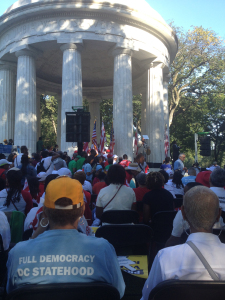
Yesterday, Washington celebrated the 50th Anniversary of one of the world’s greatest events for the cause of civil rights. There were Americans from all states of the union at the March, and many great speeches. I joined the ceremonies in the morning by participating with citizens and elected officials working for DC Statehood at the DC WWII Memorial, then walked to the Lincoln Monument with the crowd to hear the speeches.  I also took a lot of pictures.


Congressman John Lewis, who was a King confidant and who was himself arrested many times, beaten and bloodied, and who is now a member of Congress from Georgia, spoke, as did Ben Jealous, head of the NAACP, Arline Holt Baker of the AFLCIO, Mary Kay Henry, head of SEIU, Randy Weingarten, head of AFT, Attorney General Eric Holder, and Speaker of the House Nancy Pelosi, who drew a rousing round of applause. Pelosi told the crowd she was at the march 50 years ago and heard MLK Jr. speak. She observed that then there were 4 Black members of Congress back then and a Catholic in the White House; today there are 43  Black members of Congress and an African American in the White House. The Black Caucus members “are the conscience of the caucus” Pelosi said. And I was personally so pleased that she also said we need “not just a minimum wage but a livable wage.” That’s what we are fighting for right now in DC!

We ought to have been celebrating the gains made in the last 50 years and there have been many. The overwhelming sense I had from the crowd, however, which was both heavily African America and union, is that while many important gains have been achieved since Martin Luther King made his “I Have A Dream Speech”, just when you think things are going well, something monumental sets you back. The theme for this march was why the senseless killing of Trayvon Martin, the FL teenager shot while he walked back from a convenience store carrying nothing more than a bag with Skittles, ever happened? Are “Stand Your Ground” laws a chance for racists to carry out vigilante justice and get away with it? And how different is Trayvon Martin from Emmett Till? Nevertheless, it was a great day in Washington, with excellent speeches and an opportunity to reflect on King’s Dream – with the Trayvon Martin case, immigration reform stalled, and 15 million workers making minimum wage and having to work 2-3 jobs to get by, though, today was a reminder of how much more we need to do to get our house in order.

Additional consumer protections could help prevent more Jamster’s – National Consumers League

By John Breyault, Vice President of Public Policy, Telecommunications and Fraud The Federal Trade Commission (FTC) today announced its second major enforcement action against a wireless cramming scheme – a $1.2 million settlement with Jesta Digital, a.k.a. Jamster. While enforcement actions may give some scammers pause, the dozens of FTC enforcement actions against landline cramming scammers since the early 2000’s show that enforcement alone isn’t the answer.

As the FTC itself has stated, wireless cramming is a “significant consumer problem,” demanding action by federal regulators. We couldn’t agree more. Based on data reported by the California Public Utilities Commission, the Federal Communications Commission (FCC) and the Vermont Attorney General’s office, we estimated that wireless cramming fraud is costing consumers as a much as $887 million per year. As we have said before, the Jamster case as well as Wise Media and JAWA before it, are likely just the tip of a very large iceberg when it comes to wireless cramming. Unfortunately, the wireless industry seems determined to defend its assertion that there is not a significant wireless cramming problem in the U.S. For example, in June, CTIA, the wireless industry’s association, published an industry-funded study the called into question the results of an earlier study by the Center for Rural Studies at the University of Vermont.

The Vermont study found that 60% of third-party charges on consumers’ wireless phone bills were unauthorized. An earlier analysis by the Illinois Consumer Utility Board found that 44% of third-party charges were unauthorized. NCL has advocated for stronger consumers protections to address the growing problem of wireless cramming fraud.  Earlier this year, NCL and seven other public interest groups, called on the FTC to take a more active role in addressing wireless cramming fraud. Examples of reforms that could address the problem include requiring billing aggregators to obtain bonds from third-party service providers before initiating billing; prohibiting the use of negative option confirmations; and better reporting of consumer cramming complaints. As the primary regulator of the wireless industry, the FCC should also take action to address the role that carriers play in protection consumers from wireless cramming.

Reforms called for by NCL and others include requiring better disclosure of third-party charges on consumers’ bills; requiring consumer affirmative consumer opt-in consent before third-party charges can be billed; and improving cramming dispute resolution processes. When cramming fraud first emerged in the landline telephone space in the late 1990’s, the industry response was essentially “trust us, we’ll fix this.” More than a decade later, the problem persisted and the industry – under pressure from Congress, regulators, and public interest groups – finally took the right steps to end most third-party billing. How many more Jamster’s do we need to have before the industry gets serious about reforming a third-party billing system that enables wireless cramming?

Fast food workers plan a day of protest on August 29 – National Consumers League

A coalition of national labor unions and community groups announced a national fast-food worker walk-out scheduled for August 29.  This announcement follows a summer of protest, during which workers from across the country have protested against low-wages and unfair working conditions.

Striking fast-food workers have cried foul over unpaid overtime, wage theft, and a lack of upward mobility. Nationally, these workers earn a median pay of $8.94/hr. The planned walk-out is a precursor to Labor Day, a day our nation pauses to recognize the economic and social contributions of America’s workforce.  And while some workers are doing exceptionally well, median pay for chief executives at the nation’s top corporations jumped 16 percent last year, low wage workers – the bottom 20 percent of the workforce – have seen their incomes fall 5 percent in the last seven years.

Low-wage workers are demanding a $15 minimum wage. Many pro-business advocates have made claims that such an increase would harm consumers and cause prices to skyrocket. In fact, Rep. Markwayne Mullen (R-OK) stated at a town hall meeting earlier this month that a $10 minimum wage would increase the price of a hamburger 438 percent. Such a statement is intended to startle consumers and turn the public against the idea of increased wages. A close examination of the claim, however, proves it to be false. In Australia, where the minimum wage is $16.88/hr., a Big Mac costs $4.94.

Australia’s minimum wage is more than double America’s measly $7.25/ hr., and yet a Big Mac is only 74 cents more. Social media outrage has fueled a renewed invigoration to increase wages and the mainstream media is paying attention. Earlier this week, a Seattle campaign announced their push for a city-wide $15/hr. minimum wage. As public sentiment turns against corporate business greed, the reality of higher wages – and perhaps living wages – for fast-food workers inches towards a reality. On August 29, the nation will be tuned in and alert to the plight of America’s low-wage worker.