Sorry, fair pay and a safe workplace aren’t on the menu
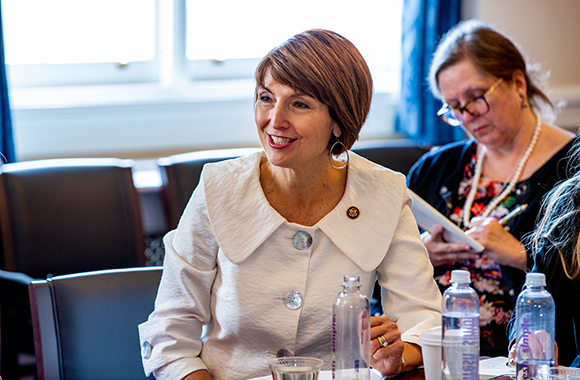
Diana Ramirez, Federal Senior Policy Advocate at Restaurant Opportunities Center,….
Diana Ramirez, Federal Senior Policy Advocate at Restaurant Opportunities Center,….
December 9, 2019
Media contact: National Consumers League – Carol McKay, carolm@nclnet.org, (412) 945-3242 or Taun Sterling, tauns@nclnet.org, (202) 207-2832
Washington, DC—Despite widespread opposition, the U.S. Department of Agriculture (USDA) has announced that it would tighten work requirements for able-bodied Supplemental Nutrition Assistance Program (SNAP) participants without dependents. The National Consumers League joins 140,000 other Americans who overwhelmingly oppose this cruel and unnecessary slashing of an effective safety net program.
Under current regulations, able-bodied adults without dependents (ABAWDs) can receive food assistance no more than three months out of every three years, unless they work at least 80 hours per month or meet other education or workforce training requirements. Previously, states could waive work requirements when jobs were unavailable or didn’t match workers’ skills, but the rule will make it more difficult to do so, causing an estimated 688,000 people to lose benefits.
The vast majority of the more than 140,000 comments submitted to USDA in response to the rule were written in opposition, including those submitted by NCL Board member National Farmers Union (NFU).
Sally Greenberg, NCL’s executive director:
“More than 37 million Americans will experience food insecurity this year in the richest country in the world. SNAP, or the Supplemental Nutrition Assistance Program, eases that pain and helps ensure that those in need can put food on their tables. Among our national safety net programs, food stamps is among the most effective. It provides that essential nutrition safety net for American families and especially children– yet this administration has done everything it can to slash gaping holes into that net, preventing hundreds of thousands of children and adults from getting rightful access to these programs. To add to the pain, these work requirements will erode food security in rural and urban communities alike.
“NCL joins with the NFU in believing that these new rules reflect the cold indifference to the struggles of our fellow Americans; we believe it is unethical and unjustified. We continue to call on the administration to rescind this rule, and we stand with the anti-hunger community and the many national, state, and local organizations who seek to support and protect our most vulnerable citizens.”
###
About the National Consumers League (NCL)
The National Consumers League, founded in 1899, is America’s pioneer consumer organization. Our mission is to protect and promote social and economic justice for consumers and workers in the United States and abroad. For more information, visit www.nclnet.org.
October 29, 2019
Media contact: National Consumers League – Carol McKay, carolm@nclnet.org, (412) 945-3242 or Taun Sterling, tauns@nclnet.org, (202) 207-2832
NCL files comment with the U.S. Treasury’s Alcohol and Tobacco Tax and Trade Bureau (TTB) objecting to a proposal to completely eliminate ‘standards of fill’ (or permissible bottle sizes) for distilled spirits, inviting consumer confusion.
Washington, DC—The National Consumers League (NCL) has filed a regulatory comment with the Alcohol and Tobacco Tax and Trade Bureau (TTB) objecting to its proposed regulation (Docket TTB-2019-0005) to eliminate the “standards of fill” or permissible bottle sizes for distilled spirits products.
For years, NCL has been urging TTB to take into account adult consumers’ interest in having access to clear, usable, and meaningful information about the alcoholic beverages they consume. Most recently, NCL wrote TTB to make the case that its effort to “modernize” alcoholic beverage labeling and advertising should include mandatory serving facts labeling so that consumers may understand how much alcohol (as well as nutrients) they consume in a serving and in a given container.
In its comment, NCL objects to the TTB proposal because of its great potential to harm consumers by damaging the common understanding of container sizes, which consumers have come to rely on since the end of Prohibition. The TTB proposal makes no sense in the absence of mandatory serving facts labeling and invites deceptive practices by unscrupulous manufacturers who will undoubtedly vary bottle sizes to deceive consumers and increase profits.
NCL’s full comment may be seen here.
###
About the National Consumers League
The National Consumers League, founded in 1899, is America’s pioneer consumer organization. Our mission is to protect and promote social and economic justice for consumers and workers in the United States and abroad. For more information, visit www.nclnet.org.
October 2, 2019
Media contact: National Consumers League – Carol McKay, carolm@nclnet.org, (412) 945-3242 or Taun Sterling, tauns@nclnet.org, (202) 207-2832
Washington, DC—Today, the National Consumers League, the nation’s pioneering consumer and worker advocacy organization applauded the Federal Trade Commission (FTC) for its successful investigation and settlement with multi-level marketing (MLM) company AdvoCare. The settlement, in addition to providing $150 million in relief to victims, implements a lifetime ban preventing AdvoCare from ever rejoining the MLM business.
The following statement is attributable to John Breyault, vice president of public policy, telecommunications and fraud at the National Consumers League:
Today’s settlement once again highlights the central role that the FTC plays in protecting Americans from illegal pyramid schemes. The FTC has a 45-year track record of winning favorable settlements and court judgements against pyramid schemes. In spite of this, many leading members of the direct selling industry continue to push a discredited bill that would dramatically undermine the Commission’s ability to protect consumers against companies like AdvoCare.
Under the Orwellian name of the “Anti-Pyramid Promotional Scheme Act,” the bill would create a series of carve outs and safe harbors that would prevent the FTC from protecting consumers and entrepreneurs from all but the most blatant pyramid schemes.
Today’s actions by the FTC demonstrate the need for continued consumer protection under its existing authority. NCL opposes pyramid scheme legalization bills like the Anti-Pyramid Promotional Scheme Act, which is even now being peddled by industry lobbyists. We hope this bill will once again be stopped from gaining momentum by members of Congress.
###
About the National Consumers League
The National Consumers League, founded in 1899, is America’s pioneer consumer organization. Our mission is to protect and promote social and economic justice for consumers and workers in the United States and abroad. For more information, visit www.nclnet.org.
September 23, 2019
Media contact: National Consumers League – Carol McKay, carolm@nclnet.org, (412) 945-3242 or Taun Sterling, tauns@nclnet.org, (202) 207-2832
Washington, DC—Today, the National Consumers League (NCL) submitted written comments opposing the USDA’s Proposed Rule: Revision of Categorical Eligibility in the Supplemental Nutrition Assistance Program (SNAP), arguing that the proposed policy change would impact millions who qualify for the federal program that is the nation’s first line of defense against hunger.
“Our organization is deeply concerned that the proposed changes would deprive an estimated *3.1 million people of access to this vital program and cause 500,000 children to lose their automatic eligibility for free or subsidized school lunch. This proposed rule may potentially worsen hunger among low-income households, harm local economies, and increase SNAP administrative costs,” wrote NCL in the comments.
Low-income households receiving cash assistance from Aid to Families with Dependent Children (AFDC), Supplemental Security Income (SSI), or General Assistance have long been considered *automatically (or “categorically) eligible for SNAP, which means they do not separately have to pass SNAP’s asset or gross income tests.
Agriculture Secretary Sonny Perdue said the proposed rule change is intended to close a “loophole” that states have misused to “effectively bypass important eligibility guidelines.” However, that’s simply not the case. Broad-Based Categorical Eligibility (BBCE) allows states to cover the gap between income and need by considering cost of living, wages, and other local economic conditions when determining people’s eligibility for SNAP.
The National Consumers League strongly opposes the proposed rule that would expose even more people to the arbitrary food cutoff policy.
NCL’s written comments are available here (PDF).
*Links are no longer active as the original sources have removed the content, sometimes due to federal website changes or restructurings.
###
About the National Consumers League
The National Consumers League, founded in 1899, is America’s pioneer consumer organization. Our mission is to protect and promote social and economic justice for consumers and workers in the United States and abroad. For more information, visit www.nclnet.org.

 With overweight and obesity stats in an upward trajectory, the National Consumers League and the Georgetown School of Business are partnering up for a survey on a simple topic: what do Americans know about portion sizes, calories of average foods, and how many calories we can eat each day without packing on the pounds?
We have a health crisis in America. From 2015-2016, 39.8 percent of American adults were considered obese–which means the body mass index (BMI) measurements of more than 129 million of us are considered obese. The annual medical cost of obesity is estimated at $147 billion because heart disease, stroke, type 2 diabetes, and cancers are tied to obesity. What is particularly concerning is that more than a third of younger people, ages 20-39, are obese.
In fact, the New York Times reported that roughly a fifth of our soldiers are obese! The military is trying to combat this problem by replacing sweet drinks with water and cutting out fried foods, but it’s not working.
The United States Department of Agriculture’s Dietary Guidelines recommend that the average person should consume about 2,000 calories a day. Do most of us know that if you exceed 2,000 calories day regularly, you pack on the pounds? (That’s unless, of course, you’re getting a lot of calorie–burning exercise or have a great metabolism.) Is that number too high for many of us? (It is for me. If I eat more than 1,650 calories, I know I’m going to put on weight.) That’s what we want to find out with our research: what do Americans really know about this guideline?
We will also be asking whether most Americans know how many calories are in average serving of common foods such as yogurt (150), hamburgers with bun (350), pizza (350 per slice), bagels (325), muffins (425), a 4-piece fried chicken dinner with all the fixings (850-1,200), a 30–oz. steak (1,400), a piece of cheesecake (650), a big chocolate chip cookie (450), and an ice cream cone (300-400.)
Also, do Americans know what an average serving is? A Cheesecake Factory salad is not an average serving! Each of their salads have more than 1,300 calories. That’s too much for one meal. Unfortunately, restaurant serving sizes have increased a lot over the last several decades.
Which brings me back to my headline–kids’ portions! I’ve begun sampling my local downtown DC upscale food spots popular with millennials like Roti, CAVA, Chopt. The custom is that you order a bowl of lettuce or spinach as a base and put lots of pretty healthy but also pretty caloric toppings, add a protein for a few bucks extra, and crowned with shredded cheese and salad dressing. When you’re done, you have a big portion and lots of good food but also lots of calories–albeit not from hamburger and fries but still, calories!
So try the kids’ portion! They are cheaper by a third, a lot less food, a lot fewer calories, and completely filling. My CAVA kids meal had a small white bread (unfortunately) pita, yogurt spread, two small spicy meatballs, cucumber salad, tomato salad, three pieces of fried bread, and scoop of brown rice. In other words, a lot of food! I figured it was about 550 calories. Voila! A third of my 1,650 allowable daily intake of food. And I was stuffed. I’ll be trying other food outlets to check out the kids’ portions. And we recommend that other consumers do the same–helps to limit calories and prevent food waste when you’re eating out!

 “Schools are a place of learning. The cafeteria should be too!”
I’m willing to guess that if you ask almost any student their favorite school period, the resounding answer will be “lunch!” My memories of school lunch involve scarfing down a peanut butter sandwich and quickly catching up with friends before our 30 minutes were up. The cafeteria is hectic, lines are long, and many students rush through their meals in order to preserve time to socialize. So too often, a hasty lunch period leaves trash bins overflowing with half-eaten sandwiches and other barely touched food items.
Food waste in American schools is a major problem. Studies have found that U.S. schools waste a total of about $1.2 billion annually. There are many theories as to why schools produce so much food waste, but in order to really identify the root causes, we have to get our hands dirty. And who better to dig into a messy issue than energetic high school students?
In the spring of 2017, students participating in LifeSmarts, NCL’s signature consumer literacy program, were given the unique challenge of conducting a food waste audit in their school cafeterias. Throughout the 2016–2017 academic year, LifeSmarts students studied the impacts of food waste that infiltrate almost every aspect of consumers’ lives. Students learned about the humanitarian and environmental impact of food waste. Having this background knowledge helped the students contextualize the auditing challenge within the discourse of the national and global food waste problem.
The terms of the challenge required students to conduct one audit in their cafeteria during one lunch period. Students worked with their peers to separate waste into five separate bins: unopened food, organic waste, liquid waste, recycling, and landfill waste. Students recorded the weight of each bin and answered a series of data-related and critical thinking questions, which gave them an opportunity to connect their real-life results with the national and global impacts of food waste.
Students’ reactions were diverse, and their suggestions inform insightful structural and policy solutions for preventing and reducing food waste in schools and communities.
One student shared:
“Before the food audit, we predicted that the amount of food wasted would peak at around 70 percent of the total weight of food received, however when we combined the total weight of food thrown away and the unserved cafeteria food we were astonished to find that the true amount of food wasted was around 85 percent.“
Some students went an extra step to try to understand why food was being thrown out:
“Additionally, we were interested in evaluating the variety, amount, and nutrition within the available choices and determine how healthy students are eating at our school. This data will be shared with the food distributer for our high school as well as the School Committee.”
Students were also confronted with limitations from their school board:
“Unopened food cannot be shared, saved, or removed from the school per BOE directives.”
“Prepared cafeteria foods that were untouched had to be disposed of as food waste.”
As students became aware of the issue, they presented next steps for increasing efforts to reduce waste:
“Our LifeSmarts Team could encourage the administration to make a student lunch advisory board to review the lunches and see which meals students are reluctant to consume.”
One of the most striking findings from the audit challenge is the combined metrics of waste generated.
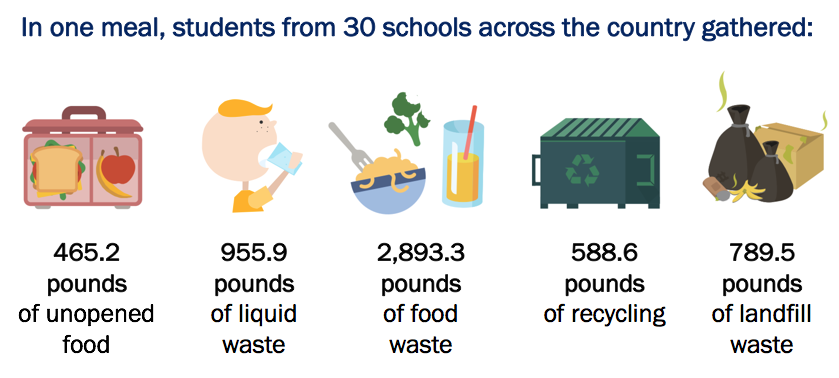 Instead of throwing away unopened food, it could have been recovered or donated. The potential for food rescue is detailed in the table below. Amounts were calculated using Food Rescue’s conversion tool.
| Items rescued | 2,444 | |
| Meals rescued | 488 | |
| Pounds of CO2e rescued (the amount of carbon dioxide which would have the equivalent global warming impact) | 305.5 |
The feedback from students who completed this challenge demonstrates the value in conducting food waste audits. Many students expressed interest in conducting more audits to dig deeper into the issue. Others were energized to move forward with engaging community members and school administrators to experiment with new solutions.
In the 2017–2018 academic year, LifeSmarts students will build on the momentum from the first audit challenge and test strategies for reducing waste in their cafeterias. Students will be encouraged to run longer audits, implement solutions, and conduct a second series of audits to measure their success. By collaborating with school administrators, food service workers, and community partners, students will navigate our complex food system, providing opportunities for solution-making from the ground up.
The work of the National Consumers League is making a difference in people’s lives across the country. Meet some of the consumers touched by our programs.
Read about NCL’s impact
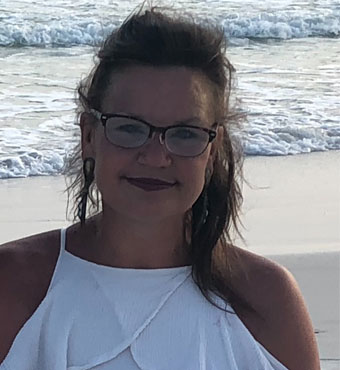
Paige, 55, a Nashville wife and mother of two, answered an employment ad for secret shoppers. Before sending payment to the scammers, she reached out to NCL.
Read about NCL’s impact
A grease fire flared up in Decklan’s kitchen. As his family scrambled and panicked, fearing that the whole house might erupt in flames, Decklan remained calm. He hurried over to the pantry, grabbed some baking soda, and dumped it on the fire quickly extinguishing the blaze.
Read about NCL’s impact

Cincinnati resident Charles, 45, lost his computer business — and health insurance— during a time of economic downturn. A diabetic, Charles was now unable to afford his medication. He stopped taking it which made him seriously ill and put his life at risk.
Read about NCL’s impact

Jeremy is a fast-food worker who has been employed at a number of Chipotle restaurants in New York City. When he was just 20 years old, he took part in an NCL research project that revealed that management practices within the fast food chain were putting workers—and food safety for customers—at risk.
Read about NCL’s impact





By Sally Greenberg, NCL Executive Director
While the COVID-19 pandemic has led to hardship for all Americans, it is clear that people of color have been disproportionately burdened. Across the health care continuum, addressing this disparity has become part of the broader conversation about the history of systemic racism and the underlying social determinants of health that negatively affect the mental, physical, and economic health of individuals and entire communities.
The pandemic has underscored persistent health disparities, and there is growing recognition that representation in research and clinical trials can have a profound impact on health outcomes. A lack of representation from racially and ethnically diverse groups in research and clinical trials have typically led to gaps in data, missing the opportunity to assess the full impact of various treatments and drugs across a range of populations. The collection and use of real-world research and data to inform the potential use, risks, and benefits of medical products and treatments can ultimately lead to better health outcomes, particularly for those who have been underrepresented in the past.
Existing efforts to improve inclusion
Efforts to expand diversity and representation in medical research are underway in Congress. Policymakers are encouraging the incorporation of Real World Evidence (RWE) in drug development through the recent Cures 2.0 draft legislation released by Reps. Diana Degette (D-CO-1) and Fred Upton (D-MI-6). While the status quo limits us from effectively reaching underserved populations, the proposed legislation would allow studies that include RWE for some drugs after they have been approved. At the heart of this issue is a growing appreciation that the same therapy can affect different populations in different ways, which is why Cures 2.0 supports collecting data that more accurately reflects the unique experiences and needs of patients across diverse populations.
Recognizing the potential for RWE in maternal health
The lack of representative research in the field of maternal health is undeniable, and its implications are staggering. The dismal state of maternal care in the United States reflects how our health care system has failed women of color, including by not adequately studying treatment options to prevent maternal morbidity and mortality. The need for RWE is clear when you consider the persistent disparities in health outcomes that plague minority communities.
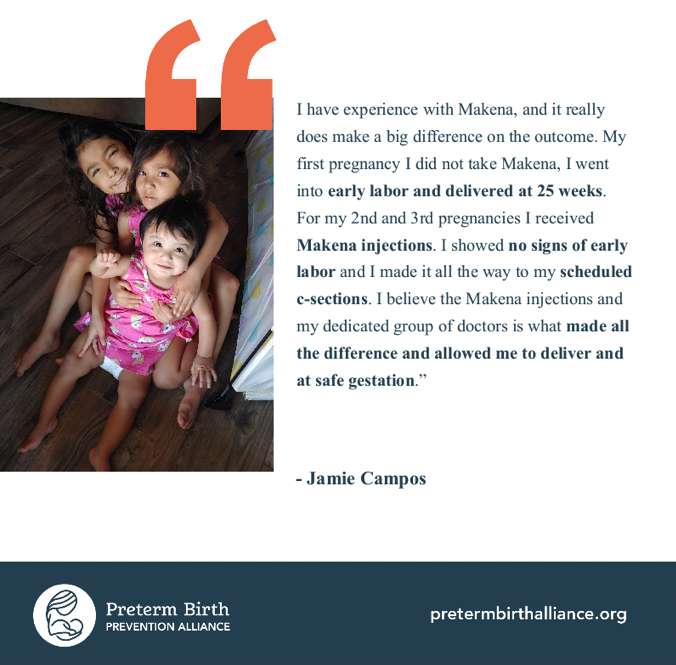
Preterm birth and its disproportionate impact on women of color is a stark illustration of the need to make progress on representative research in maternal health. Preterm birth is the second-largest contributor to infant death in America today. Despite the tremendous physical, emotional, and financial toll that preterm birth continues to take on our country — disproportionately so on women and families of color — not enough therapeutic tools currently exist to prevent it.
Today, “17P,” the only FDA-approved treatment to help reduce the likelihood of spontaneous, recurrent preterm birth in the United States is at-risk of being withdrawn from the market in all its forms, including the branded product and five generic versions. Unfortunately there is conflicting evidence from two different clinical trials, one representative of a diverse U.S. population and another studied in a largely white population in Europe. It’s not a straightforward comparison. If 17P is withdrawn, the women most affected by preterm birth, predominantly women of color, would be left without an FDA-approved treatment option.
The FDA is considering the path forward, including additional data collection through leveraging RWE from past patient use. The success of the first (approval) trial for 17P in the impacted communities signals the importance of RWE. Continued access to 17P is, at its core, a matter of health equity. Black women must not yet again be left vulnerable to a system that historically has overlooked them.