As federal and state tax fraud prevention efforts ramp up, National Consumers League launches toolkit to help promote free IRS tax preparation services, educate on refund delays new for 2017

December 7, 2016

Toolkit designed to help Volunteer Income Tax Assistance programs raise awareness among EITC/ACTC recipients about new refund delays, promote free in-person and online tax preparation IRS resources 

Contact: NCL Communications, Cindy Hoang, cindyh@nclnet.org, (202) 207-2832

Washington, DC—The National Consumers League (NCL), the nation’s pioneer consumer and worker advocacy organization, announced today the launch of its IRS Refund Delay Toolkit. The free toolkit will provide the more than 12,000 Volunteer Income Tax Assistance (VITA) programs across the country a comprehensive set of resources to help inform consumers about new changes in tax law, which require the IRS to delay issuing refunds for taxpayers claiming the Earned Income Tax Credit (EITC) or the Additional Child Tax Credit (ACTC) until February 15.

The updated law, which has no exceptions, is designed to give the IRS more time to help detect and prevent fraud. Tax identity fraud is one of the fastest-growing types of fraud—it accounted for almost half of the 491,000 ID theft complaints filed with the Federal Trade Commission last year. NCL is making this toolkit available for free to the more than 12,000 VITA programs operating nationwide to help them protect consumers from identity theft and other tax-related frauds by using free tax preparation services.

The IRS relies on local VITA programs, along with the brand-name online tax preparation software offered through its Free File program, to help qualifying individuals file their federal taxes each year, free of charge. NCL’s IRS Refund Delay Toolkit will provide VITAs with strategies, practical tips, tools, and educational messages that they can use to encourage consumers to rely on these options, thus helping them to avoid schemes which claim to offer quicker refunds, but actually result in high-interest payday loans or costly short-term refund advances, both of which are detrimental to consumers in the long run.

“It has never been more important for consumers to prepare accurate income tax returns,” said John Breyault, NCL’s Vice President of Public Policy, Telecommunications and Fraud. “Our goal is to help consumers reduce their risk of falling victim to tax identity fraud, connect with services that will help them navigate this year’s delay and keep 100 percent of their federal refunds without worrying about hidden fees or unexpected charges.”

The effort is intended to build on the IRS’ success in reducing tax identity fraud rates, which decreased by nearly 50 percent in last year’s filing season. In 2015, 1.2 million confirmed identity theft returns were filed and stopped, totaling $7.2 billion in potential losses to taxpayers. In that same period in 2016, only 787,000 confirmed identity theft returns, totaling $4 billion in fraudulent refunds, made it into the IRS’ system: a decrease of almost 500,000 fraudulent returns stopped before processing.  By guiding consumers to free IRS tax preparation services, NCL believes that the numbers of confirmed tax identity fraud cases in 2017 can continue to decline.

With the support of an unrestricted educational grant from the Intuit Financial Freedom Foundation, NCL has partnered with the CFED Taxpayer Opportunity Network to help distribute the toolkit to its network of VITA programs and volunteer tax preparers. “Helping VITA programs prepare for the potential impact the refund delay may have on EITC filers and VITA volunteers is critical,” said Rebecca Thompson, CFED’s Project Director of the Taxpayer Opportunity Network. “We are excited to work with NCL on a toolkit that helps VITAs communicate with taxpayers, volunteers and community partners about the refund delay.”

Learn more about free tax preparation services like VITAs or Free File and access the toolkit by visiting https://partners.taxtimeallies.org/resources/.

###

About the National Consumers League

The National Consumers League, founded in 1899, is America’s pioneer consumer organization. Our mission is to protect and promote social and economic justice for consumers and workers in the United States and abroad. For more information, visit www.nclnet.org.

National Consumers League calls on United Airlines to halt introduction of “Basic Economy” fare – National Consumers League

December 7, 2016

Contact: NCL Communications, Cindy Hoang, cindyh@nclnet.org, (202) 207-2832 

Washington, DC — The National Consumers League, the nation’s pioneering consumer and worker advocacy organization, today called on United Airlines to heed the concerns of passenger advocates and policymakers and halt its plans to introduce its “Basic Economy” fare class. Rules for the new fare class, scheduled to take effect on January 1, 2017, will prevent customers from bringing carry-on baggage on flights, requiring more flyers to pay onerous baggage fees. In addition, “Basic Economy” tickets will come with no guarantee that families will be able to sit together nor allow passengers to know ahead of their flights where their seats are located on an aircraft.

The following statement if attributable to John Breyault, National Consumers League vice president of public policy, telecommunications and fraud: 

In a competitive marketplace, airlines would be falling over themselves to offer consumers the most perks at the lowest price. Instead, we have the major U.S. airlines engaging in a race to the bottom to see who can offer the worst service at the highest profit margin. This is the textbook definition of market failure. United’s draconian “Basic Economy” fare cannot be seen as anything other than the beginning of a slippery slope that will pressure the other legacy airlines — who control 80% of domestic flights and are enjoying record profits — to follow suit. Flyers and policymakers should make no mistake that today’s “Basic Economy” fare will almost certainly be service level that many, if not most of us may soon be forced to endure, whether we’re United customers or not. United should heed the concerns of a diverse coalition of flyers rights advocates and senior members of Congress and halt the introduction of its “Basic Economy” fare class.

Earlier this year, NCL joined with a broad coalition of public interest and business travel groups in calling on Congress to pass the FAIR Fees Act; consumer protection legislation that would prohibit airlines from charging cancellation, baggage or other ancillary fees that are “unreasonable or disproportional” to the costs incurred by the air carrier. Given United’s actions, the need for such common-sense rules — which received bipartisan support — appears greater than ever.

###

About the National Consumers League

The National Consumers League, founded in 1899, is America’s pioneer consumer organization. Our mission is to protect and promote social and economic justice for consumers and workers in the United States and abroad. For more information, visit www.nclnet.org.

NCL statement on the nomination of Dr. Tom Price (R-GA) for Secretary of Health and Human Services – National Consumers League

December 1, 2016

Contact: NCL Communications, Cindy Hoang, cindyh@nclnet.org, (202) 207-2832 

Washington, DC—The National Consumers League (NCL) has issued the following statement, which may be attributed to Executive Director Sally Greenberg:

NCL, the nation’s pioneering consumer organization, founded in 1899, is alarmed to learn of the nomination of Dr. Tom Price (R-GA) to head the Department of Health and Human Services, whose mission is “Improving the health, safety, and well-being of America.” Dr. Price’s stated positions will, to the contrary, erode the nation’s essential health and safety laws and cause particular harm to older Americans and women.

Dr Price is an ideologue with extreme views, including: privatizing Medicare, a critical program that provides high quality health care for older Americans; repealing the Affordable Care Act, which today provides 20 million previously uninsured Americans with health coverage; and denying women access to both contraception AND abortion services, which is an illogical strategy towards a goal of reducing unwanted pregnancies. The State of Colorado is a case in point. Teenagers and poor women were offered free intrauterine devices and implants that prevent pregnancy. The birthrate among teenagers across the state plunged by 40 percent from 2009 to 2013, while their rate of abortions fell by 42 percent, according to the Colorado Department of Public Health and Environment.

NCL has a long history of supporting health insurance for all, health coverage for seniors, and access to reproductive health care for women. They worked diligently over many years to secure the health care gains that women, seniors, and all Americans enjoy today. Dr. Price would roll back the clock on the health and well-being of millions of Americans. We urge the Senate to reject Dr. Price’s nomination. President-Elect Trump should instead nominate someone whose views are in step with the health care needs of the American people.

###

About the National Consumers League

The National Consumers League, founded in 1899, is America’s pioneer consumer organization. Our mission is to protect and promote social and economic justice for consumers and workers in the United States and abroad. For more information, visit www.nclnet.org.

NCL commends Senate passage of the BOTS Act – National Consumers League

December 1, 2016

Contact: NCL Communications, Cindy Hoang, cindyh@nclnet.org, (202) 207-2832

Washington, DC—The National Consumers League (NCL), America’s pioneering consumer and worker advocacy organization, applauds the Senate’s passage of S. 3183, the Better Online Ticket Sales (BOTS) Act of 2016. The bill, which for the first time prohibits the use of ticket-purchasing software known as “ticket bots,” passed on a bipartisan vote and now heads back to the House of Representatives. NCL believes this bill is an important first step toward the goal of fostering a fairer live event ticketing marketplace.

The following statement is attributable to John Breyault, NCL Vice President of Public Policy, Telecommunications and Fraud:

“The BOTS Act received bipartisan support in both chambers of Congress because it is a common-sense, pro-consumer step forward in the fight to fix a rigged live event ticket marketplace. Ticket bots have for far too long been used by unscrupulous ticket brokers to jump in line ahead of fans who just want to buy tickets to see their favorite bands, Broadway shows and sports teams at an affordable price. This important legislation now heads back to the House of Representatives for what we hope will be a final vote. We urge lawmakers there to quickly take up this consumer-friendly bill and send it on to the President for his signature.”

###

About the National Consumers League

The National Consumers League, founded in 1899, is America’s pioneer consumer organization. Our mission is to protect and promote social and economic justice for consumers and workers in the United States and abroad. For more information, visit www.nclnet.org.

LifeSmarts consumer literacy program launches first-ever mobile app – National Consumers League

November 22, 2016

‘LifeSmarts Adventure’ offers fun alternative way to study, compete, win prizes on virtual cross-country tour of national parks

Contact: Cindy Hoang, NCL Communications, cindyh@nclnet.org, (202) 207-2832

Washington, DC—LifeSmarts, a national consumer literacy program and scholarship competition for middle-school and high-school students, today announced the launch of its first mobile app, available for smart phones through Web browsers. The new app, “LifeSmarts Adventure,” offers LifeSmarts participants a unique, fun approach to study content, compete, and win prizes. Visit LifeSmartsAdventure.org to view.

The first LifeSmarts Adventure is a virtual, cross-country road trip touring five U.S. national parks. The second version of LifeSmarts Adventure, with a new theme and content focus, will launch in the new year. To play, students answer a series of LifeSmarts curriculum questions at each stop. The app tracks progress and leaderboards show top-scoring travelers. The top three participants earn trophies that stay with them on future LifeSmarts Adventures, with new episodes released periodically throughout the LifeSmarts program year (which runs on a traditional academic calendar). Students who earn trophies will have the chance to win prizes.

LifeSmarts Adventure is a web-based app that is best rendered on a mobile device using a browser with an Internet connection, but the app may also be viewed using a computer at lifesmartsadventure.org. The app was made possible by a new partnership with LifeLock, Inc., (NYSE: LOCK), an industry leader in proactive identity theft protection.

“The app is an exciting extension of LifeSmarts,” said LifeSmarts Program Director Lisa Hertzberg. “Designed as a practice tool for LifeSmarts students to quiz themselves and see how they measure up against others across the country, it is also a fun and accessible way for all consumers to test their marketplace savvy.

The LifeSmarts Adventure app features:

  • Focus on LifeSmarts content: The first episode of LifeSmarts Adventure focuses entirely on personal finance topics, such as money management and investing
  • The ability for students to practice on their own mobile device
  • A leaderboard that students can follow to see how they score compared to their peers across the country
  • Opportunities for recognition, virtual completion badges and trophies, and prizes such as gift cards
  • Easy-to-use, attractive interface
  • Fun theme of a National Parks road trip

Beta testers from the LifeSmarts Student Advisory Board enjoyed their sneak peek of LifeSmarts Adventure, saying they cannot wait for the app to launch and be available to all students. In particular, they liked the variety of questions, the content covered, the fun graphics, and the leaderboards. Visit LifeSmartsAdventure.org to get the app.

Sample questions from LifeSmarts Adventure include:

A credit card is an example of _____ credit, a mortgage loan is not.

  1. Revolving (correct)
  2. Closed-end
  3. Single-payment
  4. Installment

Financial planners help people with more than just investing.

  1. True (correct)
  2. False

A _____ is a diversified investment, a single stock is not.

  1. Bond
  2. Certificate of Deposit
  3. Mutual fund (correct)
  4. Checking account

The FDIC protects consumers if:

  1. The stock market crashes
  2. Banks fail (correct)
  3. Treasury bonds bottom out
  4. Inflation hits double digits

###

About the National Consumers League and LifeSmarts

The National Consumers League, founded in 1899, is America’s pioneer consumer organization. Our mission is to protect and promote social and economic justice for consumers and workers in the United States and abroad. For more information, visit www.nclnet.org

LifeSmarts is a program of the National Consumers League. LifeSmarts focuses on five main content areas: consumer rights and responsibilities, personal finance, technology, health and safety, and the environment. Students are quizzed on their knowledge of these subject areas during online competition. Top-performing teams then advance to statewide competitions, and state champion teams advance to the national championship held each year in a different American city. The 2017 National LifeSmarts Championship will take place April 21-24, in Pittsburgh, PA. Winning teams receive scholarships and other prizes.

LifeSmarts offers American students the chance to get a head start on the responsibilities of adulthood before being thrown in to the marketplace through educational curriculum and scholarship / prize opportunities. Pre- and post-testing on related consumer issues show LifeSmarts participants, on average, see their scores increase from a C to a B+/A-. Last year, students answered more than 3 million competition questions about credit reports, recycling, nutrition, social media, state lemon laws, and everything in between. To learn more, visit www.LifeSmarts.org.

Remembering a beloved consumer advocate

I made the trip to Detroit yesterday on behalf of NCL to attend the memorial service for long-serving board member, Esther Shapiro. In Detroit for just a few hours to pay homage to a woman I respected and held dear, I reflect on her legacy and what that means.

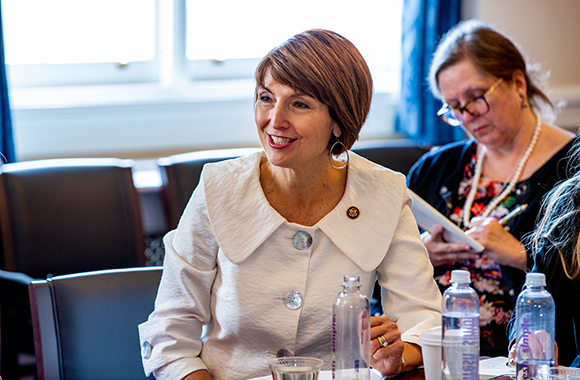
While I don’t know the breadth of Esther Shapiro’s life story, I will say the bits and pieces she shared with me throughout the years were intriguing and impactful. For example, we talked about love and losing loved ones (she having lost her son and her husband), and she helped me appreciate all the wonderful and challenging experiences I’ve had. As if the stories of how women were treated and expected “to know their place” were not inspiring enough, it was her tenacity to push forward despite all odds. I listened to one after another at the memorial service sharing stories of what a courageous woman Esther was. It all made sense how she was able to have such a great impact on consumers and the consumer movement.

Having met Esther Shapiro as a National Consumers League board member, I had the opportunity to visit with her throughout the years. Ms. Shapiro’s home included pictures of many notable politicians, artists, and consumer advocates. Her impact is remarkable. As I chatted with many of her friends, family, and former colleagues, I was transported back in time as each person reminisced about the time when his or her path crossed with Shapiro’s path: campaigning with her on behalf of workers’ rights, working to fight pyramid schemes or watching her “push the right buttons. She always knew what buttons to push, according to Jack Chase, who was hired by Esther to help run the state’s first consumer affairs department in Michigan when it opened its doors in 1974. Chase closed with one of the many Esther sayings from when they talked about the “good ole days.” She was famous for saying “We had a good run; we had fun, didn’t we?”

John R. Eddings, who also officiated the memorial service, told me that he and Esther were appointees of Detroit Mayor Coleman Young in the 1980’s. A long-time colleague of Shapiro’s and a dear family friend, Eddings described Esther well. In his words, “[Esther Shapiro] was a true believer. She believed that things could change for the better. She was a trailblazer in consumer protection and so far ahead of her time. Her work in consumer protection spilled over into civil rights.”

So, here is where I became even more intrigued, because I focused on the consumer protection. What I learned about Shapiro was so much more. She and her husband, Harold, were very active in the civil rights movement, working tirelessly to get African Americans elected. I learned from the Shapiro’s daughter, Andrea Shapiro, that Esther founded Michigan Friends of the South.  They raised funds for attorney fees to support civil rights activists caught up in the court system. Sometimes she just passed the hat around the room to collect whatever she could to help.

Eddings was right…Esther was a believer. Today was truly a celebration of her life.

In these times of uncertainty or anxiety about the future, I end this with one of Esther Shapiro’s mantras, “Pessimism is a killer. We don’t have time for that. There is work to be done.”

Esther Shapiro passed away at 98 years old, and what a legacy she left behind!

NCL mourns the passing of auto safety icon Clarence Ditlow – National Consumers League

November 11, 2016

Contact: Cindy Hoang, National Consumers League, cindyh@nclnet.org, (202) 207-2832 

The National Consumers League (NCL) mourns the passing of a great auto safety advocate, Clarence Ditlow. Clarence had served as the founder and Executive Director of the Center for Auto Safety since 1976. He died at the age of 72 after a long struggle with colon cancer. This statement is attributed to NCL’s Executive Director Sally Greenberg.

“Clarence Ditlow’s name is synonymous with auto safety. Anyone in the industry who has spent a day working in this area knows Clarence and the Center for Auto Safety. In my years at Consumers Union (CU), I had many occasions to work with Clarence, who served on CU’s Board of Directors, and see him in action. His research and advocacy exposing auto defects–including ignition switches, roof crush, and sudden acceleration–were invaluable and helped to vastly improve the safety and reliability of today’s vehicles. Consumers owe him a debt of gratitude for continuously keeping industry’s feet to the fire and demanding that automakers deliver far safer and more fuel efficient vehicles. The remarkable progress we’ve seen in reduced deaths and injuries since the Center was founded is a testament to Clarence’s work. Since 1970, the death rate on America’s roads has dropped dramatically, from 5.2 per 100 million vehicle miles traveled in 1969 to 1.1 per 100 million vehicle miles in 2010.”

The Center for Auto Safety helped to expose faulty airbag inflators, defective tires, dangerously designed ignition switches, defective engine mounts, roofs on vehicles that collapsed on impact and crushed occupants, exploding gas tanks and child seats with defective latches, and many other auto safety issues.  

Saluting his work, Sens. Ed Markey (D-MA) and Richard Blumenthal (D-VCT) said in a statement in the Congressional Record of Sept. 29, 2016:

“Through a lifetime of work improving automotive and safety laws, Mr. Ditlow has helped save thousands of lives and prevented many more injuries than would otherwise have occurred. A tireless champion for consumers, his work has resulted in better government oversight of automakers, the installation of key safety features, and the exposure of safety defects in millions of cars, SUVs and other trucks….Mr. Ditlow’s discovery of numerous automotive defects, combined with his persistent pressure on safety agencies and automakers alike, led to the removal of many unsafe vehicles from the road.”

The National Consumers League mourns the loss of Clarence Ditlow, fellow safety advocate and crusader, who did so much to advance the cause of safer and more fuel efficient automotive vehicles. 

###

About the National Consumers League

The National Consumers League, founded in 1899, is America’s pioneer consumer organization. Our mission is to protect and promote social and economic justice for consumers and workers in the United States and abroad. For more information, visit www.nclnet.org.

Fighting penny soda tax gets pricey – National Consumers League

Sally GreenbergEditor’s note: The measures discussed in this piece were approved on Election Day, 2016.

It’s hard to believe that corporate America would throw so much money fighting a penny-per-ounce tax on sodas, but that is exactly what’s happening in San Francisco and Oakland. The soft drink industry has thrown $50 million in efforts to fight this tax on sugar-sweetened drinks.

Sweetened beverages have been tied to diabetes, obesity, and tooth decay. Public health experts see measures to raise prices as a way to drive down consumption, which is the last thing Big Soda would want to promote.

These soda tax measures are proliferating. In June, Philadelphia adopted a soda tax, beating back a $10 million industry campaign petitioning it. Berkeley, CA passed its own tax two years ago. Boulder, CO is voting on a 2 cent tax today, and three California cities (San Francisco, Oakland, and Albany) will also have a sugary drink tax on the ballot. This is all happening as consumption of soda is slipping nationally.

These measures are similar: they would impose a tax of a penny per ounce on any drink with added sweetener, including soft drinks, iced teas, and smoothies. The taxes would be imposed on beverage distributors, not at checkout. Evidence from current soda taxes suggests price increases will be passed through to retailers, and, according to the New York Times, the price of a 2-liter bottle might increase 67 cents and a 12-pack of sodas would go up $1.44.

If the soda tax can achieve its dual goal: reducing consumption of sweetened drinks and using the proceeds for community and health initiatives, then this will be a success. NCL supports these efforts, and we wait eagerly to see whether both of these laudable goals will be achieved.

How a small financial transaction tax might allow us to end child slavery and the worst forms of child labor in the next nine years – National Consumers League

This post was first published at StopChildLabor.org on Nov. 2, 2016.

The UN has set a very ambitious goal—one of the sustainable development goals adopted last year—of eliminating child labor, child slavery, forced child labor, and the use of child soldiers in the next nine years. It’s daunting to think about. Nearly 170 million children remain in child labor despite a one-third reduction in the number of children trapped in child labor over the last 15 years. Eighty-five million children remain in hazardous child labor, working in brothels, mines, and places no child should be sent. Nearly six million children remain in child slavery.

How is the world to achieve this laudable, essential goal? The answer is it cannot—not without a significant infusion of resources. More than 120 million children who should be in school are not. A billion children are illiterate. Functioning schools are a critical element in the battle against child labor and child slavery. In West Africa, where two million plus children toil on cocoa plantations to harvest the main ingredient in chocolate, more than 3,000 schools are needed to provide children with educational alternatives to hazardous work.

Clearly, hundreds of billions of dollars are needed over the next nine years. Is the global community likely to provide this funding? Probably not, unless there are new revenue sources from which they can draw the money from.

Fortunately, the European Community and the US Congress is working on a new revenue source: a financial transaction tax that would be applied to all financial transactions like stock or derivative trades and bond purchases. Because there are trillions of such trades each year in US markets alone, even a tiny tax ranging from one-tenth of one percent to a half percent could raise tens of billions of dollars up to $300 billion a year. The Inclusive Prosperity Act in Congress by Rep. Keith Ellison (D-MN) and Senator Barry Sanders (I-VT) hopes to do just that, and the Child Labor Coalition, which NCL co-chairs, helped organize a congressional briefing in September to help promote the concept.

The European community is in various stages of implementing an FTT in over 10 countries. The idea is not new. The US had an FTT in the past and continues to pay for the Securities and Exchange Commission with a very tiny FTT. Japan successfully raised billions with an FTT in the 1990s before conservative forces led them to abandon the tax.

An FTT would make our tax system more equitable.

Financial trades are conducted by or on behalf of wealthier Americans and these should be taxed unless we are prepared to ask the poorest working Americans to pay an unfair share of the tax burden. Many of the richest Americans have the money to set up tax shelters that allow them to pay proportionately little taxes. Warren Buffet, one of the richest Americans has called on the richest Americans to pay a fairer share of taxes.

But what about the millions of average Americans who have their pension funds in the stock market? Economist Dean Baker of the Center for Economic Opportunities believes that an FTT would provide some incentive to reduce the number and frequency of trades and that pension funds may actually experience no, or almost no, reduced returns while still generating substantial revenues. Baker notes that computers have allowed the costs of financial trades to drop precipitously over the last two decades and a slight increase in the cost of trading could easily be absorbed and trading would still be much cheaper than it was 20 years ago.

Senator Sanders hopes to use the FTT to provide free college tuition for all young Americans. Rep. Ellison would fix America’s failing infrastructure but reserve some funds to attack the global health needs of children. 

At the CLC, we ask that should these legislative initiatives be enacted, lawmakers reserve a portion of the FTT revenues—say 20 to 25 percent—to provide basic needs like food, medicine, and access to education for children around the world. If other nations followed the US’s lead, we might have the resources to end child slavery and child labor and allow every child in the world to become educated in the next nine years.

NCL pays tribute to Esther Shapiro, longtime board member and consumer crusader (1918-2016) – National Consumers League

October 21, 2016

Contact: Cindy Hoang, National Consumers League, cindyh@nclnet.org, (202) 207-2832 

Washington, DC—The staff and Board of Directors of the National Consumers League (NCL) mourn the passing of Esther Shapiro, career consumer advocate, longtime National Consumers League Board Member, and head of Detroit’s Consumer Affairs Department for 24 years, appointed by Mayor Coleman Young in 1974. Shapiro died last Friday, October 14, at her home in Detroit’s Lafayette Park area. She was 98.

Shapiro was born in 1918 in Chicago, an only child of Jewish immigrants. According to her grandson Nick, in 1939, at age 20, she moved to New York City and got an office job at a garment factory, “very literally a sweatshop … Conditions were so bad that the girls actually went on strike.”

“Management came down on them hard, so they had a meeting and the people had pretty much decided on going back when the union organizer jumped on the table and said, ‘Like hell you’re going back.’ And that very dashing young man was her husband-to-be, Harold Shapiro,” said Nick Shapiro.

During World War II, Esther and Harold lived in Tacoma, WA. After the war, the couple moved to Detroit so that Harold Shapiro could work as a union organizer. The Shapiros became early volunteers in the civil rights movement, socializing often with Coleman Young, talking politics until the wee hours, and working hard on Young’s campaign for Mayor.

Shapiro had been a volunteer coordinator for Detroit’s board of education, but heard that the Michigan Credit Union League had a post for a consumer advocate for statewide credit unions.

“She impressed them with her ideas about educating consumers, about budgeting, and the law. So she taught herself on the job,” said her daughter, Andrea Shapiro. This gave her the skills for becoming the city’s consumer crusader

Shapiro became a consumer champion just as the movement was peaking in the 1970s. President Kennedy issued a manifesto on consumer rights in 1962, and three years later Ralph Nader’s iconic expose on the auto industry, Unsafe At Any Speed, was published. Shapiro became close with Esther Peterson, who served as consumer advisor to Presidents Kennedy and Johnson and headed the White House Office of Consumer Affairs under President Jimmy Carter. Shapiro joined the NCL Board of Directors in the 1980’s and served alongside Peterson.

Shapiro’s voice for consumers became known throughout the region because of her regular appearances on Detroit radio stations and her consumer columns in the Detroit Free Press, which ran from 1986 to 1995. She was fond of the expression, “The big print giveth and the small print taketh away.”

Shapiro headed Detroit’s consumer office well past Young’s departure, finally leaving at age 80. NCL celebrated with her and attended her induction into the Michigan Women’s Hall of Fame in October 2015. Throughout her life, Shapiro supported NCL and members of the staff, attending many LifeSmarts teen financial literacy and consumer education competitions in her years on the Board. In 1997, NCL honored Esther Shapiro with the Florence Kelley Consumer Leadership Award.

Reflecting on the evolution of consumer advocacy, Shapiro noted that consumer protection had largely taken shape of warnings in fine print on product labeling, and most of her consumer columns ended with Caveat Emptor – let the buyer beware and not expect government’s protection. In an interview two years ago, according to the Detroit Free Press, Shapiro said, “We tried — we tried very hard, and I think we did some good.”

Shapiro was predeceased by her husband and son, Mark. She is survived by her daughter, four grandchildren and three great-grandchildren. Esther also felt a great sense of pride that her granddaughter Evelyn Shapiro, works as a carpenter and has a union leadership role. 

“Esther was a force early on that propelled the consumer movement … A female force,” said NCL Board Member Jodie Bernstein.

“The National Consumers League is grateful for the many contributions of this pioneering consumer advocate and for her service to the NCL Board over several decades,” said NCL Executive Director Sally Greenberg. “She and I became friends and she always offered me wise and valued counsel since the day I arrived at NCL. It was an honor to work with a consumer champion and pioneer. We at NCL will miss her.”

A memorial service for Esther Shapiro will be held at 2 p.m. Nov. 13 in the large meeting room of 1300 Lafayette, the high-rise apartment building just down the block from Shapiro’s condominium in Detroit’s Lafayette Park development.

###

About the National Consumers League

The National Consumers League, founded in 1899, is America’s pioneer consumer organization. Our mission is to protect and promote social and economic justice for consumers and workers in the United States and abroad. For more information, visit www.nclnet.org.