NCL testifies at The Food and Drug Administration (FDA) hearing on the Center for Drug Evaluation and Research’s (CDER’s) proposal to withdraw approval of Makena
October 17, 2022
Media contact: National Consumers League – Katie Brown, katie@nclnet.org, (202) 207-2832
Washington D.C.— Today, NCL Executive Director Sally Greenberg testified at The Food and Drug Administration (FDA) hearing on the Center for Drug Evaluation and Research’s (CDER’s) proposal to withdraw approval of Makena or 17P. Sally’s full testimony can be found below.
Hello and thank you for the opportunity to speak today. My name is Sally Greenberg, and I am the Executive Director of the National Consumers League, the nation’s oldest consumer advocacy organization. For 123 years, it has been our mission to protect and promote social and economic justice for consumers and to provide the consumer’s perspective on safe and effective medicines and patient-centered health care.
We are deeply concerned about CDER’s recommendation to withdraw all forms of 17P.
We have shared our concerns with the FDA many times over, dating back to our first letter in June of 2020, which urged the agency to protect patient access to this critical therapy for preterm birth. The sentiments outlined in that letter—which was co-signed by more than a dozen maternal and infant health advocates, many of whom you will hear from today—have been reiterated in a series of subsequent letters, statements, and requests for meetings.
And long before that, the National Consumers League spent years advocating for increased regulation and oversight of medication compounding – an issue central to the question of why pregnant women deserve to maintain access to approved 17P, the only class of FDA drugs indicated to prevent a recurrent spontaneous preterm birth.
I appreciate having the time today to share thoughts on behalf of the National Consumers League to share our ongoing concerns and want to start by addressing some of the distortions and half-truths that have been floating around in the public dialogue about 17P over the past few years. I am not a scientist or a doctor, but I take our organization’s mission and ethos, which is rooted in safe products for consumers, and my responsibility as a consumer advocate very seriously. I have talked with numerous scientific, medical, and regulatory experts about this to separate fact from fiction. It is unfortunate that there has to be misinformation about such a serious subject, but that does appear to be the case.
I think you will hear from certain stakeholders that:
Makena should never have been approved. But the truth is that we aren’t here to debate the past. This class of products has been on the market for 10 years, and there is both safety and efficacy data to support that. To state it very simply: We are here today because of new, conflicting efficacy data – but that doesn’t render the original evidence null and void.
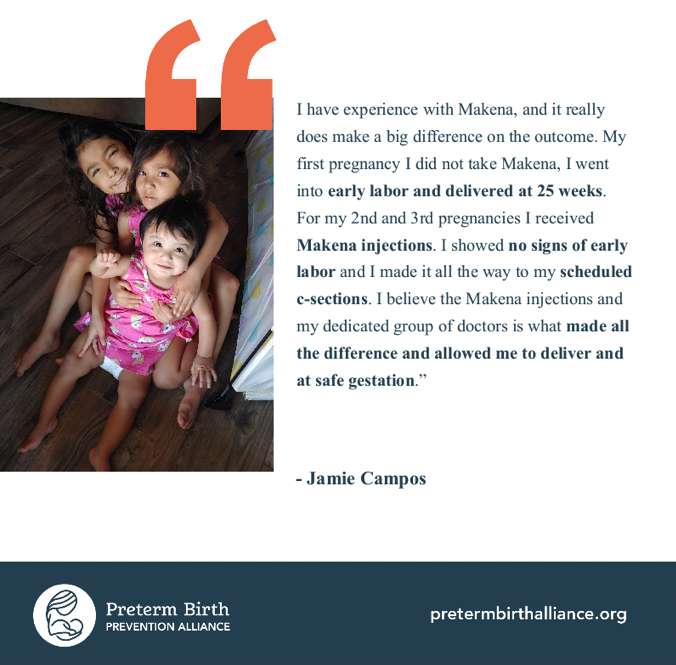
You may hear that there is no confirmed clinical benefit to 17P. This is not supported by the existing body of literature or the experiences of hundreds of thousands of American women. The primary basis for FDA approval of Makena was a randomized controlled trial conducted through an NIH network, in the highest risk preterm birth centers in the United States. The one-third reduction in recurrent preterm birth was described in the New England Journal of Medicine in YEAR. Makena is one of the most well-studied medications given in pregnancy, with data from more than 2,000 women who participated in placebo-controlled trials, and more than 300,000 women treated to date. Every day doctors prescribe 17P for their patients because they have seen evidence of its effectiveness.
You may hear that the benefits of Makena don’t outweigh the risks. This implies that there are safety issues with the therapy. But the published evidence from both clinical trials and ongoing safety surveillance data does not bear this out. We know the FDA can act when there are safety issues. If such issues existed, I find it hard to believe that the FDA – which is one of most stringent and respected regulatory bodies in the world – would have waited three years to act.
You may hear that there are other options that could replace 17P as the standard of care. This is simply not true. With very few medications specifically approved to be given in pregnancy – and no others beyond Makena for recurrent, spontaneous preterm birth – the American College of Obstetricians and Gynecologists and the Society for Maternal-Fetal Medicine continue to support their members’ expertise in determining if Makena is appropriate for their patients. Yet, the regulatory uncertainty relating to 17P has created what must be an unprecedented situation where some providers are putting their patients on vaginal progesterone, which was previously denied approval for this indication, and is often prescribed in compounded form and would therefore likely not be covered by insurance. I cannot imagine the FDA intended to put healthcare providers and pregnant people in this kind of position when there continues to be a safe, approved standard of care for pregnant women at risk of having preterm birth when the issue at hand is inconclusive data on the effectiveness of two trials. But that is the situation before us.
You may also hear about the precautionary principle of public health as a reason to remove all forms of 17P from the market. Again, this is a diversion that seeks to focus this hearing on implied, non-existent safety issues, rather than on the effectiveness and how it can best be determined for which women this therapy is most effective. I would think the precautionary principle of public health could be much more logically applied to the use of vaginal progesterone for recurrent spontaneous preterm birth, since it was denied approval for this indication but is increasingly being used off-label, in compounded form and therefore not covered by insurance, yet because of the uncertainty being created about 17P because of the current regulatory situation, it is essentially being treated as an approved, equivalent therapy.
You may hear that the company that manufacturers Makena put those who speak in support of continued access to 17P up to defending the product. No one asked me to do this. After the National Consumers League was chartered in 1899 one of our founders, Florence Kelley, who was a champion for equal rights and consumer protections, led the campaign for enactment of of the first federal health care bill, more commonly known as the Sheppard-Towner Act of 1921, which allocated federal funds to combat elevated mortality rates among mothers and newborns. The money went to state programs for mothers and babies, particularly prenatal and newborn care facilities in rural states. For decades, NCL has worked on our own and in collaboration with other advocates to ensure access to safe therapies. I believe that removing access to 17P – a safe therapy, which has been shown to be effective in its first clinical trial and for hundreds of thousands of women since coming to market – while it is determined for whom the therapy is most effective, would be a dramatic step along a path that seeks to limit access to women’s health care. Every step along that path can lead to negative consequences for the women and families who are affected.
That is why I am here today. As both a mother, and the leader of an organization that cares greatly about the safety and welfare of consumers and patients.
Personal and shared distress over a decision that could impact the long-term health of hundreds of thousands of women and babies led NCL to spearhead the Preterm Birth Prevention Alliance, a group of 15 advocacy organizations that share a common concern about the state of preterm birth in the United States and the proposed market withdrawal of 17P. My colleague Milena Berhane, who leads the Alliance, will talk on behalf of that coalition at another time during this hearing.
I want to state plainly and for the record that while this is an unprecedented situation, the National Consumers League believes the FDA can create a win-win path that leads to BOTH new data on 17P and protected access for pregnant people.
I also want to break down some specific concerns and thoughts that led to and guide the National Consumer’s League’s commitment to this issue:
Number 1: The risks of leaving women without a safe and affordable alternative. But there are real risks to removing the only approved, safe option for women for this indication and so talked with healthcare providers who care for at-risk pregnant women to understand the risks involved in removing access to 17P. If all versions of Makena were to be removed, all that would be available to pregnant women for recurrent spontaneous preterm birth would be unapproved therapy that is often provided in compounded form.
Compounding has a role in our healthcare system, but creating a situation where more pregnant women with a history of preterm birth are given compounding drugs is an unwise course of action. Even before this issue, NCL led an advocacy effort to promote passage of federal legislation to strengthen laws relating to compounding of medications. We know that if done improperly, the process of compounding can pose significant safety risks.
There has been progress since the 2012 series of medical errors that resulted in the contamination of compounded medicines, which in turn caused a deadly fungal meningitis outbreak in the U.S. — killing more than 70 people and causing more than 750 cases of infection in 20 states. And we know there have been recalls of compounded 17P since the Drug Quality and Security Act (DQSA) of 2013. However, the FDA does not interact with a vast majority of compounders and is often not aware of problems until after the report of an adverse event or contamination.
We strongly urge that all current options remain on the table while additional studies are conducted.
Number 2: The need for more diverse efficacy research on 17P At issue here is the fact that the original clinical trial and subsequent confirmatory trial – upon which the recommendation to remove was based – were essentially comparing apples to oranges. The majority of participants in the first clinical trial (Meis) were African American and other women of color in the United States. This trial demonstrated that 17P substantially reduced the rate of recurrent preterm delivery among women who were at particularly high risk for preterm birth.
The participants in a subsequent confirmatory trial (PROLONG), which was conducted primarily outside of the U.S. after 17P was approved, were predominantly white and Eastern European. While PROLONG reaffirmed the safety of 17P, it did not confirm the same benefit in white European women that it did for women of color in the U.S. But this is not the population at highest risk of preterm birth, either in the U.S. or abroad.
Even after a meta-analysis that pooled data from 31 trials concluded that both 17P injections and vaginal progesterone reduced the risk of preterm birth before 34 weeks in high-risk women with singleton pregnancies, CDER persisted in its recommendation to remove.
Given that there is conflicting efficacy data between the original approval trial and a second confirmatory trial, we are advocating to maintain patient access to a class of treatments while allowing for additional research that reflects the experiences of women in the U.S.
Women most affected by preterm birth are also historically underrepresented in clinical trials. We believe it is critical that more diverse efficacy research be gathered and combined with the extensive amount of real-world evidence on 17P that exists today.
Number 3: The state of preterm birth in the U.S. As other stakeholders have and undoubtedly will testify during this hearing, the state of maternal health and preterm birth in the U.S. is incredibly concerning and many unanswered questions remain relating to it, especially for women of color.
For far too long, U.S. maternal health care has lagged behind that of other developed countries, and maternal health care in the U.S. has consistently failed women of color.
Pregnancy should be one of the most special and exciting times in a woman’s life, with preparation and celebrations to welcome a new addition to the family. I know it was for me. Unfortunately, for about 1 in 10 women in America, their anticipation may be cut short because of an unexpected preterm delivery. Black families, as Black women have a 50% increased risk of delivery before 37 weeks of their pregnancy.
America’s preterm birth crisis led the NAACP to recently spearhead a letter to the FDA, that was also signed by the National Health Law Program, the Prevention Institute and the National Partnership for Women & Families, and stated, and I quote:
The undersigned organizations believe that the confirmed evidence of this treatment for Black women in this country is determinative, and that any disruption of access would be detrimental…As the FDA considers a path forward, we collectively urge the agency to carefully consider all available mechanisms to maintain equitable access to approved 17P while additional evidence can be developed that more accurately reflects underrepresented racial and ethnic patient populations in the U.S.
Preterm birth can have a lasting a physical, mental, emotional, and financial tolls on affected babies and families. Given the dire state of preterm birth in the U.S. and the often-devastating impact of preterm birth on pregnant people and their families, the National Consumers League believes that the decision to utilize 17P in all its forms, branded and generic, should be one left to women and their health care providers. The fact that leading medical societies continue to recognize the role of individual providers and their patients when making treatment decisions about 17P, despite the ongoing regulatory situation, is compelling.
In closing, the company that manufactures the branded version of 17P has publicly said they are willing to do more research – why would we leave that option off the table when clearly there is conflicting efficacy data that needs to be resolved? To remove the only approved and safe therapeutic option to help reduce the likelihood of another spontaneous preterm birth, with the knowledge that the population that most benefits from 17P are women of color – is not in line with consumer interest.
There is a win-win path here that could lead to both new data and protected access. To the Committee, I urge you to keep this, and the consumer perspective, in mind when making your recommendation to the agency.
Thank you.
###
About the National Consumers League (NCL)
The National Consumers League, founded in 1899, is America’s pioneer consumer organization. Our mission is to protect and promote social and economic justice for consumers and workers in the United States and abroad. For more information, visit https://nclnet.org.