National Consumers League applauds the U.S. Department of Labor’s recent lawsuit against employers that require mandatory arbitration

April 5, 2023

Media contact: National Consumers League – Katie Brown, katie@nclnet.org, 202-823-8442

Washington, D.C. – The National Consumers League (NCL) welcomes a lawsuit filed in federal court last month by the Department of Labor (DOL) challenging mandatory arbitration clauses that illegally require employees to repay earned wages if the employee does not work for the employers for specific periods of time. The defendant in the suit is Advanced Care Staffing (ACS), a Brooklyn, New York healthcare staffing provider that required their employees to repay earned wages if they did not complete three years of employment. If employees tried to leave before the three years were up, ACS mandated employees enter private arbitration and compelled employees to pay for arbitration costs, attorney fees, and future ACS profits—in addition to repaying the wages they had earned. This policy resulted in employees earning below the minimum wage.

“This situation is just one example of the harm caused by the rise of mandatory arbitration clauses. Many employers now insert—or rather, bury –these clauses in the paperwork that employees must accept if they want a job. They prohibit employees from bringing claims before a judge or jury for wage theft, discrimination and other violations of federal law,” *said Seema Nanda, DOL’s Solicitor of Labor.

“For many years, NCL has condemned the rise of forced arbitration clauses to rob consumers and workers of access to justice. This is among the most egregious violations of employee rights we have ever seen. Workers’ right to seek alternative employment must not be compromised,” said Sally Greenberg, NCL’s executive director. “Consumers and workers are often forced into an arbitration system where corporations write the rules, and those rules are not understood by consumers and employees.  There is no meaningful judicial review and no ability to appeal bad decisions by arbitrators who get things wrong. We can never permit consumers and workers to be stripped of their right to go to court, which is guaranteed by the U.S. Constitution.”

*Links are no longer active as the original sources have removed the content, sometimes due to federal website changes or restructurings.

###

About the National Consumers League (NCL)
The National Consumers League, founded in 1899, is America’s pioneer consumer organization.  Our mission is to protect and promote social and economic justice for consumers and workers in the United States and abroad.  For more information, visit nclnet.org.

The National Consumers League announces support for the pro labor “PRO Act”

March 2, 2023

Media contact: National Consumers League – Katie Brown, katie@nclnet.org, 202-823-8442

WASHINGTON, D.C. — The National Consumers League, the nation’s oldest consumer and labor advocacy group, announced support today for legislation known as the Pro Act. The bill is comprehensive labor legislation to protect workers’ right to stand together and bargain for fairer wages, better benefits, and safer workplaces.

The Richard L. Trumka Protecting the Right to Organize (PRO) Act, was recently re-introduced in Congress, will address those very critical issues.

“We applaud Senator Murray for leading the charge on passage of the PRO Act. Labor laws badly need  strengthening in the US. The PRO Act will protect workers trying to organize a union, and strengthen their ability to earn higher wages, quality health care, gain safe working conditions and a more secure retirement. It’s long past time that we pass the PRO Act, which will help build a stronger and fairer economy—and ensure workers get their fair share of the wealth they help create,” said Sally Greenberg, NCL’s CEO.

Congressional supporters and union leaders announced the introduction of the PRO Act at a press conference on February 28, 2023. Members of Congress supporting the legislation include Senator Patty Murray (D-WA), Chair of the Senate Appropriations Committee, Senate Majority Leader Chuck Schumer (D-NY), Senator Bernie Sanders (I-VT), House Democratic Leader Hakeem Jeffries (D-NY), Congressman Robert C. “Bobby” Scott (D-VA), and Congressman Brian Fitzpatrick (R-PA).

The PRO Act would protect the right to organize and collectively bargain by:

  • Bolstering remedies and punishing violations of workers’ rights through authorizing meaningful penalties for employers that violate workers’ rights, strengthening support for workers who suffer retaliation for exercising their rights, and authorizing a private right of action for violation of workers’ rights.
  • Strengthening workers’ right to join together and negotiate for better working conditions by enhancing workers’ right to support secondary boycotts, ensuring unions can collect “fair share” fees, modernizing the union election process, and facilitating initial collective bargaining agreements.
  • Restoring fairness to an economy rigged against workers by closing loopholes that allow employers to misclassify their employees as supervisors and independent contractors and increasing transparency in labor-management relations.

Senator Murray—former Chair of the Senate Health, Education, Labor, and Pensions (HELP) Committee—first introduced the PRO Act in the 116th Congress and held a hearing urging action to protect workers’ right to organize. Senators also held a roundtable in Seattle with U.S. Secretary of Labor Marty Walsh and Representative Pramila Jayapal (D-WA) to discuss the importance of protecting workers’ right to form a union and pass the PRO Act. In the spending bill passed into law last December, Congress secured a long overdue $25 million increase in funding for the National Labor Relations Board (NLRB) to help ensure the agency can protect the rights of workers everywhere.

For the bill text of the PRO Act, click here.

For a fact sheet on the PRO Act, click here.

For a section-by-section summary of the PRO Act, click here.

###

About the National Consumers League (NCL)
The National Consumers League, founded in 1899, is America’s pioneer consumer organization.  Our mission is to protect and promote social and economic justice for consumers and workers in the United States and abroad.  For more information, visit nclnet.org.

National Consumers League applauds nomination of Julie Su for Secretary of the Department of Labor

March 1, 2023

Media contact: National Consumers League – Katie Brown, katie@nclnet.org, 202-823-8442

WASHINGTON, D.C. — The National Consumers League welcomes President Biden’s announcement that he intends to nominate Julie Su to serve as Secretary of the Department of Labor. Su is an experienced labor expert who can continue the Administration’s commitment to a stronger, more resilient, and more inclusive economy for all Americans. She has been serving as Deputy Secretary of Labor since July 2021. As Deputy Secretary, Su has worked with Secretary Walsh to advance President Biden’s vision of a strong, resilient, inclusive economy with worker well-being at its center.

Under Walsh and Su’s leadership, the Department of Labor has witnessed an increase of more than 12 million jobs and the unemployment rate has inched down to 3.4 percent, the lowest rate since May of 1969.

Su previously led California’s Labor and Workforce Development Agency — the nation’s largest state Department of Labor – where she launched the “Wage Theft is a Crime” campaign with the support of both labor and management. During her tenure as Labor Commissioner, she cracked down on wage theft, fought to protect trafficked workers, increased the minimum wage, helped to create good-paying, high-quality jobs, and established and enforced workplace safety standards.

“We are excited by President Biden’s nomination of Julie Su as Labor Secretary and urge a quick confirmation,” said Reid Maki, Director of Child Labor Advocacy for the National Consumers League. “Her record of cracking down on illegal labor trafficking and her long career as a civil rights attorney gives her a unique understanding of the plight of the most vulnerable workers.”

“Given heightened attention to the scourge of hazardous child labor, as highlighted by a recent New York Times expose, we hope Su will make this issue a top priority,” added Maki. NCL chairs the Child Labor Coalition which has long raised concerns about the safety and health of young workers in meat processing plants and in agriculture. “Unaccompanied minors are working in dangerous conditions for long hours—in the fields and in meat processing plants and other factories. Many live in the US alone without family looking after their welfare, and thus they are easily exploited. They are  our most vulnerable workers,” observed Maki. “We hope that if Su is confirmed, she will make underage teens illegal employment a top priority; we also will press DOL and Su to address badly needed safety protections for children who work in agriculture, an issue before Congress that is urgently in need of a solution.”

NCL was founded by progressive era leaders at the turn of the 20th century with the goal of ending child labor in the United States and enacting minimum wage and maximum hours laws.

###

About the National Consumers League (NCL)
The National Consumers League, founded in 1899, is America’s pioneer consumer organization.  Our mission is to protect and promote social and economic justice for consumers and workers in the United States and abroad.  For more information, visit nclnet.org.

The Child Labor Coalition expresses alarm over the results of DOL’s investigation into child labor at meatpacking plants in the U.S. and calls for current protections to be enhanced, not weakened

February 21, 2023

Media contact: National Consumers League – Katie Brown, katie@nclnet.org(202) 823-8442

Washington, D.C. – The Child Labor Coalition, consisting of 39 organizational members who work to end exploitative child labor domestically and internationally, calls attention to today’s announcement by the U.S. Department of Labor (DOL) that its just-completed investigation found 102 children working in cleaning crews in 13 meatpacking plants in eight states. DOL levied a fine of $1.5 million in civil money penalties against Packer Sanitation Services, Inc. (PSSI).

The children often worked the graveyard shift and used caustic chemical agents while they cleaned meat processing equipment including backsaws, brisket saws and head splitters. DOL learned that three minors were injured while working for PSSI.

Sally Greenberg, chair of the Child Labor Coalition, publicly called for meatpacking plants to be investigated for underage worker in 2008 during a congressional hearing on child labor.

“While we applaud this seemingly robust investigation by U.S. DOL, we wonder why the meatpacking firms who benefited from illegal child labor are not being held liable,” said Reid Maki, who is the Child Labor Coalitions coordinator and the Director of Child labor Advocacy for U.S. DOL. “Firms like JBS Foods, Tyson Food, Cargill, Turkey Valley Farms and others, hired PSSI to do the cleaning but company employees witness underage workers performing hazardous work with dangerous chemicals and did nothing to stop it. Why aren’t these companies being punished?” he asked.

Maki noted that the fine amount is the legal maximum that DOL could assess in the case but $1.5 million is roughly one day’s revenue for a company like PSSI that has over $450 million in annual revenue. “We would really love to see maximum and minimum child labor fines increased, and we had discussions with Senator Schatz’s office about it this very week,” he noted.

Maki noted that the investigation results are well-timed because the state of Iowa is considering a reprehensible child labor bill that would allow children to work expanded hours and in hazardous work areas.

“Iowa bill S.F. 167 not only extends hours for teen work, it permits minors to work in highly hazardous areas like meatpacking loading docks and assembly areas,” said Maki. “It’s a cynical, dangerous bill that builds in liability waivers for employers against teen worker injuries that the legislative authors know will happen. We strongly oppose this bill.”

Other states, including Ohio and Minnesota, are considering bills to weaken hard-won child protections.

Maki also noted giant loopholes in U.S. child labor law that expose child workers on farms to great risks. “Our weak child labor laws allow kids who are only 12 to work unlimited hours on farms when school is not in session. We’ve met many 12-year-olds who work 70–80-hours a week in the summer and in stifling heat, performing back-breaking labor,” explained Maki. “A teen worker has to be 18 to perform hazardous work in the U.S. but in agriculture they only need to be 16,” he added.

“The presence of young children in farm work, makes it critical that U.S.DOL begin enhancing hazardous work rules for child workers in agriculture,” said Maki. “DOL succumbed to political pressure when it scuttled needed protections over a decade ago and since then has refused to honor its responsibility to protect kids from known work dangers.”

We have also been waiting for DOL to protect child tobacco workers who regularly become ill from nicotine absorption and poisoning, noted Maki. “You must be 21 to buy cigarettes in the U.S., why does U.S. law allow tobacco growers to hire 12-year-olds to harvest this toxic crop? DOL needs to do more to protect these vulnerable workers.”

###

About the National Consumers League (NCL)
The National Consumers League, founded in 1899, is America’s pioneer consumer organization.  Our mission is to protect and promote social and economic justice for consumers and workers in the United States and abroad.  For more information, visit nclnet.org.

Do children in America ever work in deplorable, dangerous, Dickensian conditions? The short answer is “yes.”

Reid Maki is the director of child labor advocacy at the National Consumers League and he coordinates the Child Labor Coalition.

Most Americans are unaware that the U.S. still has child labor, but 2022 made it abundantly clear that we do, and stories in the news made it clear that conditions can be downright shocking. Here are 10 child labor stories or developments that indicate child labor in the U.S. is not something in the past. Through the Child Labor Coalition, which the National Consumers League founded in 1989, we bring together 39 groups to work collectively to reduce international and domestic child labor and to protect working teens from occupational dangers. Our top 2022 U.S. developments:

  • Minors found working illegally in Brazilian-owned JBS meatpacking facilities in Nebraska and Minnesota. Several children suffered caustic chemical burns, including one 13-year-old. The children worked on the killing floor in cleaning crews, toiling long nights in the graveyard shift and used dangerous pressure-washing hoses while they stood in water mixed with animal parts. Initially, the number of children numbered 31 in Nebraska and Minnesota, but U.S. DOL has suggested the number of illegally employed teens in processing plant cleaning crews may be much larger. The CLC has expressed concerns about teens illegally working in meat processing plants since a large immigration raid in Iowa in 2003 found 50 minors working illegally in the plant.
  • Teens found working in an Alabama factory that supplied parts to Hyundai. In July, labor officials found three siblings, aged 12, 14, and 15, working in an Alabama stamping plant that supplied part to the car manufacturer Hyundai. According to reports, a larger number of minors worked in the factory in recent years. The story drew enormous publicity because factory-based child labor in the U.S. has become rare.
  • The Wisconsin legislature passed a bill to weaken child labor laws by expanding the hours of teen work, which endangers children’s educational development and presents certain health risks. The CLC amplified the work of labor unions on social media, we also wrote a letter to Gov. Tony Evers, urging him to veto the proposed legislation, which he did in February. According to research, high school age workers who toil more than 20 hours a week get lower grades and have an increased risk of dropping out.
  • An estimated 300,000 children still work for wages in agriculture, performing backbreaking labor in searing heat. Currently, federal law allows children who are only 12 to work unlimited hours as long as they are working when school is not in session. Federal legislation which would protect child farmworkers, the Children’s Act for Responsible Employment and Farm Safety (CARE), H.R. 7345, would raise the minimum age of farm work from 12 to at least 14 and lift the age of hazardous work from the current 16 to 18—the same as all other sectors. CARE saw some promising developments in 2022, including the holding of a congressional hearing on the bill—the first since 2009. We also secured over 200 organizational endorsements for CARE and we worked with CLC-members Human Rights Watch, Justice for Migrant Women, and First Focus Campaign for Children to obtain 47 CARE legislative cosponsors.
  • The Children Don’t Belong on Tobacco Farms Act, H.R. 3865 –and its companion bill S.2044—would ban child labor on U.S. tobacco farms where children toil long hours and routinely suffer symptoms of nicotine poisoning such as vomiting, fainting, dizziness, headaches and nausea. In a desperate attempt to keep nicotine off their skin, many teen tobacco workers toil while wearing black plastic garbage bags with holes punched out for their arms and head. Some teens work at great heights and great danger in tobacco drying barns. In the U.S., you have to be 21 to buy cigarettes but at age 12, you can work on tobacco farms and suffer poisoning from toxic nicotine. In this congressional session, we helped secure 32 cosponsors for H.R. 3865—more than double the amount of cosponsors in the 116th.
  • Enforcement of domestic child labor laws in 2022 through mid-November saw an almost 40 percent increase in the number of child workers involved in a violation of child labor rules—nearly 4,000 children, according to reporting by com, using Department of Labor data. Nearly 20 percent of the violations involved teens performing hazardous work.
  • USDOL and state labor agencies frequently found child labor violations among fast food restaurants. Massachusetts Attorney General Maura Healey fined Dunkin’, the donut franchises, $145,000 for over 1,200 child labor violations in 14 stores. U.S. DOL found violations in 13 Pittsburgh area McDonalds restaurants in which teens worked too many hours or too late, as well as a case of a teen doing prohibited hazardous work
  • In September, Human Rights Watch, a CLC member, issued a child rights report card for all U.S. states related to child marriage, child labor, juvenile justice, and corporal punishment, and how well they meet the standards set by the Convention on the Rights of the Child. Alarmingly, only four states earned passing grades: 20 received an “F”; 26 received a “D”; four received a “C” and none received a “B” or and “A.”
  • In July, Massachusetts became the seventh US state to ban entirely child marriage. Like child marriage globally, U.S. child marriage has substantial health, educational, and financial impacts on teens who marry. Most states have broad exemptions that allow teens to marry with the approval of parents or the courts. Massachusetts joins six other states that passed legislation to end child marriage: New York, Delaware, New Jersey, Rhode Island, Pennsylvania and Minnesota. The CLC is a member of the National Coalition to End Child Marriage, headed by the NGO Unchained at Last.
  • The CLC and HRW held a series of meetings with Wage and Hour in 2022 to secure the reopening of the occupational child safety rules for agriculture called “Hazardous Occupation Orders.” These rules have not been updated for agriculture in roughly four decades despite many lessons-learned about farm injuries during that time. We also helped Rep. Roybal-Allard and Rep. David Cicilline (D-RI) draft a letter to DOL Secretary Walsh urging enhanced safety precautions. The letter had 47 congressional signatories.

NCL supports FTC efforts to ban non-compete clauses

January 6, 2023

Media contact: National Consumers League – Katie Brown, katie@nclnet.org, 202-823-8442

WASHINGTON DC. – The National Consumers League (NCL), the nation’s pioneering consumer and worker advocacy organization, applauds the Federal Trade Commission’s (FTC) initiative to ban non-compete clauses. Such provisions prevent employees from taking new jobs in the same industry, violating free-market values and dampening fair competition. 

The following statement is attributable to NCL Chief Executive Officer, Sally Greenberg: 

“Non-compete clauses harm workers by blocking them from seeking better wages and working conditions. They also reduce market competition by barring other businesses from attracting talent and stopping employees from setting up their own shops. The FTC’s proposed ban on non-compete clauses is a significant step towards a more fair and free economy for all.

Allowing the unrestricted movement of labor will benefit consumers in addition to workers and competitive businesses. NCL has long believed that consumers stand to gain when purchasing goods and services provided by a healthy and robust workforce. We look forward to supporting the FTC’s efforts to prohibit non-compete clauses across the country.”

The FTC estimates that once its ban on non-compete clauses goes into effect, workers earnings would increase by nearly $300 billion per year, creating new opportunities for approximately 30 million individuals. Furthermore, these unjust clauses harm all incomes groups, with a 2019 report finding that 29% of workplaces offering an average hourly pay under $13.00 were subjecting their employees to a non-compete agreement. 

###

About the National Consumers League (NCL)
The National Consumers League, founded in 1899, is America’s pioneer consumer organization.  Our mission is to protect and promote social and economic justice for consumers and workers in the United States and abroad.  For more information, visit https://nclnet.org.

NCL welcomes minimum wage for tipped workers in the District of Columbia

November 9, 2022

Media contact: National Consumers League – Katie Brown, katie@nclnet.org, (202) 207-2832

Washington D.C.— The National Consumers League welcomes the decision by the voters of the District of Columbia to support Initiative 82, lifting tipped workers from the subminimum wage to a full minimum wage and to be phased in over the next five years. NCL’s founders, who wrote the first minimum wage laws in the United States at the turn of the 20th Century, is part of the One Fair Wage (OFW) movement headed by visionary Saru Jayaraman. OFW aims to do away with the subminimum tipped wage across America. That subminimum wage is a relic of post-slavery emancipation in the U.S. when African Americans were expected to work for free and get a tip if they were lucky.

Four years ago, residents of the District overwhelmingly voted to support Initiative 77 to get rid of the $5.05 tipped wage and move to the full DC-mandated minimum wage for all tipped workers. Unfortunately, in 2018, the DC Council voted 8-5 to overturn the will of the people and the law never went into effect. However, One Fair Wage and Initiative 82 backers were able to get the measure on the ballot again in 2022, and once again, the measure won by overwhelming margins. This time, DC Council members have pledged to let the ballot measure become law.

Currently, the tipped wage is $5.35. Initiative 82 affects all in DC who rely on tips to bring them up to the minimum wage, which will be $16.10 by 2027 and will apply to restaurant servers, bartenders, nail salons workers, and parking lot attendants.

Employers are required by current law to ensure that if tips don’t bring workers up to the minimum wage, they must make up the difference. Unfortunately, more often than not this doesn’t happen. As DC Councilmember Mary Cheh has noted, the current law “is an invitation to cheat.”

The statement below is attributable to Sally Greenberg, Executive Director of the National Consumers League:

“NCL is deeply appreciative that the voters of the District have once again decided that all workers in DC are entitled to earn the same minimum wage. We hail the overwhelming popularity of Initiative 82 among DC residents and applaud the work of One Fair Wage and the organizers of Initiative 82 in getting this measure on the ballot. This is a big win for workers.

“As a former waitress, I can attest that relying on customers to tip you so that you make minimum wage is unsustainable. Many customers tip minimally, some don’t tip at all, and employers frequently don’t make up the difference. As a result, tipped workers – many of whom are women and people of color – end up with poverty wages; are subject to some of the highest rates of sexual harassment; and are unable to feed their families under the current system.

“Initiative 82 is long overdue. We need to say goodbye to the tipped wage and give all workers in the District the respect they deserve and that includes the right to earn the same minimum wage as all other workers.

“NCL looks forward to working with the DC Government and the  Attorney General’s office to see this measure implemented across the District in the coming months.”

###

About the National Consumers League (NCL)

The National Consumers League, founded in 1899, is America’s pioneer consumer organization. Our mission is to protect and promote social and economic justice for consumers and workers in the United States and abroad. For more information, visit https://nclnet.org.

Sunshine in Litigation Act introduced in the District of Columbia

By Sally Greenberg, NCL Executive Director

Here in the District of Columbia, we have a chance to stop the problem of secret settlements with the introduction of the DC Sunshine in Litigation Act (SILA).

The bill, which is scheduled for a hearing before Councilmember Allen’s Judiciary Committee on December 8, would require DC judges to consider public health and safety before granting a protective order, sealing court records, or approving a settlement agreement. Introduced by consumer champion and DC Councilmember Mary Cheh, the bill will ensure that injuries caused by dangerous or unhealthy products do not any longer get sealed away from the public through legal settlements.

As Councilmember Cheh said in her letter to the Council:

“This presumption in favor of public access is especially important in cases that have implications for individuals beyond the parties to litigation—in particular, cases that involve defective products or dangerous environmental conditions that pose a risk to the general public. Unfortunately, it has become increasingly common in cases like these for parties to undermine the public interest, often with a court’s endorsement, either through sweeping confidentiality clauses in settlement agreements or through protective orders issued by the court.

“Court-sanctioned secrecy in such cases can be a matter of life and death. Perhaps the clearest example of this comes from the high-profile litigation related to the opioid epidemic. As early as 2001, individuals and governments began filing lawsuits alleging that opioid manufacturers had misled doctors about the dangers of prescription opioids. However, because judges in these cases required that court records remain under seal, the compelling evidence of the manufacturers’ wrongdoing and of the dangers of opioids uncovered by the litigants was kept from the public for over a decade.”

This issue of secret settlements has a long and sordid history. Typically, a consumer sues a manufacturer for an injury or death that has resulted from a defect in one of the manufacturer’s products. The victim is suing a large corporation that can spend huge sums of money defending the lawsuit and delaying its resolution. Facing a formidable opponent and mounting medical bills, plaintiffs are discouraged from continuing and often seek to settle the litigation. In exchange for monetary damages, the victim is often forced to agree to a provision that prohibits him or her from revealing information disclosed during the case. While the plaintiff gets a respectable award and the defendant can keep damaging information from being publicized, the public remains unaware of critical health and safety information that could save lives.

Bipartisan federal SILA bills have been introduced since the 1990s, with Senator Herb Kohl (D-WI), now retired, being the prime champion, but sadly, none became law. So, we are left to legislate this important consumer protection matter on the state level.

The witnesses who testified before Congress in past years have developed a strong set of stories that underscores the importance of getting these bills passed. A shameful litany of products that have caused injury and death exists but without public scrutiny, the company continues to market and sell the product and keeps the hazards secret. At the hearings in 1990 and 1994, Congress heard testimony about silicone breast implants, adverse reactions to a prescription pain killer, “park to reverse” problems in pick-up trucks, defective heart valves, dangers from side-saddle gas tanks, playground equipment, IUD birth control devices, tires, and portable cribs.

Fast forward to 2011, the Senate Judiciary Committee hearing included many such stories of dangerous products whose hazards remained a secret, including the following.

  • Phenylpropanolamine – Known as PPA, in 1996 caused a seven-year-old boy in Washington State to suffer a sudden stroke and fell into a coma hours after taking an over-the-counter medicine to treat an ear infection. After three years in a coma, he died. The child’s mother sued the manufacturer of the medicine alleging that the stroke was induced by PPA, an ingredient with deadly potential side effects, which has since been banned by the Food and Drug Administration (FDA). Unknown to the public, similar lawsuits in state and Federal courts had previously been filed against the drug manufacturer, but were settled secretly, with the lawyers and plaintiffs subject to restrictive confidentiality orders.
  • Silicone breast implants – Information about the hazards of silicone breast implants was discovered during litigation as early as 1984, but because of a protective order that was issued when the case settled, the information remained hidden from the public and the FDA. It was not until several years and tens of thousands of victims later that the public learned of potentially grave risks posed by the implants.
  • “Park-to-reverse”’ malfunction – For many years, one car company was aware of problems associated with “park-to-reverse”’ malfunction in its pick-up trucks and quietly settled cases stemming from this alleged defect. It was not until years later that the company made a minimal effort to notify original owners by sending stickers alerting them that there was a problem. The stickers made no mention of the potential risks of severe injury or death. Unfortunately, 2.7 million of these truck owners did not receive the warning. One victim was Tom Schmidt. His parents Leonard and Arleen Schmidt testified before the Subcommittee on Courts and Administrative Practice. During their lawsuit they learned that the company had known about the problem as early as 1970 and had quietly settled cases with strict protective orders concealing information about the problem.
  • Bjork-Shiley heart valve – Over the course of several years, Bjork-Shiley heart valves were linked to 248 deaths. The manufacturer insisted on secrecy agreements when settling dozens of lawsuits before the FDA finally removed the valves from the market. The Subcommittee on Courts and Administrative Practice heard testimony from Fredrick Barbee about how court-endorsed secrecy prevented him and his wife from learning about the potential heart valve malfunction and prevented her from getting the appropriate and life-saving treatment she needed when her valve malfunctioned.
  • Dalkon Shield – In 1974, the FDA suspended use of the Dalkon Shield, a popular intrauterine birth control device. The device was linked to 11 deaths and 209 cases of spontaneous abortion. Prior to the FDA’s action, the maker of the device had settled numerous cases with strict confidentiality agreements. The manufacturer even attempted to include agreements with the plaintiffs’ lawyers that would have prohibited them from taking another Dalkon Shield related case.
  • Side-saddle gas tanks – Over the course of several years, one car company quietly settled more than 200 cases brought by victims of fiery truck crashes involving the automaker’s side-mounted gas tanks before the defect became known. It was not until 1993, when General Motors sued Ralph Nader and the Center for Auto Safety for defamation, that lawyers discovered records showing that GM had been sued in approximately 245 individual gas tank pick-up truck cases. The earliest cases had been filed as far back as 1973. Almost all cases were settled and almost all the settlements required the plaintiffs to keep the information secret.
  • Playground equipment – Miracle Recreation Company manufactured and sold a piece of playground equipment called Bounce Around the World. Dozens of lawsuits were brought against the company alleging that it was dangerous and caused serious injuries to young children, including severed limbs and crushed bones. For 13 years, the public and regulatory agencies remained in the dark about the potentially crippling equipment because the company insisted on settling lawsuits conditioned by confidentiality agreements. Approximately 80 children between the ages of four and five were seriously injured before the CPSC learned about the magnitude of the danger and the company recalled the merry-go-round
  • Collapsing decks – On June 16, 2015, shortly after midnight, five Irish J-1 visa students and one Irish-American died and seven others were injured after a balcony on which they were standing collapsed. The group was celebrating a 21st birthday party in Berkeley, California. One of those injured died of her injuries later that year. Building inspectors later found that the wooden supports holding up the balcony had been eaten away by dry rot, even though the structure was less than 10 years old. It subsequently emerged that the contractors who built the complex, Segue Construction of Pleasanton, California, had paid $26.5 million in settlements for previous defect cases, but that this information had not been available to the state construction licensing authority or to clients.

What needs to be done

Time is of the essence in getting this bill enacted in the District of Columbia. Residents of DC will not know what hazards are lurking out there until this bill passes!

Business interests have typically opposed these bills in other states and in Congress. They claim that the Sunshine in Litigation legislation will slow down the courts, discourage settlements, and launch fights over production of documents. In fact, AK, FL, LA, MT, NV, NC, OR, SC, TX, VA, and WA, have all adopted some form of SILA laws and there has been no such collapse of the legal process.

As Councilmember Cheh noted in her letter introducing the bill, “according to the legal advocacy organization Public Justice, there is no evidence that these anti-secrecy laws have discouraged settlements, exposed proprietary interests or trade secrets, or imposed burdens on the courts.”

We look forward to the December 8 hearing and having residents of the District come forward to tell members of the City Council how especially important the Sunshine in Litigation Act is to their families and communities.

Support for labor unions on the rise

By Sally Greenberg, NCL Executive Director

The good news is in: 71 percent of Americans support labor unions. This is an all-time high and so encouraging as America celebrates our federal Labor Day holiday.

I’ve had some interesting labor experiences this past week while visiting my sister Jane in Minneapolis. Wednesday, we went by Starbucks and saw that it was closed due to striking workers. We cheered them on and went across to Caribou coffee for our drinks. Then a mailer showed up at Jane’s house addressed to her son, who is a Minnesota school teacher. It read “Stop Funding Racism with Your Union Dues.”

Hmmm, I thought, this is curious. Union dues to fund racism? Sounds fishy to me.

The flyer featured a photo of young African American woman holding teaching materials and said, “Your union really negotiated a contract that undermines the Civil Rights Act.”

I started to dig deeper and learned that the union has negotiated terms that guarantee a diverse work in Minnesota. That is what this group is calling “racism” – racism against white folks apparently. The mailer’s return address was from the “Freedom Foundation,Cincinnati OH”. At the bottom it says “CancelUnionDues.com”.

Yup, you guessed it – it’s a full-on attack on teachers’ unions, which I learned from reading an interview this week with AFT president Randi Weingarten. As part of an on ongoing attack on teachers by the right, this flyer was directed at the Minneapolis Federation of Teachers.

As for the Freedom Foundation mailer, the Maryland State Education Association has this to say about them:  The Freedom Foundation [is funded by] conservative donors, including the billionaire brothers Charles and David Koch, that supports conservative and libertarian organizations.

“When educators are aware of who’s funding [these anti-union campaigns], and what their agendas are, then the charade of these emails falls away pretty quickly,” said Adam Mendelson, a spokesperson for the Maryland State Education Association.

For a shot in the arm about labor rising, I recommend both President Weingarten’s Labor Day blog post along with AFL-CIO President Liz Shuler’s remarks to the Federation of International Football Associations titled Don’t Leave Workers Behind. Young people are excited about organizing unions – they get it – and we must be there to support them.

My path from strawberry and blueberry fields to college

By Alma Hernandez, NCL Child Labor Coalition Summer 2022 Intern

Alma attends the University of South Florida, where she is pursuing a Bachelor of Science in Public Health.

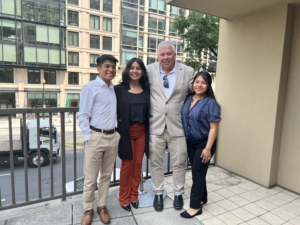
Alma Hernandez (far right) is joined by fellow National Migrant and Seasonal Head Start Association  farmworker youth interns Jose Velasquez Castellano and Gizela Gaspar. NCL CLC Coordinator Reid Maki is also in the photo.

Imagine being a five-year-old child – happy and carefree. The age where you either attend pre-K or start kindergarten. But can you imagine a five-year-old working in farm fields in hot 90-degree humid weather with her parents? I was that child. I wore a long-sleeved shirt, jeans, closed-toed shoes, and a hat to protect me from the hot sun. At five years old, I was unaware of how difficult agricultural labor is. My mom had enrolled me at the Redlands Christian Migrant Association (RCMA), a Migrant and Seasonal Head Start program, but she also wanted to teach me to value my education.

My mother’s life lesson started during the weekend after I did not want to wake up for school. My mother remembers that I was full of confidence when asked if I wanted to go to work with her and my father. However, I did not know what was in store for me.

Arriving at the fields around 7:30 am, I first saw endless rows of strawberry fields. I felt enthusiastic. My task: collect as many bright red strawberries as I could and place them in my pink Halloween bucket. After filling my bucket, I would give the strawberries to one of my parents. Around 12, I felt the heat. It was around 90 degrees. The humidity made it feel worse. I felt like I was in 100-degree weather; I did not like that at all and wanted to go home. I was already tired and asked if we could leave. My mom said no; I had to stay until they finished. And so I kept working.

I do not recall what happened the rest of the time I was there, but I remember what happened afterward. I went home and sat on the stairs of the house with a red face, a headache, and clothes covered in dirt, and reflected on the decision I had made to join my parents in the strawberry fields. I went inside. I was so tired that I ignored dinner and skipped a shower and went straight to bed just to wake up the next day, to repeat another day of long, hard work. My parents had me help them one more day; and convinced that my lesson was learned, they let stay home where, in the next few years, I could help take care of younger siblings when my parents could not find childcare.

Although my work in the strawberry fields was short-lived, I have much more experience harvesting blueberries. I started working on blueberry farms when I was 12 years old and worked every summer until I was 16. The blueberry season starts in the summer after school ends in Florida.

My family and I would leave Florida near the end of June and start the 17-hour drive to Michigan. Unlike the strawberry season, I liked picking blueberries because I did not have to bend down low to the ground all day; blueberry plants grow higher. My job was to fill up my six buckets. Once they were all filled, I would carry all the buckets to place them into plastic containers and have them weighed. On average, six buckets would be 42 to 45 pounds, and depending on who we were working for, the average pay was 0.45 to 0.55 cents a pound. I had to pick as many pounds as I could. On good days, I would be able to pick 200 pounds or more; on many other days, I would pick less.

The clothing I wore was also the same: long sleeves, jeans, closed toes shoes, and a hat to protect myself from the sun. The weather in Michigan is not as humid as it is in Florida; usually, it was in the mid-80s to low 90-degrees however it was still hot being there all day. We would go in each morning at 8:30 or later depending on how wet the blueberry plants were and leave the fields around 8 or 9 at night.

I did not like going to a new school in Michigan every September just to leave in late October and return to Florida and start school. The curriculum was very different; I would excel quickly in Michigan since what I was learning I had already studied in Florida. But I also did not like how every time I would go to a new school, I’d be the “new girl,” struggling to make friends but knowing I would soon be migrating. “What is the point?” I would wonder. So I always kept to myself and only spoke when I was spoken to, and to this day I still do.

I also did not like the “what did you do during the summer?” question on the first day of school when I returned to Florida because all I did was work all summer and had no fun. Work caused my parents to miss many school functions that other parents would attend. Sometimes, it felt like a lack of support, but I understood that this type of work was their only way to generate income to provide for the family.

This summer, after four years away, I came back to Michigan with my family for the blueberry harvest one more time. Now that I am 20 and reflecting on my family’s agricultural experience, I appreciate my parents for what they have done for my siblings and me. They wake up early every day, go to work, come home to cook, and still spend a little bit of time with my younger siblings. I help around as much as I can because I know they cannot do everything on their own, especially now that they are getting older. I know they are tired and have no rest days. But thanks to them, I am the first person in my family to go to college and serve as an example to my siblings which proves to them that there is a reason for our parent’s sacrifices.