Corinthian College is the first domino to fall in a misleading industry – National Consumers League

Its an odd thing to cheer when an institution collapses, but in the recent case of the for-profit Corinthian College – one of the country’s largest for-profit colleges – applauding what appears to be its downfall, is the right thing to do. NCL has applauded actions by the Department of Education and other federal entities to insist on transparent and accurate results reporting for these schools. 

The rise of the for-profit college industry, which largely recruits low income, military, and students of color falsely promise a solid education and good job prospects upon graduation when in reality, they have dismal records on both counts. For-profit colleges have been yet another example of industry engaging in predatory practices that target low-income Americans.

For profit colleges are dependent on students taking out hefty federal loans in order to pay the often sky-high tuition. Without federal loan programs, the vast majority of these colleges cannot survive. There are some exceptions – those students getting short term degrees to be a dental hygienist, medical technician, or other technical degrees may in fact get the training they need to get real jobs that pay decent wages upon graduation. But there are far more deceptive actors in this industry than good ones. When the federal government began tightening up requirements on for-profits getting, schools like Corinthian went into a financial tailspin.

Since January several states and the US Department of Education have been investigating Corinthian. NCL has long supported efforts by federal regulators to crack down on these schools.

Corinthian has 72,000 enrolled students and 12,000 employees. It has now agreed to shut down 100 campuses in the coming months. The school’s downfall came when it refused to provide DOE with data on how students were succeeding and admitted to the California attorney general Kamala Harris that it had falsified data on whether graduates were getting jobs, and had lied to investors as well. The company advertised rates suggesting that 100 percent of graduates were getting jobs when in fact not a single student had done so within the prescribed period of time.

The lawsuits say the school heavily recruited low-income single parents on the brink of poverty. In June federal officials put Corinthian on a 21 day delay for receiving federal aid. Corinthian said it would have to shut down because even a short-term delay in access to federal funds would result in its downfall.

Not surprisingly other for-profit colleges are lobbying heavily to weaken rules that allow them to get access to federal loan monies. These lobbying efforts should not succeed. While the Obama administration’s rules could be stronger, the current rules will help stop bad actors. Under the rules, for example, the program’s loan default rate could not exceed 30 percent – the for- profit colleges typically have a much larger default rate because the vast majority of students drop out or can’t find jobs after graduation and thus cannot repay their loans.

Most important to protecting low-income students lured to take out loans for worthless degrees, schools that lose eligibility for federal funds should have to pay back the loans and Pell grants themselves and not saddle students with this debt. Corinthian College, one of the biggest, is the first to fall, but others engaging in similar false and deceptive practices will go down as well, and that is for the best. 

Chicago Data Breach Victims at Heightened Risk of Identity Theft, New Study Shows – National Consumers League

July 16, 2014

Contact: National Consumers League, Ben Klein, (202) 835-3323, benk@nclnet.org
Carol McKay, (412) 945-3242, carolm@nclnet.org
Javelin Strategy & Research, Danielle Ostrovsky (410) 302-9459,dostrovsky.ctr@javelinstrategy.com
Natalie Bauer, Office of Attorney General Madigan, 312-814-4947,nbauer@atg.state.il.us

Attorney General Madigan and National Consumers League Address Online Security for Illinois Residents

Chicago – New research released today by the National Consumers League (NCL) and Javelin Strategy and Research reveals disturbing trends for Chicago residents who have been affected by data breaches, finding that 72 percent of fraud victims were also victims of data breach, suggesting a strong link between breaches and fraud.

Attorney General Madigan joined representatives from NCL and Javelin Strategy & Research Wednesday at 1871 to discuss the research findings and resources for Illinois residents to protect themselves from identity theft.

“The latest data breaches have served as a wakeup call signaling that government and the private sector need to take serious, meaningful action to curb this growing threat to our financial security,” Madigan said.

Also included in the research were findings that show consumers are losing faith in business to protect their identities and want more government action on fraud prevention measures.

“Data insecurity is leading to real consumer harm and this report confirms consumers are at a loss for where to turn in the face of this national problem,” said NCL’s John Breyault. “As consumers share vast amounts of personal data with businesses, government and other entities, they expect their information to be protected from malicious hackers.”

This event today in Chicago is the third in NCL’s’ #DataInsecurity Project, and follows similar events in Miami and Los Angeles which featured United States Attorney for the Southern District of Florida Wifredo Ferrer, Federal Trade Commission Commissioner Terrell McSweeny and Joanne McNabb, Director of Privacy Education & Policy for the California Office of the Attorney General.

“In this polarized political climate, it’s rare for Americans to express such agreement on any issue,” said Al Pascual, Javelin’s Senior Analyst of Fraud and Security. “But when itcomes to the security of their personally identifiable information, the respondents said with one voice that the government must do more.”

#DataInsecurity Project Findings For Chicago Metropolitan Area Fraud Victims

The National Consumers League recently released new research examining the impact of data breaches and identity fraud on consumer victims in four key regions nationwide, including the Chicago metropolitan area. According to the study, Americans are urgently calling out for government action on the growing threat posed by data breach and identity theft.

The study, conducted in partnership with Javelin Strategy & Research, shows that theimpact of data breaches on consumers is indeed severe: 61 percent of data breach victims who also experienced identity theft reported that the breached information was used to commit the fraud against them. What’s more, nearly half of all fraud victims – 49 percent – do not know where the information used to defraud them was compromised.

The NCL/Javelin study, which includes surveys of fraud victims from Chicago, Los Angeles, Miami and Minneapolis, along with additional Javelin research on national fraud trends, found that consumers are calling for government to take action. A mere 28 percent of victims surveyed said the government’s requirements for protecting healthcare and financial data were “sufficient.”

In Chicago, 43 percent of fraud victims said their data was used to make online purchases and 28 percent said their information was used to make purchases in-person. Among fraud victims in Chicago, 72 percent had previously received a data breachnotification which is higher than reporting by victims in Minneapolis (66 percent), but is comparatively worse than in Los Angeles (82 percent) and Miami (80 percent) where the rates of data breach notification among fraud victims were significantly higher.

According to the new study, the consequences of consumer fraud have a serious ripple effect: fraud victims report losing trust in the businesses where their data was compromised. For example, 59 percent of respondents whose data was breached at a retailer expressed  “significantly decreased” trust in retailers who failed to protect their information. “When consumer trust drops, so do sales,” added Breyault, “This study is only the latest evidence for why the business community should be one of the most vocal advocates for protecting consumer data.”

###

About the National Consumers League

The National Consumers League, founded in 1899, is America’s pioneer consumer organization. Our mission is to protect and promote social and economic justice for consumers and workers in the United States and abroad. For more information, visitwww.nclnet.org.

Should the word “natural” be banned from food labels? – National Consumers League

According to The U.S. Food and Drug Administration (FDA) “natural” means…very little.  The only guidelines FDA provides are that foods labeled as natural should not contain added color, artificial flavors or synthetic substances.  These loose guidelines, which were put into effect in 1993 as an informal policy, are puzzling consumers and food manufactures alike.

So much contention surrounds the word natural that the Grocery Manufacturers Association came out in support of the Safe and Accurate Food Labeling Act introduced in the House last April.  The bill would require FDA to define the term “natural” for use on food and beverage products, finally providing more guidance for industry and consumers.

The issue with defining the word natural is that it’s difficult to draw a line where natural stops and artificial begins.  Take an apple for example.  That seems to be very natural as it grows directly from the ground and little to no processing occurs but would it still be considered natural if it contained synthetic chemical preservatives?  What about synthetic pesticide residue? Could a very processed food like Bugles be considered “natural” if it was made entirely from products originating from the earth?

Not only was FDA faced with a massive grey zone of “natural” definitions when they first requested comment on the word’s definition twenty years ago, but they also needed to protect first amendment rights and therefore could not prohibit its use altogether.  Ultimately, FDA took a hands off approach.  Labeling practices have become more contentious, with political battles surrounding GMOs and country of origin labeling, and the time has come to address the issue.

At the end of the day, manufacturers just want to sell their product. Consumers have come to associate the term “natural” with healthy food. And so, food manufacturers continue to label as many foods as possible natural to attract more buyers. The lack of a strict definition for “natural,” however, causes it to be used in a variety of circumstances where it makes unhealthy foods, look healthy or “good” to consumers.  Even if FDA managed to pull together a definition for natural, it would no doubt be abused.  Soda made from cane sugar or other natural ingredients would be deemed “natural” (case in point Seven-Up, which later dropped their 100% natural claims).  The human body doesn’t necessarily process it differently and it certainly isn’t healthy no matter how the ingredients were produced.

Soda is just one example of the many possibilities where natural could be misused.  The term “natural” should simply be banned from labeling.  It carries little to no meaning in terms of its perceived health benefits and should not serve as decision making tool for consumers.

Education campaigns improve safe acetaminophen use – National Consumers League

Untitled-1.jpgAcetaminophen is the most commonly used drug ingredient in America. It is found in over 600 of the most commonly used over-the-counter (OTC) and prescription drugs, including Tylenol, Robitussin, Dayquil, Nyquil and so many more. An estimated 50 million Americans take acetaminophen every week. When taken as directed, acetaminophen is safe and effective. Taking too much acetaminophen, however, can cause severe liver damage.

Acetaminophen is the most commonly used drug ingredient in America. It is found in over 600 of the most commonly used over-the-counter (OTC) and prescription drugs, including Tylenol, Robitussin, Dayquil, Nyquil and so many more. An estimated 50 million Americans take acetaminophen every week. When taken as directed, acetaminophen is safe and effective. Taking too much acetaminophen, however, can cause severe liver damage.

Consumer education is a key step to ensuring safe acetaminophen use and preventing overdoses. A new report from the Acetaminophen Awareness Coalition (of which National Consumers League is a founding member) “Acetaminophen: How It’s Used, Preventing Overdose and What We Can Do to Promote Safe Use,” explores the successful impact of ongoing healthcare provider and consumer-led education campaigns. Over the last three years many organizations have launched new campaigns aimed at educating consumers about safe medicine use. Among these efforts is TakeWithCare.org, launched by NCL in 2014 to educate teens on safe use of over-the-counter medications.

The report found that consumer awareness about safe medicine use between 2010 and 2013 improved across the board. In 2010, 90 percent of people said it’s dangerous to exceed maximum doses and 76 percent said they were aware they could overdose by doubling up on multiple medications with the same active ingredient. By 2013 those numbers improved to 98 percent and 81 percent respectively.

Perhaps the most substantial finding from the new report is that consumer education campaigns do work and do help consumers be more informed. In 2010, 78 percent of those surveyed understood that, “exceeding the recommended daily dose of acetaminophen may lead to liver damage.” By 2013 that number increased to 87 percent. Many stakeholders from different backgrounds are working on educating consumers about the dangers of acetaminophen overdose. We must keep up these efforts to reduce unintentional overdosing.

As an organization that runs many consumer education initiatives it is great to know these campaigns truly do create a more informed and healthy consumer base. 

So…what is Acetaminophen?

Acetaminophen is the most widely used pain reliever and fever reducer that temporarily relieves minor pains and aches such as those resulting from the common cold, muscle aches, headache, arthritis, allergies, and premenstrual and menstrual cramps.

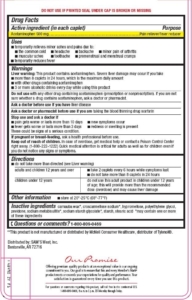
To find out if a medicine you are taking contains acetaminophen, read the drug facts label. Here’s an example:

When used properly, acetaminophen is safe and effective. Like any medicine, however, there is a limit to how much should be taken in one day. The FDA recommends a maximum daily dose of no more than 4,000 milligrams (mg) of acetaminophen. The amount of acetaminophen in an individual product varies and you can find the amount listed in milligrams on the medicine label. Exceeding the daily limit, or overdosing on acetaminophen can lead to severe liver damage or death. Overdose occurs when consumers take too much at one time or take a second dose before they are supposed to in an effort to help manage the pain. Using multiple medications that contain acetaminophen can also result in misuse or overdose. It is important to read the directions carefully or ask your health care provider before taking any medicine.

Tips to Safely Use Acetaminophen

  1. Read and follow the medicine label.  Reading the labels provides consumers with need-to-know ingredients as well as proper usage directions. Find out if a medicine contains acetaminophen.
  2. Talk to your pharmacist/physician. Become more aware and informed about your prescribed or over-the-counter medicines. Ask questions about allergies, proper dosage, and how often the product should be used.
  3. Never take two acetaminophen-containing medicines at the same time. Double check the label, and don’t double up on acetaminophen.

For more information visit, Know Your Dose today!

NCL applauding DC City Council for Wage Theft vote – National Consumers League

July 14, 2014

Contact: Ben Klein, National Consumers League, benk@nclnet.org, (202) 835-3323

Washington, DC—Today, the National Consumers League (NCL), the nation’s pioneering consumer and worker advocacy organization, is applauding the Washington, DC City Council for its unanimous vote in favor of the Wage Theft Prevention Act of 2014. The bill is designed to create formal hearings with enforceable judgments, provide better access to lawyers for wage theft victims, strengthen the District’s worker protection laws, and increase penalties for employers who commit wage and hour violations.

“This is another great step towards protecting District workers from a destructive labor practice,” said Michell K. McIntyre, Outreach Director, Labor & Worker Rights. “We’re hopeful that Mayor Gray will sign the bill into law to better the lives of workers across Washington, DC. NCL thanks every member of the DC City Council for standing up for all District workers, showing strength and resolve to do the right thing in the face of industry opposition. The DC Council has set an exemplary standard for city and state legislators around the nation.”

The bill now heads to Mayor Vincent Gray’s desk. He has three options: he can sign the bill into law; veto the bill, sending it back to the City Council for a councilmember vote to override the veto; or he can choose to take no action and after a set amount of time the bill will become law. 

###

About the National Consumers League
The National Consumers League, founded in 1899, is America’s pioneer consumer organization. Our mission is to protect and promote social and economic justice for consumers and workers in the United States and abroad. For more information, visit www.nclnet.org.

Teen safety: Preventing workplace violence – National Consumers League

julie.jpgBy Julie Duffy, Child Labor Coalition Intern

No one expected 18 year-old Christina LoBrutto’s first overnight shift at the Pathmark grocery store in Old Bridge, New Jersey to be her last. Sadly, however, the recent high school graduate lost her life after being fatally shot by a co-worker suffering from post-traumatic stress disorder (PTSD). LoBrutto’s tragic and deadly story of workplace violence is not as uncommon as you might think. 

According to the Occupational Safety and Health Administration (OSHA), over 2 million Americans workers, as young as 15, report being victims of workplace violence each year. OSHA classifies workplace violence as “any act or threat of physical violence, harassment, intimidation, or other threatening disruptive behavior that occurs at the work site.” The United States Department of Labor cites workplace violence as the fourth leading cause in workplace deaths. Teens are often the most susceptible to workplace violence because they are not properly trained in workplace safety and activism. Proper training, for both teens and their employers could save many young lives.

On June 23rd, David Michaels, Assistant Secretary of Labor for OSHA, and teen safety peer educators held a phone press conference on how to prevent workplace violence. The panel stressed the importance of training programs about workplace safety. Such training programs can teach teens about identifying an unsafe work environment and how to voice their concerns to their employers. Training programs can also help educate employers on how to maintain a safe workplace. Under OSHA’s mandates, employers have the responsibility to provide a safe place of employment free from recognized hazards, including workplace violence. This could mean increased use of safety cameras, working alarms, workplace panic buttons, or the presence of security guards.  

Since 1978 the Susan Harwood Training Grant Program has trained over 1.8 million workers and employers about how to recognize and prevent health and safety hazards in their workplaces. This summer “Teens Lead @ Work,” a project of Massachusetts Committee for Occupational Safety and Health, plans to educate 540 younger workers between the ages 15-22 on workplace safety in Massachusetts. When it comes to ending workplace violence empowerment is key. Teens should feel confident in the safety of their work environment and comfortable addressing their employers when they feel their workplace is unsafe.   

Yet another study confirms childhood vaccines are safe – National Consumers League

In not so surprising news, researchers again prove that childhood vaccinations are safe for routine immunizations. At a time when vaccination rates are declining and when once eradicated diseases like measles are resurging (500 cases since January), this report couldn’t have come at a better time. 

This news confirms the importance and safety of vaccines, especially as many parents are declining routine vaccinations for fear of harm. The bottom line: childhood vaccinations don’t cause autism, and they do protect patient and public health.

The results of a comprehensive, systematic review of vaccine safety were released last week in the journal of Pediatrics. This study was done as a follow up to a 2011 Institute of Medicine report, investigating the scientific evidence for potential adverse effects of childhood vaccines. Researchers scoured published data for articles evaluating both vaccine safety, capturing adverse event reports, and describing patient characteristics for immunizations recommended for routine use in children 6 and under.  From an initial batch of over 20,000 research papers, 67 were chosen to be analyzed. Based on the evidence presented in the papers, vaccine safety was classified as being high, moderate, low confidence or insufficient evidence.

This new research can be added to a long list of already published medical information that support vaccinations effectiveness to prevent terrible, life threatening diseases and illnesses.

Americans are lucky to live in a country that provides access to these safe and effective vaccinations at a relatively low cost. In other countries, it isn’t as easy. The measles vaccine for instance costs less than $1, yet measles is still a leading cause of child death worldwide. The World Health Organization reports that there are 330 child deaths every day due to measles. In America, where the vaccine is completely affordable and there are few barriers towards getting vaccinated, we see parents refuse vaccinations, citing reasons of harm often based on little or no accurate science.

It has been more than half a century since vaccinations for polio, measles, and other diseases were rolled out on a public scale. And illnesses like mumps or measles, once commonplace, are so rare that many US doctors don’t even know how to treat it nor would they know how to identify the characteristic rash and implement safety protocols to prevent spread. Yet today, that is exactly what is happening. 

It’s time for science and rigorous and accurate research studies to be the basis of our health care decision-making, not baseless opinions of non-scientists. Both the FDA and CDC regularly monitor vaccines for safety, even after they have been approved, and have mechanisms to alert the public if issues are found. Let’s all do our part to protect our community’s health by staying current with the recommended vaccinations to prevent the spread of disease.

Here’s a quick recap of what this study found for the childhood vaccinations.

  • DTaP: No evidence for any causal link between side effects or causing diabetes. DTap is for diphtheria toxoid, tetanus toxoid and pertussis. Think, DTaP prevents tetanus and whopping cough.
  • Hib Vaccine: No association with severe side effects. One study found an association with redness and swelling at the injection site. Hib is a serious disease that can affect the lungs, brain, ears.
  • Hepatitis A: Moderate association with excessive bruising (purpura) for children 7 to 17 years of age, which clears up shortly after injection.
  • Hepatitis B: No evidence for causal relationship with neurologic disorders including autism or multiple sclerosis.
  • IPV (Inactivated Polio Virus): Insufficient evidence to claim that this vaccine leads to food allergy sensitivities in newborns.  
  • Influenza vaccines: Low evidence that the vaccine causes flu-like illness in children when vaccinated. The study did find moderate evidence that vaccination leads to mild gastrointestinal events (e.g. vomiting or diahrrea). There is moderate evidence that links flu vaccine to febrile seizures especially when administered at the same time as the pneumococcal vaccine.
  • MMR: The evidence did not support a causal relationship with the vaccine and autism.  There is a moderate association with increased emergency department visits 2-weeks after administration, likely linked to the increase chance of febrile seizures. MMR is the vaccine for mumps, measles and rubella.
  • Meningococcal: The evidence is moderate that the vaccine may cause anaphylaxis in children with allergies to ingredients.
  • PCV13: This vaccine is against pneumonia and has a moderate association of febrile seizures especially when given at the same time as the flu vaccine.
  • Rotavirus Vaccines: Rotavirus causes severe diarrhea in children. The vaccine is moderately associated with intussusception (problem with the intestine that can be fixed with minor surgery), but this is quite rare!
  • Varicella: There is evidence that the vaccine can lead to some illnesses especially in immune-compromised individuals.


A conservative war on women is a reality – National Consumers League

Conservatives bristle at the idea that they are waging a “war on women,” but if you take the sum total of their actions, it’s hard NOT to see it that way. Let’s take the issue of a woman’s right to contraception. Preventing unwanted pregnancies is largely a woman’s responsibility, even today, and the best protection is taking an oral contraception or using a contraceptive patch. When women cannot access contraception it often leads to unwanted pregnancy, which leads to a higher demand for abortion. 

Last week, in a rightwing-orchestrated case known as “Hobby Lobby,” the Supreme Court decided that companies cannot be required to provide their employees with access to birth control. The result for women who are employed by Hobby Lobby, or other companies who argue that providing contraception violates their religious beliefs, is that they have to pay for treatment out of pocket, or forego contraceptive protection and risk unwanted pregnancies. 

However, conservatives for decades – ever since the Supreme Court decided Roe v. Wade in 1973 protecting the right to abortion – have conducted a campaign against women’s access to the procedure. In some states like Virginia, which until the recent election of a democratic governor and attorney general was on the road to driving all abortion providers out of the state by imposing new onerous requirements on abortion providers, is just one example of a state that has tried to pass extreme measures in recent years to make a woman’s access to abortions more difficult.   

So what happens when women cannot get contraception or an abortion for unwanted pregnancies? They might well be forced to give birth to a child they don’t want and are ill equipped to feed and care for. Low income women are hit the hardest – they may have to quit their job to take care of that child, and if they apply for welfare or food stamp benefits – well, conservatives in Congress have been declaring war on those programs too. A dramatic reduction in food stamp funding passed in the farm bill last year. As a result, many people have been dropped off the rolls, with single mothers and low-income women disproportionately hit by these draconian policies. 

So the vicious cycle of denying women access to contraception, abortion, and then welfare or food stamp benefits to help with them care for an unwanted pregnancy, amounts in my book, to a war on women. It’s an outrage that women bear the brunt of these indefensible policies, but they do. So conservatives should face up to the reality of their mean spirited policies – if the shoe fits wear it – you’re waging nothing less than a war on women.


FTC Commissioner Terrell McSweeny speaks at NCL event on data breach, ID theft – National Consumers League

July 8, 2014

Contact: National Consumers League, Ben Klein, (202) 835-3323, benk@nclnet.org
Carol McKay, (412) 945-3242, carolm@nclnet.org
Javelin Strategy & Research, Danielle Ostrovsky 410-302-9459, dostrovsky.ctr@javelinstrategy.com

FTC Commissioner Terrell McSweeny Speaks at National Consumers League Event on Data Breach, Identity Theft

Commissioner McSweeny Joined by Joanne McNabb, Director of Privacy Education & Policy For the California Office of the Attorney General, to Discuss New NCL Research on Data Breach, Identity Theft and Impact on Californians

Los Angeles, CA – Federal Trade Commission Commissioner Terrell McSweeny spoke today at a National Consumers League briefing on data breach and identity theft, where she discussed new research findings about the consumer impact of data breach and fraud.

Commissioner McSweeny was joined in Los Angeles by Joanne McNabb, Director of Privacy Education & Policy for the California Office of the Attorney General, for the second event of the National Consumers League’s #DataInsecurity Project, a cross-country series to raise awareness and push for action on consumer data security.

After a morning press event with several data security experts, the two officials joined NCL Vice President John Breyault to discuss a new study, released by NCL and Javelin Strategy & Research, which revealed disturbing trends for Los Angeles residents who have been affected by data breach and identity fraud. Nearly half of identity fraud victims are unaware where their information was compromised, while 61 percent of those who were also data breach victims reported that the breached information was used to commit fraud. The majority of data breaches affecting fraud victims involved a compromised retailer; fraud victims also reported that their information was used to make unauthorized purchases, either online (31 percent) or in person (39 percent). As a result, Los Angeles identity fraud victims are losing trust in retailers’ ability to keep their personal information secure and prevent it from being used to commit fraud.

“This report shows that fraud victims are calling for a decisive and coordinated response from both governments and the business community,” said Sally Greenberg, NCL executive director. “We thank Commissioner McSweeny and Director McNabb for joining us for this important discussion, and for their continued advocacy on behalf of consumers.”

#DataInsecurity Project Findings on Los Angeles Metropolitan Area Victims

The National Consumers League has released new research examining the impact of data breaches and identity fraud on consumer victims in four key regions nationwide, including the Los Angeles metropolitan area. According to the study, Americans are urgently calling out for government action on the growing threat posed by data breach and identity theft.

The study, conducted in partnership with Javelin Strategy & Research, shows that the impact of data breaches on consumers is indeed severe: 61 percent of data breach victims who also experienced identity theft reported that the breached information was used to commit the fraud against them. What’s more, nearly half of fraud victims — 49 percent — do not know where the information used to defraud them was compromised.

“Data insecurity is leading to real consumer harm, and this report confirms consumers are at a loss for where to turn in the face of this national problem,” said NCL’s Breyault. “As consumers share vast amounts of personal data with businesses, government and other entities, they expect their information to be protected from malicious hackers.”

The NCL/Javelin study, which includes surveys of fraud victims from Los Angeles, Miami, Chicago, and Minneapolis, along with additional Javelin research on national fraud trends, found that consumers are calling for government to take action. A mere 28 percent of victims surveyed said the government’s requirements for protecting healthcare and financial data were “sufficient.”

In Los Angeles, 35 percent of fraud victims said their data was used to make online purchases and 44 percent said their information was used to make purchases in-person. Among fraud victims in Los Angeles, 82 percent had received a notice of data breach previously which corresponds with reporting by victims in Miami (80 percent), but it is significantly higher than in Chicago (72 percent) and Minneapolis (66 percent).

“In this polarized political climate, it’s rare for Americans to express such agreement on any issue,” said Al Pascual, Javelin’s Senior Analyst of Fraud & Security. “But when it comes to the security of their personally identifiable information, the respondents said with one voice that the government must do more.”

According to the new study, the consequences of consumer fraud have a serious ripple effect: fraud victims report losing trust in the businesses where their data was compromised. For example, 59 percent of respondents whose data was breached at a retailer expressed “significantly decreased” trust in retailers who failed to protect their information. “When consumer trust drops, so do sales,” added Breyault, “This study is only the latest evidence for why the business community should be one of the most vocal advocates for protecting consumer data.”

###

About the National Consumers League

The National Consumers League, founded in 1899, is America’s pioneer consumer organization. Our mission is to protect and promote social and economic justice for consumers and workers in the United States and abroad. For more information, visit www.nclnet.org.

In Harris v. Quinn, another slap in the face to workers – National Consumers League

Last week the Supreme Court‘s 5-4 decision in the Harris v. Quinn case was a slap in the face to working families and especially female employees across the country. In the home healthcare industry, where a vast majority of workers are minority women, the Harris v. Quinn decision eliminated agency fee arrangements for Illinois home healthcare workers. 

The ruling casts doubt and creates insecurity and instability for employers and unions throughout the public sector. The decision creates a special class for Medicaid and state funded home healthcare workers as neither private nor public but ‘partial public employees.’ 

Many of the basic workplace standards and protections that we take for granted as Americans are thanks to the efforts of collective bargaining and organized labor. At issue in this case was whether non-union members could reap the wages, benefits and protections negotiated in a collectively bargained contract without the needing to pay their fair share.

As ‘partial public employees’, the Court rules that the same labor rules do not apply and that workers can opt out of joining a union and not be required to contribute dues to the labor group that negotiates their employment contract – essentially allowing some workers to get free use of an employment consultant/lawyer while everyone else pays. 

At a time when wages are either eroding or remaining stagnant, and income inequality is out of control, joining together to collectively bargain is one of the only proven ways home care workers have to improve their lives and the lives of the people they care for. And with our aging population, the home healthcare industry is one of the fastest growing in the US, yet the workers have very little employment protections.

In the meantime, the Obama Administration must stick to its promise to the 2.5 million home care workers waiting for basic fair pay protections implementing the long-awaited federal companionship worker regulations by January 1, 2015. These new rules will finally extend basic federal minimum wage and overtime protections to the millions of workers who care for seniors and people with disabilities living independently in their homes.