Coding Bootcamps: Who’s really in charge? – National Consumers League

You’ve found a coding bootcamp that promises it all: a six-figure salary, positions at Uber, Google, Facebook, and Snapchat…all thanks to visionary founders and highly experienced instructors. But how much of it is hype?

As any graduate knows, success depends on qualified instructors creating a structured environment, where students have space to experiment, fail, and ultimately learn from mistakes. But as simple as this formula may be, it’s not enforced at every coding school.

In a free market driven by intense demand for programmers, one simple rule applies: if anyone can open a coding school, then anyone will. And despite the marketing hype that surrounds the coding bootcamp industry as a whole, there’s no guarantee that individual schools have the credentials to deliver on their promises.

Accreditation in coding schools

In recent years, several bootcamps have been shut down by state authorities for a lack of accreditation, namely, a failure to meet educational standards. As an accredited institution, a school is held to high educational standards. By granting a school the proper credentials (and subjecting it to rigorous internal and external reviews), regulators put the government’s seal of approval on an institution, clearing the school to accept students.

From 2014 to 2016, under then-President Barack Obama, the Department of Education cracked down on for-profit schools, prohibiting them from using federal financial aid. The driving force behind the crackdown was widespread abuse, from blatant fraud at for-profit schools to systematic corruption on the part of accreditors and regulators.

All this is to say that there is already a substantial lack of oversight in the for-profit education sector, where neglect on the part of regulators allows unscrupulous operators to defraud students. The world of coding bootcamps is a veritable Wild West, anything-goes, environment—populated by both reputable institutions and fly-by-night operators.

In 2014, the Bureau for Private Postgraduate Education (BPPE) made an attempt to rein in the industry and threatened to shut down several California-based coding schools (among them Hack Reactor, App Academy, and General Assembly), unless they complied with regulations. Part of the problem was a question of jurisdiction: several of these schools didn’t recognize that BPPE’s authority includes both vocational and academic schools.

Even today, few bootcamps are accredited by the government. As of 2016, the BPPE had only certified five: Dev Bootcamp, Galvanize, General Assembly, Sabio, and Hackbright Academy.

Who’s running the show?

In an industry fraught with inconsistency, the answer of course varies with the school.

On one end of the spectrum are the reputable institutions that are certified by accrediting bodies, including the BPPE. On the other end, there are convicted felons creating false credentials, posting fake student reviews, and disappearing with students’ tuition dollars.

The free-for-all nature of the coding bootcamp industry means that the barriers to entry are so low that nearly anyone can start a school, especially one that’s entirely online (many reputable schools offer face-to-face classes). One school was shut down by California authorities in late 2016 despite its attempts to force students to delete negative reviews. Those reviews that remain online paint a picture of a school rife with unqualified instructors—many of whom who could barely code themselves—poorly-planned curricula, and even the hiring of alumni to teach immediately after graduation (before they had an opportunity to build any real-world experience). Lacking any real programming skills, many of its graduates were unable to find jobs upon completing the program.

A lack of consistent standards for coding instructors is the problem, but neither the industry’s own disregard for accreditation, nor the pervasive Silicon Valley mindset—that startups are here to “move fast and break things”—are helping the situation. Even when offered the chance to partner with existing universities, one startup founder dismissed the idea of allying with traditional higher education, noting that such institutions moved too slowly—even as he himself lamented the lack of standardization in the coding bootcamp industry.

The problem is also that the “if anyone can do it, then anyone will do it,” rule applies broadly in for-profit education—and wherever the barriers to entry are too low, ultimately, the consumer suffers. Though certification presents a significant cost, both to regulators and bootcamp operators, in the end, credentialing heightens students’ trust in the legitimacy of teachers, and of coding schools as a whole.

In our next post, we’ll take a hard look at the numbers: namely, the statistics coming out of coding bootcamp marketing. Do they truly graduate as many students as they say they do? How many students really find jobs? In reality, the numbers don’t always have to be inflated to be misleading.


Hotels holding consumers hostage with increasingly unfriendly cancellation policies – National Consumers League

Written by NCL Intern Trang Nguyen

Hotels used to let customers cancel their reservations up to 6pm on the day of arrival. This was the *accepted norm for more than a decade. But this policy, which allowed flexibility for travelers, took a blow in 2015 when two big hotel chains, Marriott and Hilton, put into effect a penalty for last-minute cancellations. According to the new rule, cancellations later than 24 hours before the scheduled arrival date would result in a fee of one night’s room rate. There is no umbrella rule for cancellation fees for the hotel industry, which allows hotels to arbitrarily determine the cost. Depending on the destination and star-ratings, hotels are known to have charged up to three-night rates for resorts—or even allow no refund at all for the entire reservation.

Now, Marriott has announced a terribly anti-consumer policy: a three-day cancellation fee. In other words, if a consumer’s plans change within three days of travel, they get slammed with paying a full overnight stay—even if the hotel is able to re-rent the room and recoup all the money it would have lost from an empty room. Cancellation fees are punitive for both businesses and tourists. In 2014, the hotel industry collected *$2.25 billion in fees and surcharges. These fees *include in-room wifi, “resort fees,” and cancellation fees.

We did a little research and found some interesting information. The cancellation rates for online travel agencies (OTAs) (like Orbitz, Expedia, etc.) are significantly higher than those of reservations made directly to brand websites (i.e., *Hilton.com or *Marriott.com). The cancellation rate from brand websites hovers at 19 percent, while the rate for popular OTAs run from 25 percent (Expedia) to 39 percent (Booking). A possible explanation for the difference may be that customers who book directly through brand website are more likely to be loyal customers, who are set to travel according to the planned booking. Bookings through OTAs can be more whimsical. OTAs send rigorous marketing campaigns to their subscribers, urging them to make reservations for limited, discounted offers even if they have no existing need to travel. Since OTAs often have flexible, free cancellation, and no booking fees, many subscribers end up making the reservation and cancel them later.

We think this new rule ought to be illegal because hotels can double dip, just like the airlines are currently allowed to do. We think fair is fair. If the customer cancels a booking and the hotel is able to re-rent the room, the hotel should be required to refund the customer’s payment. We ask Marriott executives: is it really fair for hotels to punish customers who might have to cancel their reservation because of an emergency or a change in the location of a business meeting or family event when you’ve been able to re-rent the room? Or is this just another way to gouge consumers whose plans change (often through no fault of their own)?

Hotels can also mitigate this problem by measuring the cancellation rate for each channel they distribute to, and giving lower quota and higher rates to sites with high cancelation rates. They can offer different payment options to discourage arbitrary booking behaviors or send reminders to fickle customers to reduce risk of last-minute cancellations. Hotels can also up their last-minute reservation game by investing and giving special deals on their mobile apps. Right now, OTA mobile apps dominate the industry when it comes to last-minute booking, with 70 percent of the market. If hotels can tap into that segment through their own apps, it could surely relieve them of higher commission to the OTAs.

Clearly, limiting the main source of cancellation, not upsetting loyal customers, and attracting more last-minute reservations through direct booking would be a win-win for hotel chains and consumers. And refunding canceling customers for a room that is ultimately is rebooked is only fair.

*Links are no longer active as the original sources have removed the content, sometimes due to federal website changes or restructurings

High school students shocked at waste uncovered during cafeteria food waste audits – National Consumers League

“Schools are a place of learning. The cafeteria should be too!”
I’m willing to guess that if you ask almost any student their favorite school period, the resounding answer will be “lunch!” My memories of school lunch involve scarfing down a peanut butter sandwich and quickly catching up with friends before our 30 minutes were up. The cafeteria is hectic, lines are long, and many students rush through their meals in order to preserve time to socialize.  So too often, a hasty lunch period leaves trash bins overflowing with half-eaten sandwiches and other barely touched food items.

Food waste in American schools is a major problem. Studies have found that U.S. schools waste a total of about $1.2 billion annually. There are many theories as to why schools produce so much food waste, but in order to really identify the root causes, we have to get our hands dirty. And who better to dig into a messy issue than energetic high school students?

In the spring of 2017, students participating in LifeSmarts, NCL’s signature consumer literacy program, were given the unique challenge of conducting a food waste audit in their school cafeterias. Throughout the 2016–2017 academic year, LifeSmarts students studied the impacts of food waste that infiltrate almost every aspect of consumers’ lives. Students learned about the humanitarian and environmental impact of food waste. Having this background knowledge helped the students contextualize the auditing challenge within the discourse of the national and global food waste problem.

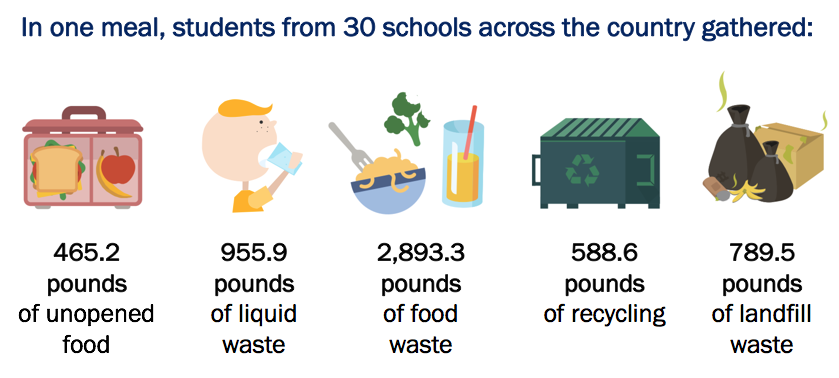
The terms of the challenge required students to conduct one audit in their cafeteria during one lunch period. Students worked with their peers to separate waste into five separate bins: unopened food, organic waste, liquid waste, recycling, and landfill waste. Students recorded the weight of each bin and answered a series of data-related and critical thinking questions, which gave them an opportunity to connect their real-life results with the national and global impacts of food waste.

Students’ reactions were diverse, and their suggestions inform insightful structural and policy solutions for preventing and reducing food waste in schools and communities.

One student shared:

“Before the food audit, we predicted that the amount of food wasted would peak at around 70 percent of the total weight of food received, however when we combined the total weight of food thrown away and the unserved cafeteria food we were astonished to find that the true amount of food wasted was around 85 percent.“

Some students went an extra step to try to understand why food was being thrown out:

“Additionally, we were interested in evaluating the variety, amount, and nutrition within the available choices and determine how healthy students are eating at our school. This data will be shared with the food distributer for our high school as well as the School Committee.”

Students were also confronted with limitations from their school board:

“Unopened food cannot be shared, saved, or removed from the school per BOE directives.”

“Prepared cafeteria foods that were untouched had to be disposed of as food waste.”

As students became aware of the issue, they presented next steps for increasing efforts to reduce waste:

“Our LifeSmarts Team could encourage the administration to make a student lunch advisory board to review the lunches and see which meals students are reluctant to consume.”

One of the most striking findings from the audit challenge is the combined metrics of waste generated.

Instead of throwing away unopened food, it could have been recovered or donated. The potential for food rescue is detailed in the table below. Amounts were calculated using Food Rescue’s conversion tool.

Items rescued 2,444
Meals rescued 488
Pounds of CO2e rescued (the amount of carbon dioxide which would have the equivalent global warming impact) 305.5

The feedback from students who completed this challenge demonstrates the value in conducting food waste audits. Many students expressed interest in conducting more audits to dig deeper into the issue. Others were energized to move forward with engaging community members and school administrators to experiment with new solutions.

In the 2017–2018 academic year, LifeSmarts students will build on the momentum from the first audit challenge and test strategies for reducing waste in their cafeterias. Students will be encouraged to run longer audits, implement solutions, and conduct a second series of audits to measure their success. By collaborating with school administrators, food service workers, and community partners, students will navigate our complex food system, providing opportunities for solution-making from the ground up.

NCL letter to Committee on Commerce, Science, and Transportation in support of Fair Fees Act – National Consumers League

June 28, 2017

The Honorable John Thune
Chairman
Committee on Commerce, Science, and Transportation
United States Senate
512 Dirksen Senate Office Building
Washington, DC 20510

The Honorable Bill Nelson
Ranking Member
Committee on Commerce, Science, and Transportation
United States Senate
512 Dirksen Senate Office Building
Washington, DC 20510

Dear Senators Thune and Nelson,

The National Consumers League (NCL) urges you to support the FAIR Fees Act of 2017. The bill, sponsored by Senators Markey and Blumenthal will increase competition and benefit consumers who are increasingly abused by the airlines’ nickel-and-diming practices.

Thanks to unchecked consolidation, four major airlines now control more than 80% of all domestic flights. This unprecedented concentration of power has allowed the proliferation of punitive add-on fees to spread unchecked. Through an industry-wide “unbundling” strategy, the three biggest U.S. airlines — United, American, Delta — increased their ancillary fees revenue from $5.3 billion in 2008 to $14.69 billion in 2015, a staggering 177% increase. [1] U.S. air carriers, legally barred from colluding on fares, have shown a willingness to collaborate on fees. In 2013, for instance, the three largest domestic airlines all increased their cancellation/change fees from $150 to $200 within two weeks of each other. [2]

The massive increase in ancillary fees coincided with a long period of low fuel costs and historically high profits for the airlines. [3] In a truly competitive marketplace, airlines would have shared their savings with consumers to increase their market share, or at the very least, the increase in fees would have coincided with additional service. Unfortunately for consumers, the ancillary fees charged by the airlines bear no relation to the actual cost for the airline to provide the service that these fees allegedly support.

Fortunately, the FAIR Fees Act, which received bipartisan support when it was considered last year, would rein in this abusive practice. Under the legislation, airlines would be prohibited airlines from charging cancellation, baggage or other ancillary fees that are “unreasonable or disproportionate to the costs incurred by the air carrier,” as determined by the Department of Transportation.

Increasing competition is the best solution for improving consumers’ air travel experience. In the absence of competition, rules banning unfair and deceptive practices, such as advertising low fares only to slam consumers with large ancillary fees that bear no relation to the cost of providing the service is the next best step. NCL urges you to support the bipartisan FAIR Fees Act, and we hope we can count on your help in advancing this common sense pro-consumer legislation through committee.

Sincerely,

Sally Greenberg
Executive Director
National Consumers League

CC: Members of the Senate Commerce Committee

[1] IdeaWorksCompany.com. 2016 CarTrawler Yearbook of Ancillary Revenue. September 20, 2016. Online: https://www.cartrawler.com/ct/media/2016/09/CarTrawler-ancillary-revenue-yearbook-2016.pdf

[2] Mayerowitz, Scott. “Analysis:Airline mergers have already led to higher fares,” Associated Press. August 14, 2013. Online:https://indianexpress.com/article/news-archive/web/airline-mergers-have-already-led-to-higher-fares/

[3] Mouawad, Jad. “Airlines Reap Record Profits, and Passengers Get Peanuts,” New York Times. February 6, 2016. Online: https://www.nytimes.com/2016/02/07/business/energy-environment/airlines-reap-record-profits-and-passengers-get-peanuts.html


NCL disappointed in House committee vote to give airlines control of air traffic control – National Consumers League

June 28, 2017

Contact: National Consumers League, Cindy Hoang, cindyh@nclnet.org, (202) 207-2832

Washington, DC–The National Consumers League (NCL) today expressed disappointment with the passage of anti-consumer legislation extending the authorization on the Federal Aviation Administration (FAA) in the House Transportation and Infrastructure Committee. The following statement is attributable to Sally Greenberg, NCL executive director:

Yesterday, in a near party-line vote the Republican members of the House Committee on Transportation and Infrastructure voted to give away our public airspace to the airlines. Under this proposal, the very entities that have suffered numerous computer outages that downed thousands of flights, would be in charge of the critical Air Traffic Control (ATC) infrastructure.

It is mind-boggling that in an era of record airline consolidation, members of the committee chose to give even more control to the oligopolistic airline industry. It is further troubling that, when given the choice to support an amendment to ensure that government representatives of the newly privatized ATC corporation act in the public interest, the committee again declined even this modest improvement, ensuring that the airline industry has full control of the ATC corporation.

The National Consumers League urges members of the House and Senate to reject this radical and dangerous privatization proposal and to vote “no” on any bill or amendment that gives control of the nation’s critical ATC infrastructure to the airlines. We will continue to do all we can to oppose this anti-consumer, anti-competition legislation.

###

About the National Consumers League

The National Consumers League, founded in 1899, is America’s pioneer consumer organization. Our mission is to protect and promote social and economic justice for consumers and workers in the United States and abroad. For more information, visit www.nclnet.org.

NCL letter to the Senate Commerce Committee in support for Markey/Blumenthal Passengers’ Bill of Rights – National Consumers League

June 26, 2017 

The Honorable John Thune
Chairman
Committee on Commerce, Science, and Transportation
United States Senate
512 Dirksen Senate Office Building
Washington, DC 20510 

The Honorable Bill Nelson
Ranking Member
Committee on Commerce, Science, and Transportation
United States Senate
512 Dirksen Senate Office Building
Washington, DC 20510

Dear Senators Thune and Nelson,

The National Consumers League urges you to support the Airline Passengers’ Bill of Rights introduced by Senators Markey and Blumenthal.[1] This pro-consumer legislation would lay the groundwork for increased competition and introduce long-awaited consumer protections to the airline marketplace.

Today, unchecked consolidation has allowed 4 airlines to control 80% of domestic flights. This consolidation has left many cities at the mercy of one or two airlines, and left many consumers with no choice but to keep returning to the same airlines that continue to mistreat them. Given this lack of competition and choice, it is perhaps little wonder that consumers are forced to suffer from a laundry list of mistreatment including:

  1. Airlines have increased load factors to more than 80%.[2] This makes overbooking situations more likely and increases the hardship faced by consumers when mass cancellations occur either due to weather, or due to a airline wide technological failure.
  2. 40,629 paying consumers were involuntarily bumped in 2016.[3]
  3. Seat size pitch has dropped from 35 inches in the 1970s an average of 31 inches today.[4] The decreased seat size has raised concerns in the medical community due to the fear of deep vein thrombosis[5] and disability rights community who are concerned that their constituents are not able to use the inflight lavatories.[6]

With shrinking seats, involuntary bumpings, and with few rights in the event of a cancellation, it is perhaps not surprising that airline complaints have skyrocketed nearly 70% in recent months.[7] The Passengers’ Bill of Rights will address these concerns by:

  1. Prohibiting involuntary bumping – Airlines that wish to continue the practice of overselling will have to revert to the free market concept of offering increasing levels of compensation to motivate consumers to take a later flight.
  2. Requiring airlines to maintain interline agreements with other airlines, and compensate consumers for lengthy delays – Interlining agreements will allow consumers to get to their destination sooner, and in the event that flying on another airline is not possible, they will receive the accommodations they deserve.
  3. Creating a minimum seat size standard – After careful study by health professionals and input from the disability rights community, the Department of Transportation will create a minimum seat size standard that will protect consumers from the adverse health effects of squeezing yourself into a small seat.
  4. Reining in out-of-control nickel-and-diming – Airlines will be required to justify sky-high ancillary fees for services like changes and cancellations and baggage fees. Airlines will also be required to refund bag fees immediately when a bag is lost or damaged.
  5. Reinstating passengers’ access to the courts – Consumers will once again be able to hold airlines accountable for denying them basic rights, including denying people with disabilities access to airline facilities
  6. Beginning to address the lack of competition in the airline industry – The GAO will begin a long-overdue review of the impact of the dramatic consolidation of the U.S. airline industry on consumers and competition

U.S. airlines have long claimed that deregulation, combined with competition would lead to a better air travel experience for all. Unfortunately for consumers, the mergers they promised would improve their service have instead only raised prices and lowered customer service. The Passengers’ Bill of Rights would restore the basic rights of passengers when they fly. NCL strongly urges you to support this common sense, pro-consumer legislation.

Sincerely,

Sally Greenberg
Executive Director
National Consumers League

CC: Members of the Senate Commerce Committee


[1] “MARKEY, BLUMENTHAL INTRODUCE AIRLINE PASSENGERS’ BILL OF RIGHTS,” Press release. June 26, 2017. Online: https://www.markey.senate.gov/news/press-releases/markey-blumenthal-introduce-airline-passengers-bill-of-rights

[2] Bureau of Transportation Statistics. “Load Factor (passenger-miles as a proportion of available seat-miles in percent (%)) All U.S. Carriers – All Airports,” Online: https://www.transtats.bts.gov/Data_Elements.aspx?Data=5

[3] United States Department of Transportation. Air Travel  Consumer Report. Pg. 35. April 2017. Online: https://www.transportation.gov/sites/dot.gov/files/docs/resources/individuals/aviation-consumerprotection/278481/2017-april-atcr.pdf

[4]Congressman Steve Cohen. “Reps. Cohen and Kinzinger, Senators Blumenthal, Schumer, Markey, Menendez and Feinstein Introduce Bipartisan, Bicameral SEAT Act,” Press release. March 9, 2017. Online: https://cohen.house.gov/media-center/press-releases/reps-cohen-and-kinzinger-senators-blumenthalschumer-markey-menendez-and

[5] “Safety risk of shrinking airline seats questioned,” Los Angeles Times. April 14, 2015. Online:             https://www.latimes.com/business/la-fi-airline-seat-risks-20150414-story.html

[6] Eng, Dinah. “Smaller Bathrooms on Planes Pose Challenges for Passengers,” New York Times. December 23, 2016. Online: https://www.nytimes.com/2016/12/23/travel/smaller-airplane-bathrooms-challenges-forpassengers.html

[7] U.S. Department of Transportation. Air Travel Consumer Report. June 2017. Pg. 37. Online: https://cms.dot.gov/sites/dot.gov/files/docs/resources/individuals/aviation-consumer-protection/282456/2017juneatcr_0.pdf

NCL statement on the Senate Republican release of the Better Care Reconciliation Act of 2017 – National Consumers League

June 23, 2017

Contact: National Consumers League, Cindy Hoang, cindyh@nclnet.org, (202) 207-2832

Washington, DC–The following statement is attributable to Sally Greenberg, NCL executive director:

After weeks of unprecedented closed-door meetings and deal making, Senate Republicans released their version of a bill to repeal and replace the Affordable Care Act. This cruel legislation shows a brazen disregard for the well-being of Americans, and prioritizes special interests and tax breaks for the rich over affordable healthcare for all. Provisions of this bill include the elimination of essential health benefits, the establishment of ineffective high risk pools to cover America’s most vulnerable populations, and catastrophic cuts to Medicaid that surpass those included in the House bill. The bill directly contradicts President Trump’s guarantee to leave Medicaid intact, and represents a broken promise to the American people to improve upon the House’s legislation and ensure affordable coverage for every American. 

The National Consumers League urges patients and consumers to engage their Senators and ask them to vote “no” on this bill that will take healthcare away from millions of Americans. We will continue to work with our colleagues in the health and advocacy arenas to vehemently oppose this unscrupulous bill.

###

About the National Consumers League

The National Consumers League, founded in 1899, is America’s pioneer consumer organization. Our mission is to protect and promote social and economic justice for consumers and workers in the United States and abroad. For more information, visit www.nclnet.org.

School lunches crucial for growing kids – National Consumers League

Students who are hungry or malnourished have trouble concentrating and learning. In fact, students who get healthier meals show a 4 percent improvement in test scores, according to Dr. Michael Anderson, associate professor of Agricultural and Resource Economics at the University of California, Berkeley. Anderson found that “students at schools that contract with a healthy school lunch vendor score higher on CA state achievement tests, with larger test score increases for students who are eligible for reduced price or free school lunches.”

Indeed, Congress recognized the value of a nutritious meal  when it enacted in 2010 the Healthy, Hunger Free Kids Act, spurred by First Lady Michelle Obama’s advocacy. In passing that Act, Congress noted that not only did children need regular meals but that healthier choices were better for children’s learning and cognition. So not only are more kids getting food, but the meals are healthier and include fruits and vegetables. As the USDA noted on its website:

Improving child nutrition is the focal point of the Healthy, Hunger-Free Kids Act of 2010. The legislation authorizes funding and sets policy for USDA’s core child nutrition programs: the National School Lunch Program, the School Breakfast Program, the Special Supplemental Nutrition Program for Women, Infants and Children (WIC), the Summer Food Service Program, and the Child and Adult Care Food Program. The Healthy, Hunger-Free Kids Act allows USDA, for the first time in over 30 years, opportunity to make real reforms to the school lunch and breakfast programs by improving the critical nutrition and hunger safety net for millions of children. 

But under Republican leadership, the House of Representatives, and now USDA Secretary Sonny Purdue, we may be taking steps backward. Perdue wants to roll back rules that required schools to reduce sodium content in meals and offer more whole grains.  In his rollback plan, Purdue is also raising the allowed fat content in flavored milk from fat-free to 1 percent. The Berkeley team led by Anderson has found that diets high in trans and saturated fats – often found in high sodium foods or highly processed foods – have a negative impact on learning and memory. Some may argue that students simply won’t eat fruits or vegetables in defense of rolling back the healthier meals. However, three large studies by Pew Charitable Trusts found that food waste – an issue NCL is deeply involved in – actually declined in 12 Connecticut schools when better nutrition rules were in place.

Making healthier foods more convenient for students decreased consumption of unhealthy foods by 28 percent. Simply moving the salad bar from a corner of the lunchroom to the center increased sale of these vegetables and fruits. In her recent column in the New York Times, columnist Jane Brody noted that, “offering students a choice between two vegetable options and having them pay cash for unhealthy items like desserts and soft drinks … may enhance consumption of healthier foods without reducing revenue or participation in school lunch programs. While the studies are not conclusive, they suggest that with a few simple steps, schools may have an impact on the foods students eat.”

School nutrition programs are helping kids across the country adopt healthier eating habits and become better learners. The proof is ample. Why go backwards now? NCL calls on USDA Secretary Perdue to resist industry pressure to reverse these promising trends in school lunch and other feeding programs for children.

In defense of the Consumer Financial Protection Bureau – National Consumers League

In its short tenure, the Consumer Financial Protection Bureau (CFPB), under Director Richard Cordray has done an excellent job  of preventing consumers from harm and helping wronged consumers get the recourse they deserve. The American people have seen the great work the Bureau has accomplished, and it is not surprising that the CFPB enjoys support from both sides of the aisle. Unfortunately, given the success of the CFPB as a consumer watchdog, it is also not too surprising to see the very industries and actors the CFPB has been charged to regulate, amass support for its weakening or even outright dismantling in Congress. 
Earlier this month, the House of Representatives passed the Financial CHOICE Act, the first step in the latest effort to dismantle one of the most successful consumer protection agencies in America’s history. Given the amount of rhetoric from the CFPB’s detractors, it’s worth setting the record straight about the history, structure, and success of the agency.

In 2008, the United States experienced the worst financial crisis since the Great Depression. As the dust settled, there was a much-needed examination of factors contributing to the collapse. One of the things we learned was that consumers were often preyed upon or tricked into predatory loans.

Predatory lenders, including sketchy mortgage companies, payday and car title loan companies, and “no credit needed” car dealerships helped create an environment where consumers could become ensnared in an inescapable cycle of debt. Another cause of the crisis was bureaucratic paralysis due to too many agencies sharing consumer protection responsibilities. As a result, agencies often felt they did not have the authority to protect consumers from financial predators.This created an environment where unsavory lenders were emboldened to engage in loan shark tactics. Absent strong consumer protections, when the stock market crashed, many Americans had no choice but to default on their loans, making the crisis worse. In the wake of trillions of dollars in losses, the American people vowed to never allow such a situation to happen again.

The ensuing wave of consumer and policymaker revulsion coalesced in the creation of the Consumer Financial Protection Bureau. By any objective measures, the CFPB has been a runaway success in its mission to protect and empower consumers. So far, the CFPB has returned almost $12 billion to nearly 29 million wronged consumers. Consumers at Bank of America, Citibank, and JPMorgan Chase received $1.7 billion in refunds after they were charged for needless and unwanted services. Likewise, it was the CFPB that investigated and provided $100 million in financial relief to consumers when Wells Fargo defrauded its customers.


While the CFPB has had many big wins for consumers, it has also become a leader in mediation between harmed consumers and lenders. Since its formation, the CFPB, has collected over 1 million complaints. After collecting each complaint, the CFPB will work with the consumer to provide a resolution, typically within 15 days. The CFPB then takes that complaint information and puts it into a searchable database. This database allows consumers, government agencies, and advocates to identify emerging trends and work with industry and policymakers to stop harmful practices.

The CFPB has also been incredibly effective at preventing consumers from becoming victims in the first place. For instance, the CFPB created rules to prevent loan-shark style payday and car-title lenders from sucking consumers into unmanageable debt spirals. Likewise, the Bureau severely limited the prevalence of last dollar scams, which prey on consumers who are on the verge of bankruptcy. The CFPB has also been active in helping consumers navigate large, once-in-a-lifetime purchases like home mortgages. A few years back, the Bureau created rules ending “booby trapped mortgages.” The CFPB added protections that forced lenders to seriously consider a borrower’s ability to repay a loan, as well as a requirement to provide consumers with “know before you owe” disclosures that inform homebuyers how much they need to budget for their mortgage before they sign on the dotted line. It is because of these initiatives that home buyers have a much better understanding of how much they will end up paying.

Thanks to these and other successes, it is no wonder that an overwhelming majority of Americans (even a majority of Trump supporters) approve of the work the CFPB is doing and do not support efforts to weaken the agency. Unfortunately, the CFPB’s consumer protection success has created powerful enemies in the banking and financial services industry.

Opponents of the CFPB, emboldened by the results of the 2016 elections, are challenging the very structure that made it successful, starting with its funding source. The CFPB was created to be independent of the highly politicized appropriations process in Congress. Similar agencies including the Federal Reserve, Comptroller of the Currency, and FDIC are also funded independent of the appropriation process for the same reason. The creators of these financial institutions understood the importance of insulating critical financial protection agencies from the pressure of politics.

The CFPB’s detractors also argue that the agency is not accountable, which is simply not true. The CFPB is accountable to the Financial Stability Oversight Council, which has the authority to veto the Bureau’s rules. In addition, the CFPB reports twice a year to Congress and is accountable to the Federal Reserve’s Inspector General, as well as the Government Accountability Office. All of these agencies have conducted audits of the CFPB on numerous occasions. Detractors of the CFPB wish to either undermine the bureau’s ability to receive funds or splinter the agency’s leadership structure.

These baseless attacks must not be allowed to go on unchecked. The work the CFPB does is too important to let unscrupulous lenders dismantle it with anti-consumer legislation like the Financial CHOICE Act. As this bill progresses to the Senate for consideration, rest assured, this is an issue we take very seriously at NCL, and we will not rest until we have done everything we can to prevent the dismantling of the CFPB.

The Rise of Coding Bootcamps – National Consumers League


Coding schools are hot. A quick Google search removes any doubt about that. Countless pages of results follow a similar, well-worn format: an intensive course of anywhere from 3-6 months, taught by “experienced” programmers who have worked at “leading startups.” The sales pitch concludes with impressive graduation rates, salaries, and job placement statistics—and perhaps a list of the cutting-edge companies at which their alumni work, like Google, Facebook, and LinkedIn.

Coding bootcamps are a large and rapidly growing industry. In 2016, 91 schools raked in nearly $200 million in profits and graduated 17,966 coders. This was an eightfold increase from 2013, expanding to 69 cities across the United States (as well as other cities internationally). 

Where did these bootcamps come from? More importantly, how did they grow to their current size? To answer these questions, it’s important to look into the underlying societal and educational factors behind the rise of these short-term, high-octane programming schools.

At the height of the Great Recession, America’s slow, uneven recovery was led in large part by Silicon Valley. Even as earnings nosedived across the nation (and low-wage jobs grew to outnumber mid- and high-wage ones), tech continued its strong performance. In 2014, Silicon Valley salaries were up by an astonishing 30 percent, a bright spot that defied the nation’s otherwise inconsistent economic performance. Even today, amidst fears of a tech slowdown (characterized by declining venture capital and growing inequality), tech remains strong. In 2016, for the fifth year in a row, Silicon Valley was the fastest-growing economy in America; its 8.9 percent growth rate even outpaced China’s (which stood at 6.9). Salaries remain high, with intense competition for designers and programmers driving salaries of anywhere from $123,000 to $312,000 per year.


Given the high cost of a traditional four-year computer science degree and the fact that many students leave high school unprepared for the rigor of undergraduate (let alone graduate) education, coding bootcamps can be an attractive alternative for students who want to reap the benefits of the tech boom. Compare, for example, the $45,370 average annual tuition at a private college with the $11,451 price tag on the average coding bootcamp, and it’s easy to see the appeal of the second option. The hands-on experience afforded by a coding bootcamp (which is often missing in a four-year C.S. program) can also appeal to budding programmers. A 2015 Bloomberg profile of bootcamp students found that in addition to cost, they feared that traditional colleges would not offer the practical, real-world education that a bootcamp might.

Unfortunately, as we’ll explore in future posts, all that glitters about coding bootcamps is not gold. While many can and do offer an incredible opportunity to quickly set off down a new career path, the industry is rife with misleading and sometimes outright fraudulent claims. And, facilitated by lax government regulation, some unscrupulous schools take advantage of the very circumstances that have propelled the industry to such great heights.