
It’s Time to Regulate Big Data: An Argument for Privacy in the Information Age
By Margaret Peterman, NCL Summer Communications Intern
Media Contact: Lisa McDonald, Vice President of Communications, 202-207-2829
Washington, DC – Today, the National Consumers League and six other public interest groups filed comments opposing the U.S. Department of Transportation’s (“DOT”) proposal to either weaken or entirely eliminate the Reagan-era Full Fare Advertising Rule. For over 40 years, the Full Fare Advertising Rule has required the price that airlines advertise to include all mandatory charges. If DOT continues with the most extreme proposal under consideration, there would be no meaningful requirement for the advertised airfare to resemble the actual cost charged to consumers.
“Since 1985, the Full Fare Advertising Rule has protected flyers from hidden fees and false advertising when shopping for flights,” said NCL Vice President of Public Policy, Telecommunications, and Fraud John Breyault. “DOT’s plan to undo this protection would harm the millions of travelers who depend on truthful price displays to make accurate purchasing decisions. By law, DOT must regulate in the public interest. This proceeding falls far short of that mandate.”
NCL and two other organizations also formally petitioned DOT to hold a public hearing to address the several factual disputes at the core of Department’s proposal. The deregulatory plan relies on several claims that are not supported by evidence or directly contradicted by publicly available sources.
The comments to DOT were submitted by NCL, the American Economic Liberties Project, Consumer Action, the Consumer Federation of America, FLYERSRIGHTS, the National Consumers League, Travelers United, and the U.S. Public Interest Research Group. The full comments can be found here.
The petition for a hearing on the matter was submitted by NCL, the American Economic Liberties Project, and the U.S. Public Interest Research Group. The full petition can be found here.
Additional reading:
###
About the National Consumers League (NCL)
The National Consumers League, founded in 1899, is America’s pioneer consumer organization. Our mission is to protect and promote social and economic justice for consumers and workers in the United States and abroad. For more information, visit www.nclnet.org.
As a college student with friends who live all over the country, I try my best every summer to plan a trip to see at least one of them. This summer, that came with an extra challenge. When I first started looking at flights, I knew off the bat that seeing my friends in Europe or on the West Coast was out of the question. After turning on my Google Flights price tracker notifications and comparing all my options, I settled on visiting a friend outside of Boston. From DCA to BOS, I was used to a round-trip ticket costing around $180. Compared to the $325 ticket I ended up purchasing, it was clear that I hadn’t adjusted my expectations to the current cost of travel.
For most Americans, gas is not an optional expense. With the stark increase in fuel prices, alongside relatively static incomes, households have been forced to adjust their habits at the pump to stick to pre-existing budgets.
According to a report by the Associated Press, members-only retailers such as Costco, Walmart’s Sam’s Club, and BJ’s Wholesale Club have seen an increase in traffic at their gas pumps, where fuel prices are typically lower than at independent gas stations. Not only has the price of gas influenced where consumers are filling their tanks, but also how they are doing so. Costco Chief Financial Officer Gary Millerchip noted a pattern of customers coming in to “top up in between what would have normally been a gap between getting the tank to empty,” reflecting the anticipation of price increases.
When looking at the Consumer Price Index (CPI) for July 2026, I was surprised to see that prices were relatively stable. Although the CPI rose .1% over the prior month, I had anticipated seeing prices of groceries, healthcare, housing, and other categories skyrocket – which was simply not the case. Instead, those categories showed far more modest changes than I anticipated. One notable exception that has been most heavily impacted by the surge in gas prices is the cost of air travel. Over the past twelve months, the CPI increased 3.4% across all items, while airline fares rose sharply, increasing 25.5% from July 2025.
Consumers who save all year for their summer vacations have been forced to adapt their plans as airfare prices surge, particularly for international travel. Since the Strait of Hormuz was closed, jet fuel prices have spiked 50%, significantly increasing airlines’ operating costs. That surge in jet fuel costs is the primary factor behind the 25.5% increase in airline ticket prices.
During the summer months, people are more eager than ever to use their PTO – whether that means relaxing on the beach, exploring a new city, or visiting family that lives far away. Despite the rising cost of travel, consumers have not stopped traveling altogether; rather, they have adapted their plans to fit the current economy. Travel remains a priority for many, but people are being forced to scale back their travel plans to stay within their budgets. NPR’s Stephen Basha spoke to a travel agent who reported a 10.5% decrease in fall bookings, along with a clear avoidance of “long-haul, far-off destinations”. Alternatively, spending on travel has pivoted towards more budget-friendly options, such as staycations and trips to nearby destinations.
As the summer ends and travel begins to slow for many consumers, the impact of the war in Iran and the subsequent increase in gas prices will continue to influence household spending well beyond travel. Although the rise in costs has been less abrupt in other categories, prices for groceries, retail goods, healthcare, and transportation continue to fluctuate and remain elevated. Consumers will be forced to meticulously plan and shift their budgets and lifestyles to account for the higher cost of living.
Uncertainty related to the trajectory and timeline of the war in Iran leaves consumers in the dark as to the future of prices. Until the Trump administration agrees to a deal with Iran that has the support to move forward, uncertainty is likely to persist, making the outlook for inflation, consumer spending, and the broader economy difficult to assess.
Media Contact: Lisa McDonald, Vice President of Communications, 202-207-2829
Washington, DC – Today, the National Consumers League (NCL) is proud to celebrate the 91st anniversary of the Social Security Act. This landmark achievement helped establish a stronger economic foundation for millions of American families. Frances Perkins, who led NCL’s New York office in the early decades of the 20th century before becoming FDR’s Secretary of Labor and the first woman to serve in a U.S. Cabinet, was instrumental in ushering in a new era of economic security for American families. Perkins witnessed firsthand the devastation of poverty among older Americans, observing elderly people picking through garbage cans, starving with no money, no family, and nothing to eat. She called it a “national disgrace,” and that moral outrage drove NCL and others to fight for a social safety net for older Americans, resulting in the Social Security Act of 1935.
“That principle is as important today as it was in 1935. Social Security has become one of the most important consumer protections in our nation’s history, helping millions of Americans afford the essentials and live with dignity in retirement, after the loss of a family breadwinner, or when disability makes work impossible,” said NCL CEO Sally Greenberg. “Frances Perkins understood that economic security is not a luxury—it is a foundation for a healthy, fair, and functioning society.”
Today, 22 million Americans rely entirely on Social Security with no other source of income. The program was never intended to operate that way. It was designed as a supplement to a pension. But as pensions have become increasingly rare, Social Security has become the vital safety net that millions of Americans live on. “At NCL, we carry that same conviction into our work every day. Consumers cannot have true power or independence when they are one unexpected expense, illness, job loss, or other hardship away from financial ruin. We celebrate Frances Perkins and the legacy of the Social Security Act because protecting people means giving them the security to weather life’s inevitable challenges,” Greenberg concluded. “We must honor that legacy by protecting and strengthening the programs that American families have spent generations building and relying upon. We owe that to the women of NCL and the progressive movement of the early 20th century who made it possible.”
###
About the National Consumers League (NCL)
The National Consumers League, founded in 1899, is America’s pioneer consumer organization. Our mission is to protect and promote social and economic justice for consumers and workers in the United States and abroad. For more information, visit www.nclnet.org.
By Nancy Glick, Director of Food and Nutrition Policy
In casual speech, geologic time is a way of describing an excessively long, painfully slow process of change. It is appropriate to describe how long it has taken the Food and Drug Administration (FDA) to issue a proposed rule to strengthen the agency’s oversight of food ingredients determined to be “Generally Recognized as Safe” (GRAS).
Going back to the Food Additives Amendment of 1958, Congress established a mandatory pre-market approval process under which manufacturers must submit safety data to the FDA before a new additive may be used in food production. At the same time, Congress recognized the need for a statutory carve-out for common, time-tested ingredients like salt, vinegar, baking soda, and flour and created the “Generally Recognized as Safe” provision for substances widely understood by qualified experts to be safe under their conditions of use. Thus, in December 1958, the FDA published the first GRAS list in the Federal Register, and soon hundreds of traditional ingredients received GRAS status.
Yet there were problems with the GRAS carve-out from the start. The 1958 statute did not lay out exactly how “general recognition” should be proven; the FDA was flooded with manufacturers’ requests for opinion letters on whether their conclusions of GRAS status were justified; and food chemical manufacturers started hiring their own experts to review proprietary safety data and declare a new chemical “GRAS.”
Then, in 1969, the FDA removed cyclamate salts from the GRAS list due to safety concerns, prompting a “comprehensive review” of presumed GRAS substances conducted over many years by an outside scientific body known as the Select Committee on GRAS Substances (SCOGS). By 1982, SCOGS submitted opinions to the FDA on the health aspects of more than 400 substances. At the same time, the FDA established rulemaking procedures for a GRAS affirmation petition process, which allowed companies to assert the GRAS status of a particular use of a substance. Under this framework, the FDA signed off on the GRAS status of numerous ingredients, including canola oil, whey, and cocoa butter substitutes.
However, because the GRAS affirmation petition process was resource-intensive, the FDA sought an alternative pathway and, in 1997, shifted to a voluntary GRAS notification system. In doing so, the FDA unintentionally created the GRAS loophole. This regulatory gap allows food companies to introduce new chemical additives into the food supply without getting approval from, or even notifying, the FDA. For consumers, this means a wide range of food products may contain undisclosed chemicals and alternative proteins that the FDA never reviewed for safety.
How serious is the problem? Reports from independent bodies and consumer and environmental organizations find that the GRAS loophole is overwhelming the food safety system. Specifically:
For decades, the National Consumers League has been advocating for closing the GRAS loophole through reforms that will increase FDA oversight, so food companies can no longer add ingredients without the FDA’s knowledge. And we are far from being alone. In May 2017, the Center for Science in the Public Interest (CSPI) and other public-interest groups filed a lawsuit challenging the FDA’s voluntary GRAS notification rule, first proposed in 1997 and finalized in 2016, as unlawful and undermining the integrity of the nation’s food system. (Sadly, the court sided with the FDA).
Then, in 2025, former FDA Commissioner Dr. David Kessler filed a citizen petition urging the FDA to revoke the GRAS status of refined carbohydrates used in industrial food processing, such as corn syrup, corn solids, glucose syrups, wheat, and corn flour. Dr. Kessler’s petition argues that processed refined carbohydrates can no longer be considered GRAS now that scientific evidence links their consumption to metabolic harm, leading to obesity, diabetes, and cardiovascular disease.
Now, 68 years after the FDA published the first GRAS list, there is potential for meaningful change. On August 10, 2026, the agency issued a proposed rule that would end the voluntary notification system for most GRAS substances by requiring companies to notify the agency and provide details on how the manufacturer deemed the additive “generally recognized as safe.” Manufacturers with GRAS substances already on the market would also need to let the FDA know how the additive is used, information that would be made public in a database of GRAS notices. According to FDA officials, these actions will modernize the GRAS framework, increase transparency, and give the FDA greater visibility into substances entering the food supply.
NCL considers the proposed rule a good start, but along with other advocacy groups, believes that improving the GRAS framework requires more than mandatory notification. For this reason, public health and consumer advocacy organizations will be pressing for guardrails to strengthen the proposed rule, such as a requirement that companies provide the underlying data supporting their independent GRAS conclusion and a premarket approval requirement, so companies cannot sell products with GRAS ingredients before completing the notification process. Other reforms include penalties or sanctions for noncompliance and the requirement that companies conduct post-market reviews of GRAS ingredients.
Complementing these reforms, organizations like NCL are also working to pass the Food Chemical Reassessment Act of 2025 (H.R. 4306), proposed federal legislation introduced by Representatives Jan Schakowsky (D-IL) and Rosa DeLauro (D-CT) that will require the FDA to systematically reevaluate the safety of chemicals added to food and packaging every three years, targeting aging approvals and the “Generally Recognized as Safe” loophole.
After decades of debate, there is broad consensus that the GRAS loophole must be closed for good. Now it is up to those speaking on behalf of consumers to ensure that the FDA’s final rule not only ends the loophole, but adds the regulatory guardrails needed to enhance the safety of the food supply.
By Nancy Glick, Director of Food and Nutrition Policy
The numbers are staggering. The nation is facing the largest cyclospora outbreak in U.S. history, with nearly 23,000 reported (over 10,400 laboratory-confirmed) cases since May 1, 2026, tied to contaminated shredded iceberg lettuce imported from central Mexico. Now traced to 47 states, the outbreak is hitting the Midwest and South hardest, with Michigan, Ohio, and Missouri reporting the largest number of infections.
However, the magnitude of the problem is far greater than the cases reported to date. While the illness caused by the cyclospora parasite is not generally life-threatening, the Centers for Disease Control and Prevention (CDC) classifies cyclosporiasis as a nationally notifiable disease requiring ongoing monitoring. This is because the symptoms of cyclosporiasis – including explosive bowel movements, frequent diarrhea, and vomiting – can last for weeks or months without treatment with antibiotics. And, in young children, older adults, and immunocompromised individuals, cyclosporiasis can be deadly. As of August 2026, there have been over 500 hospitalizations and two reported deaths linked to underlying conditions and severe dehydration.
Yet the most troubling aspect of this outbreak is that the federal food safety system we rely on is falling short. The system was designed to be comprehensive, giving shared responsibility for the safety of our food supply to the Food and Drug Administration (FDA), the U.S. Department of Agriculture (USDA), and CDC. It also involves healthcare providers, hospitals, and laboratories reporting probable cases of foodborne pathogens such as cyclospora to local and state health departments, which in turn voluntarily share the data with the CDC to track, prevent, and stop public health threats.
But in March 2025, the federal government’s investment in the food safety infrastructure started to change. First, USDA terminated two long-standing advisory panels – the National Advisory Committee on Microbiological Criteria for Foods (NACMCF) and National Advisory Committee on Meat and Poultry Inspection (NACMPI) – indicating to consumers that food safety will not be a priority at USDA in the foreseeable future. The agency’s Food Safety and Inspection Service (FSIS) also withdrew a strict rule that would have kept poultry products containing high levels or dangerous strains of Salmonella from being sold.
While USDA was stripping away food safety protections affecting meat and poultry processing, the “Department of Government Efficiency” (DOGE) zeroed in on the CDC, laying off roughly 18 percent of the workforce including eight of the 11 members of the CDC laboratory team specializing in cyclospora outbreaks. This was made worse by the dismantling of the Agency for International Development (USAID) and the loss of experts and labs dealing with diseases like cyclosporiasis in facilities that USAID shared with the State Department and CDC. These reductions, according to health experts, have left the agency under-resourced to handle large-scale monitoring and traceback efforts.
The other injustice also occurred in 2025 when CDC scaled back its Foodborne Diseases Active Surveillance Network (FoodNet), which was created in 1995 to track the top eight pathogens most responsible for the estimated 48 million cases of foodborne illness in the US every year: Campylobacter, Cyclospora, E-coli, Listeria, Salmonella, Shigella, Vibrio, and Yersinia. Designed as a collaborative effort among CDC, state health departments, USDA, and FDA, FoodNet was considered the backbone of America’s foodborne illness surveillance system for 30 years because it gathered data from clinical laboratories at 10 sentinel sites, estimated the burden of foodborne infections, and guided prevention efforts.
Regarding cyclospora specifically, FoodNet captured infection data across roughly 15 percent of the U.S. population – which would have been valuable in addressing the current outbreak. But, as a budget-saving move rationalized by Administration officials as eliminating duplicative CDC programs, the agency restricted federal monitoring under FoodNet to only Salmonella and E. coli. Thus, the burden for tracking cyclospora and the five other pathogens now falls largely to participating state and local health departments– themselves facing localized funding and staff constraints.
When news of FoodNet became public, NCL spoke out about the potential consequences of this action, calling the measure tantamount to playing Russian Roulette with Americans’ health. We were joined by other consumer advocates, food safety experts, public health leaders and state health departments, all of whom stressed that foodborne disease surveillance is the foundation of our food safety system and requires the expertise, resources and coordination of information and data beyond borders that are beyond the ability of states.
Now, with the cyclospora outbreak, we are witnessing the consequences of not viewing foodborne illness surveillance as a national priority. Because investigators are working with incomplete information, it took six weeks from the start of the outbreak around May 1 for CDC and the FDA to link the source of the parasite to iceberg lettuce imported by Taylor Farms de Mexico. Thus, on July 14, CDC issued a Health Alert Network alert notifying clinicians and public health practitioners about the outbreak and followed on July 17 with a food safety alert warning the public not to eat this lettuce. On the same day, Taylor Farms initiated a recall covering shipments to food service operations like Sysco, restaurant chains including Taco Bell locations, and Marketside-brand products at select Walmart stores in at least 27 states.
However, we are not yet out of the woods. CDC and FDA are currently investigating six separate cyclospora outbreaks not yet linked to an identifiable product; it is unclear which cases across the country are connected, and food safety experts caution that multiple sources are likely contributing to the cyclospora surge. It is an object lesson that food safety requires a coordinated national system staffed by specialists in foodborne pathogens, based on collaboration among local, state, and federal agencies.
Underscoring the need for corrective action, recent polls by Gallup and the International Food Information Council reveal that only half of today’s consumers have confidence in federal food regulation (53%) and the overall safety of the food supply (55%). Even more troubling, a Quinnipiac University poll conducted as cyclospora cases passed 20,000 shows that only 12 percent of consumers express a lot of confidence in the nation’s food safety system while 31 percent express some support but another 30 percent say they have no confidence at all, Also of interest, polls show that Americans favor stronger food safety oversight and, in a 2022 survey, 74 percent said it would be worth a 1 to 3 percent increase in the cost of food to pay for added safety measures.
With this consensus as a starting point, NCL is one of the organizations pressing Congress to fully fund CDC’s foodborne illness surveillance and other food safety programs in the upcoming fiscal year. Recently, we joined with the Consumer Federation of America and 25 other organizations and food companies in sending a letter to the House and Senate Subcommittees on Labor, Health and Human Services, Education and Related Agencies urging Congressional appropriators to provide a 50 percent ($37 million) increase in funding to maintain FoodNet along with other critical problems needed to solve outbreaks. This would bring total funding to $111 million for FY2027, a small price to pay for Americans to have confidence in the safety of the foods we buy and eat.
If there is any good to come from the cyclospora outbreak, it is that we now know food safety cannot be taken for granted. It is a national priority that all Americans should count on.
Media Contact: Lisa McDonald, Vice President of Communications, 202-207-2829
Washington, DC – The National Consumers League (NCL) is calling for the Trump administration to address a widening generational gap in consumer financial resilience, as highlighted by the July 2026 Financial Resilience Index (FRI). Consumers are struggling to keep up with the cost of groceries, medical bills, gas, and other household expenses. Gas prices have risen by an average of 81 cents per gallon compared to this time last year. Grocery prices have risen by 33% since 2019, the highest jump in over half a century, while over 100 million Americans are facing some form of medical debt. As a result, only 61% of Gen Zers reported feeling in control of their day-to-day finances, 28 points lower than their Baby Boomer counterparts.
“The next generation of consumers is more vulnerable than ever to economic shocks,” said NCL CEO Sally Greenberg. “This Administration has a responsibility to enact policies that protect Americans’ financial stability—which includes considering Americans’ financial needs when making domestic and foreign policy decisions.”
While the FRI rose 1.5 points from June to July (61.6 to 63.1), NerdWallet cautioned that the statistics do not reflect consumer financial stability after the ceasefire in Iran collapsed, which has driven up gas prices, the impact of high tariffs, is renewing concerns about the stability of the US economy.
As prices rise and fears of recession grow, NCL remains committed to protecting and promoting consumer interests. NCL urges federal lawmakers to keep household financial pressures top of mind and enact policies to improve the long-term financial security of all Americans.
###
About the National Consumers League (NCL)
The National Consumers League, founded in 1899, is America’s pioneer consumer organization. Our mission is to protect and promote social and economic justice for consumers and workers in the United States and abroad. For more information, visit www.nclnet.org.
As a kid, I would count down the days until I was an adult. I yearned for freedoms like staying up late and being able to drive. Nothing in my imagination rivaled the maturity, respect, and independence that the milestone promised. Now, as a college student, I realize that the flagship freedoms of adulthood are, in fact, not free.
This discovery is not just a personal one. Balancing finances, building a stable career, and managing personal responsibilities is no easy task for anyone to learn. However, the newest generation to enter adulthood appears to be struggling to an unprecedented extent.
Generation Z, which currently encompasses the young adult population, has been slower to achieve financial benchmarks—such as homeownership or having children—than previous generations. This trend is driven by higher housing costs, stagnant wages, and rising education costs. Although economic inflation and political volatility are burdens affecting Americans of all ages, these challenges weigh most heavily on young adults. With limited work experience and fewer financial resources to absorb unexpected expenses, many members of Generation Z are particularly susceptible to financial instability.
Nonetheless, an often overlooked barrier also undermines Generation Z’s financial well-being—one whose impact, just like its origin, remains relatively hidden from public discussion.
Medical debt.
Nearly 38 percent of adults between the ages of 18 and 34 carry some form of medical debt. Unlike budgeting for groceries or buying a car, medical expenses cannot be adequately budgeted for in the United States. They are the result of a potent combination of unpredictability and systemic complexity. A single injury or diagnosis becomes an ultimatum, forcing young adults to choose between medical care and their livelihoods.
While it is true that Generation Z is the most uninsured generation, medical debt is an issue that extends beyond insurance status alone. Young adults can receive bills totaling thousands of dollars for relatively common procedures, even if they are insured. A Wall Street Journal reporter detailed that after insurance, his out-of-pocket cost for wisdom tooth removal surgery was $7,000—reduced from $10,000 only after negotiating directly with the provider. Although the procedure would have been three times more expensive without insurance, this anecdote nonetheless illustrates an uncomfortable truth: health insurance protects patients from catastrophic costs less effectively than many Americans assume.
Herefrom, two important questions arise:
First—what is so wrong within our healthcare system that this is such a significant problem?
Second—how do we fix it?
While the former question does not have an entirely straightforward answer, one obstacle is clear—our healthcare system is highly fragmented. Healthcare in the United States is achieved through a complex network composed of private insurers, public programs, independent providers, intermediaries, and employers. This structure creates administrative complexity, makes care harder to coordinate, and contributes to our country spending more on healthcare than any other developed nation but yielding worse health outcomes.
This cost is ultimately felt by the consumer and continues to inflate as time progresses. An inability to compare pricing for medical services, predatory insurance practices, inadequate primary care options, surprise events, and a pinch of juvenile naïveté in regard to healthcare forms the perfect recipe for a medical debt-idemic.
One way to help address the medical debt problem is through increased price transparency in the healthcare market. Unlike virtually every other expenditure—such as groceries, clothes, cars, or appliances—it is nearly impossible for consumers to compare healthcare service prices across insurance plans or providers. Consequently, consumers often do not receive the best value care simply because they are not aware that better options exist. By clarifying medical pricing data and cost estimates, information asymmetry dissipates, making healthcare a more economical pursuit through fair competition and predictability.
Namely, requiring hospitals and insurers to publish clear, upfront prices and limiting aggressive debt-collection practices puts consumers themselves in control of the healthcare market. Legislation such as the Patients Deserve Price Tags Act includes such provisions, alongside other common-sense reforms, to increase hospital price transparency so consumers can better understand the price for healthcare services they receive.
Healthcare should not require consumers to become financial experts before seeking treatment, particularly those who are just beginning to navigate adulthood. Generation Z is entering adulthood during a period of extraordinary economic uncertainty; their futures should not be jeopardized by medical debt—especially after surprise incidents. Healthcare is a basic, human need that everyone should be able to access, affordably.
I, and many of my peers, are tired. We do not want to deal with the stress of medical bills piled atop the already-towering mountain of adult life’s pressures. Adulthood is already hard; it should not be made harder by overcomplicated and artificial systemic deficiencies. Put plainly, the medical debt-idemic must end. Ensuring that healthcare is both accessible and financially sustainable must remain a national priority for the sake of both my generation and every one that follows.
The work of the National Consumers League is making a difference in people’s lives across the country. Meet some of the consumers touched by our programs.
Read about NCL’s impact

Paige, 55, a Nashville wife and mother of two, answered an employment ad for secret shoppers. Before sending payment to the scammers, she reached out to NCL.
Read about NCL’s impact

A grease fire flared up in Decklan’s kitchen. As his family scrambled and panicked, fearing that the whole house might erupt in flames, Decklan remained calm. He hurried over to the pantry, grabbed some baking soda, and dumped it on the fire quickly extinguishing the blaze.
Read about NCL’s impact

Cincinnati resident Charles, 45, lost his computer business — and health insurance— during a time of economic downturn. A diabetic, Charles was now unable to afford his medication. He stopped taking it which made him seriously ill and put his life at risk.
Read about NCL’s impact

Jeremy is a fast-food worker who has been employed at a number of Chipotle restaurants in New York City. When he was just 20 years old, he took part in an NCL research project that revealed that management practices within the fast food chain were putting workers—and food safety for customers—at risk.
Read about NCL’s impact

Our office is open:
Mon-Fri, 9 am- 5 pm, Eastern
Email: info@nclnet.org
Phone: (202) 835-3323
Fax: (202) 835-0747
[gravityform id=”11″ title=”true” description=”false”]
[gravityform id=”9″ title=”true” description=”false” ajax=”true”]

PBPA Commends HHS Funding to Support Maternal and Infant Health
The Preterm Birth Prevention Alliance (PBPA), a coalition of maternal and women’s health advocates dedicated to improving preterm birth outcomes in the United States and addressing its disproportionate impact on women of color, applauds the U.S. Department of Health and Human Services (HHS) for awarding nearly $350 million to states across the country to improve support for safe pregnancies and healthy babies.
“For far too long, U.S. maternal health care has lagged behind that of other developed countries, particularly for women of color,” noted Sally Greenberg, Executive Director of the National Consumers League. “This additional funding will enable local health departments and nonprofits to better address the health care needs of the most vulnerable mothers and their babies.”
The funding, awarded by HHS’ Health Resources and Services Administration (HRSA), will support home visiting services, increase access to doulas, address infant mortality and maternal illness, and improve data reporting on maternal mortality.
“Maternal health care in the U.S. has consistently failed women of color,” Greenberg continued. “We applaud HHS for this additional funding that will help to improve the maternal health for all mothers and babies, especially women of color and those most at-risk.”
The funding announcement follows the release of a report by the U.S. Commission on Civil Rights which found that Native American women are more than two times more likely to die from pregnancy-related complications than white women in the U.S. This disparity was further exacerbated for Black women in the U.S., who are three to four times more likely to die from pregnancy-related complications than white women.
“In addition to expanding programs to support maternal health, we must increase representation from racially and ethnically diverse groups in research and clinical trials, particularly those studying treatment options to prevent maternal morbidity and mortality,” said Greenberg. “The need for the additional HHS funding and the report from the Commission on Civil Rights clearly illustrate how critical representative research and real world evidence are to ensuring all mothers and their babies have the same opportunity for the best possible health outcomes.”
/in Blog, Health, Prevention Blog Post

By Sally Greenberg, NCL Executive Director
While the COVID-19 pandemic has led to hardship for all Americans, it is clear that people of color have been disproportionately burdened. Across the health care continuum, addressing this disparity has become part of the broader conversation about the history of systemic racism and the underlying social determinants of health that negatively affect the mental, physical, and economic health of individuals and entire communities.
The pandemic has underscored persistent health disparities, and there is growing recognition that representation in research and clinical trials can have a profound impact on health outcomes. A lack of representation from racially and ethnically diverse groups in research and clinical trials have typically led to gaps in data, missing the opportunity to assess the full impact of various treatments and drugs across a range of populations. The collection and use of real-world research and data to inform the potential use, risks, and benefits of medical products and treatments can ultimately lead to better health outcomes, particularly for those who have been underrepresented in the past.
Existing efforts to improve inclusion
Efforts to expand diversity and representation in medical research are underway in Congress. Policymakers are encouraging the incorporation of Real World Evidence (RWE) in drug development through the recent Cures 2.0 draft legislation released by Reps. Diana Degette (D-CO-1) and Fred Upton (D-MI-6). While the status quo limits us from effectively reaching underserved populations, the proposed legislation would allow studies that include RWE for some drugs after they have been approved. At the heart of this issue is a growing appreciation that the same therapy can affect different populations in different ways, which is why Cures 2.0 supports collecting data that more accurately reflects the unique experiences and needs of patients across diverse populations.
Recognizing the potential for RWE in maternal health
The lack of representative research in the field of maternal health is undeniable, and its implications are staggering. The dismal state of maternal care in the United States reflects how our health care system has failed women of color, including by not adequately studying treatment options to prevent maternal morbidity and mortality. The need for RWE is clear when you consider the persistent disparities in health outcomes that plague minority communities.
Preterm birth and its disproportionate impact on women of color is a stark illustration of the need to make progress on representative research in maternal health. Preterm birth is the second-largest contributor to infant death in America today. Despite the tremendous physical, emotional, and financial toll that preterm birth continues to take on our country — disproportionately so on women and families of color — not enough therapeutic tools currently exist to prevent it.
Today, “17P,” the only FDA-approved treatment to help reduce the likelihood of spontaneous, recurrent preterm birth in the United States is at-risk of being withdrawn from the market in all its forms, including the branded product and five generic versions. Unfortunately there is conflicting evidence from two different clinical trials, one representative of a diverse U.S. population and another studied in a largely white population in Europe. It’s not a straightforward comparison. If 17P is withdrawn, the women most affected by preterm birth, predominantly women of color, would be left without an FDA-approved treatment option.
The FDA is considering the path forward, including additional data collection through leveraging RWE from past patient use. The success of the first (approval) trial for 17P in the impacted communities signals the importance of RWE. Continued access to 17P is, at its core, a matter of health equity. Black women must not yet again be left vulnerable to a system that historically has overlooked them.
PRETERM BIRTH PREVENTION ALLIANCE APPLAUDS FDA’S GRANTING OF HEARING FOR THE ONLY FDA-APPROVED THERAPIES TO REDUCE RECURRENT PRETERM BIRTH
WASHINGTON, DC, August 26, 2021 –
Preterm Birth Prevention Alliance a coalition of maternal and women’s health advocates dedicated to improving preterm birth outcomes in the United States and addressing its disproportionate impact on women of color, commends the U.S. Food and Drug Administration (FDA) for granting a public hearing to discuss 17P, the only FDA-approved class of branded and generic treatments to reduce preterm birth in indicated patients.
We appreciate the FDA’s willingness to hear directly from individuals facing prematurity and the providers who treat them about their experiences with 17P,” said National Consumer League’s Executive Director Sally Greenberg. “It is an important step towards better understanding variations in efficacy across diverse populations and ensuring all women have an equal chance at the best possible outcomes.”
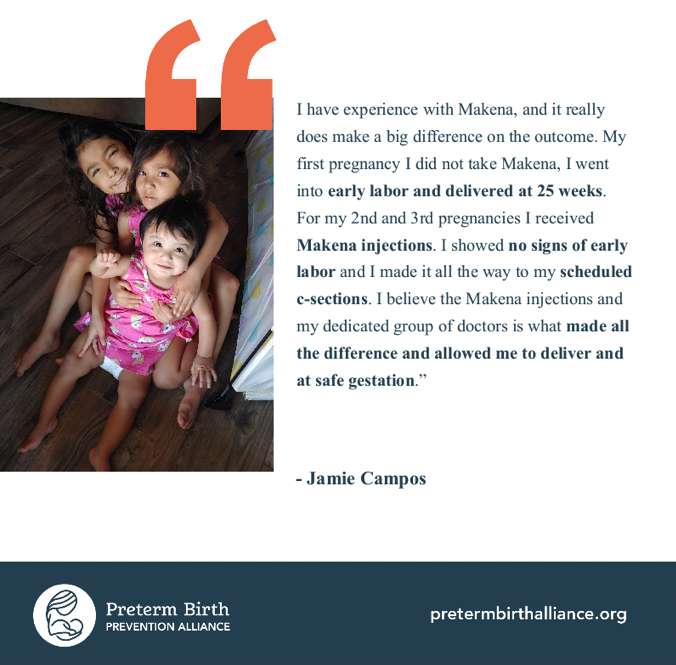
Last week, the FDA agreed to grant Covis Pharma, the manufacturer of the branded 17P product Makena its request for a public hearing to discuss 17P. Hydroxyprogesterone caproate—or “17P”—has been approved since 2011 and is the only FDA-approved class of treatments to help prevent spontaneous, recurrent preterm birth in the United States. In 2020, the FDA proposed withdrawing 17P in all its forms, including the branded product and its five generic versions, based on conflicting efficacy data from two studies composed of vastly different populations, one predominantly inclusive of women in the U.S. most vulnerable to preterm birth and one not.
“Mothers and birthing people deserve access to the best possible treatments to prevent preterm birth. We cannot achieve birth equity if we study pregnant women as a monolith,” said Blythe Thomas, Initiative Director of 1,000 Days. “It is only by systematically researching the real-world, post-market impact of 17P on individuals from a variety of racial and ethnic backgrounds, while maintaining access for all affected, that we can reduce disparities in maternal and infant health.”
While the hearing date has not yet been set, the Alliance looks forward to sharing the perspectives of affected individuals and their physicians with the agency once the hearing is scheduled and will continue to advocate for at-risk moms and babies of all races and ethnicities.
###
ABOUT THE PRETERM BIRTH PREVENTION ALLIANCE
The Preterm Birth Prevention Alliance (PBPA) is a coalition of maternal and women’s health advocates who share a common concern about the state of preterm birth in the United States and the proposed market withdrawal of 17P, the only FDA-approved class of treatments to help prevent spontaneous, recurrent preterm birth. Formed in 2021 by the National Consumers League, the 15 partners in the PBPA seek to improve preterm birth outcomes in the United States by maintaining access to safe, FDA-approved treatment options and advocating for more diverse medical research that adequately represents the experiences of women and newborns of color. Women of color need a seat at the table. To learn more, visit www.pretermbirthalliance.org
LEADING PATIENT ADVOCATES LAUNCH PRETERM BIRTH PREVENTION ALLIANCE TO PROTECT CRITICAL ACCESS TO THE SOLE FDA-APPROVED CLASS OF THERAPIES TO REDUCE RECURRENT PRETERM BIRTH
WASHINGTON, DC, April 20, 2021 – Today, the National Consumers League (NCL), along with a coalition of patient advocacy organizations dedicated to advancing the health of mothers and infants, announced the launch of the >Preterm Birth Prevention Alliance.
Members of the Alliance are joining forces in an effort to preserve patient access to the only Food & Drug Administration-approved class of treatments for pregnant women who have previously had an unexpected, or spontaneous, preterm birth. Together, Alliance members seek to ensure that the Food & Drug Administration (FDA) hears concerns from the full range of stakeholders about the potential risks and impact of withdrawal for at-risk pregnant women and their providers.
For the fifth year in a row, the U.S. preterm birth rate has increased (to 10.2 percent of births), and preterm birth and its complications were the second largest contributor to infant death across the country. Preterm birth also represents a significant racial health disparity, with Black women in America experiencing premature delivery at a rate 50 percent higher than other racial groups throughout the country.
However, in 2020, the FDA >proposed withdrawing hydroxyprogesterone caproate, commonly called “17P” or “17-OHPC”, the only FDA-approved class of branded and generic treatments to help prevent the risk of preterm birth in women with a history of spontaneous preterm birth. The FDA is currently determining whether to hold a hearing on the status of 17P, based on conflicting efficacy data from two studies composed of vastly different patient populations, one inclusive of women in the U.S. most vulnerable to preterm birth and one not.
“We’re fighting for a more inclusive healthcare system that gives everyone an equal chance to have the best outcomes possible,” said Sally Greenberg, executive director of the National Consumers League. “We don’t believe that removing 17P from the market without gaining a better understanding of who could benefit the most from its use is in the best interests of patients, nor their healthcare providers, particularly as there are no other approved treatment options available.”
To date, 14 organizations have joined NCL to advocate for the health interests of at-risk pregnant women and infants, including: 1,000 Days; 2020 Mom; American Association of Birth Centers; Black Mamas Matter Alliance; Black Women’s Health Imperative; Expecting Health; Healthy Mothers, Healthy Babies Montana; HealthyWomen; Miracle Babies; National Birth Equity Collaborative; National Black Midwives Alliance; National Partnership for Women & Families; Sidelines High-Risk National Support Network; and SisterReach.
“As a trained obstetrician and gynecologist, I know firsthand the impact of preterm birth on Black women and birthing people. I also know that racism – not race – is the driving factor leading the disproportionate impact of preterm birth on Black women and birthing people thereby exacerbating systemic inequities in maternal and infant health. To achieve birth equity, which is the assurance of the conditions of optimal births for all people with a willingness to address racial and social inequities in a sustained effort, we must work to protect and uphold a standard of care for spontaneous, recurrent preterm births and ensure it remains accessible and affordable for all who stand in need,” added Dr. Joia Crear Perry, founder and president of the National Birth Equity Collaborative.
The Preterm Birth Prevention Alliance is calling for the FDA to grant a public hearing to fully consider all of the data, additional research methods, and stakeholder perspectives before deciding whether to withdraw approval of this critical class of therapies. The health of America’s moms and babies warrants the utmost care and consideration.
###
ABOUT THE PRETERM BIRTH PREVENTION ALLIANCE
The Preterm Birth Prevention Alliance is a coalition of maternal and women’s health advocates who share a common concern about the state of preterm birth in the United States and the proposed market withdrawal of 17P, the only FDA-approved class of treatments to help prevent spontaneous, recurrent preterm birth. Formed in 2021 by the National Consumers League, we seek to improve preterm birth outcomes in the United States by maintaining access to safe, FDA-approved treatment options and advocating for more diverse medical research that adequately represents the experiences of women and newborns of color. Women of color need a seat at the table. To learn more, visit www.pretermbirthalliance.org.
Initial support for the Preterm Birth Prevention Alliance is provided by Covis Pharma.
MEDIA CONTACT:
Carol McKay, carolm@nclnet.org
<embed src=”https://art19.com/shows/ce489618-5918-423a-9b5f-35ce4c28ca09/episodes/2f8fa6fc-6aad-4f1f-bf13-3bdb0aa41732/embed?theme=light-custom&primary_color=%231850a3″ width=”100%” height=”300″></embed>
<iframe src=”https://art19.com/shows/we-can-do-this/episodes/c7b22520-c0aa-4718-9b59-4ee67e494547/embed?theme=light-custom” style=”width: 100%; height: 200px; border: 0 none;” scrolling=”no”></iframe>
<iframe src=”https://art19.com/shows/we-can-do-this/episodes/ab80228e-48d9-4a45-a894-a1bfc4e41c64/embed?theme=light-custom” style=”width: 100%; height: 200px; border: 0 none;” scrolling=”no”></iframe>
<iframe src=”https://art19.com/shows/we-can-do-this/episodes/ea08cbc0-f9f2-4082-9222-4e33f68b6826/embed?theme=light-custom” style=”width: 100%; height: 200px; border: 0 none;” scrolling=”no”></iframe>
<iframe src=”https://art19.com/shows/we-can-do-this/episodes/5039453f-6008-413a-9f6b-c9be649fd26e/embed?theme=light-custom” style=”width: 100%; height: 200px; border: 0 none;” scrolling=”no”></iframe>
<iframe src=”https://art19.com/shows/we-can-do-this/episodes/fafb46f8-6d90-4cd8-91be-616366d1b8ca/embed?theme=light-custom” style=”width: 100%; height: 200px; border: 0 none;” scrolling=”no”></iframe>
<iframe src=”https://art19.com/shows/we-can-do-this/episodes/25f0485d-bbce-46c8-bb90-139dcf1a2e7b/embed?theme=light-custom” style=”width: 100%; height: 200px; border: 0 none;” scrolling=”no”></iframe>
<iframe src=”https://art19.com/shows/we-can-do-this/episodes/ffbcae35-84c5-4c8b-9686-6e2c79679dd0/embed?theme=light-custom” style=”width: 100%; height: 200px; border: 0 none;” scrolling=”no”></iframe>
<iframe src=”https://art19.com/shows/we-can-do-this/episodes/520bdd73-d142-4508-9706-d81b5c042dff/embed?theme=light-custom” style=”width: 100%; height: 200px; border: 0 none;” scrolling=”no”></iframe>
<iframe src=”https://art19.com/shows/we-can-do-this/episodes/12354e8b-bf15-4eba-b34f-20e435df3bb7/embed?theme=light-custom” style=”width: 100%; height: 200px; border: 0 none;” scrolling=”no”></iframe>
<iframe src=”https://art19.com/shows/we-can-do-this/episodes/e2091efc-d66d-49f4-aa8e-8e6249858310/embed?theme=light-custom” style=”width: 100%; height: 200px; border: 0 none;” scrolling=”no”></iframe>