This Labor Day, Remember the Women Who Fought for the 40-Hour Workweek
By NCL CEO Sally Greenberg
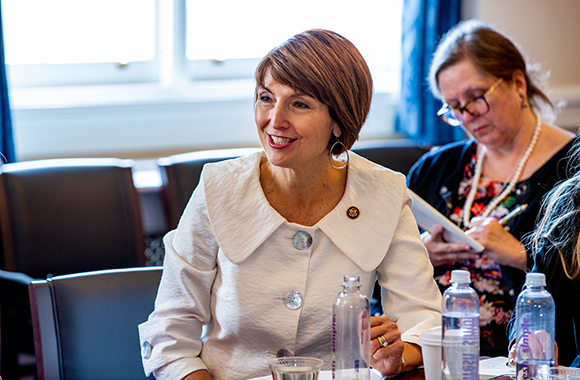
Labor Day 2026 is around the corner, and fittingly, I was asked this week to join an important discussion about “Responsible Purchasing Practices,” hosted by the Fair Labor Association (FLA), on whose board I serve. It may sound like a niche topic, but the issue is anything but: for generations, workers have been pushed into exploitative conditions to meet relentless demand for goods.
Unrealistic deadlines, last-minute changes, low prices, and production demands can put enormous pressure on the factories and workers who make our products. Children too are often exploited in the supply chain, with low wages, forced labor, hazardous work conditions, and human trafficking.
Florence Kelley, NCL’s esteemed first General Secretary appointed in 1899, made responsible purchasing practices an issue early on. One example is her work with Edward Filene of Filene’s Department Store to encourage shoppers to buy not 2 days before the holidays but weeks before. They launched the campaign because workers – often shopgirls as young as 10 and 11 – could typically be required to work 12 hours a day or more behind counters until late in the evenings, especially during holiday crunch season.
The Filene’s campaign was launched decades before the adoption of the U.S. Fair Labor Standards Act of 1938, which Frances Perkins, who was an acolyte of Florence Kelley and in 1932 became the Department of Labor Secretary under FDR, brought to fruition. The FLSA gave us maximum-hours laws, minimum wages, banned child labor, and required overtime pay beyond a 40-hour week. Ten and 12 hour days were not unusual, and often people worked 6-7 days a week. I talked about this fact on the panel this week – for 88 years, American workers – with a few categories unfortunately carved out and still lacking protections – have enjoyed the benefits of a 40-hour workweek. Workers around the world deserve the same.
The FLA’s program on Responsible Purchasing Practices shows that good RPPs remain a critical concern for workers around the globe – especially those who don’t enjoy broad labor law protections. Without limits on the demands manufacturers and retailers can make on workers to produce around the clock, suffering, exploitation, and misery will surely result.
The FLA is distinctive as a multistakeholder 501(c)(3) organization, bringing together universities, manufacturers, civil society organizations, and other stakeholders to advance laws, policies, and practices that promote safe and ethical working conditions. Responsible Purchasing Practices are central to that mission.
Florence Kelley understood that consumers also have a role to play in demanding decent working conditions for the people who make the goods they buy. When Filene’s and the National Consumers’ League launched their campaign, a central goal was to build that consumer awareness.
As significant as the Fair Labor Standards Act was for workers, NCL has spent decades working to close a major gap in its protections: the exemption affecting children who work on farms alongside their parents. In some states, that exemption can result in children working seven days a week without a guaranteed day of rest.
Poverty was—and remains—a major driver of child labor around the world. Early reformers understood that simply removing children from the workplace was not enough; families often depended on their earnings. Philanthropists therefore stepped in to help replace that lost income, making it possible for children to remain in school rather than at work.
That history helps explain why responsible purchasing practices matter today.
Consumers may see only the finished product on a store shelf or delivered to their homes. But behind every product are workers whose time and labor made it possible. Companies therefore have a responsibility to ensure that their purchasing practices do not encourage excessive overtime, unsafe conditions, or the erosion of basic labor standards.
More than 125 years after NCL was founded, the principle that guided Florence Kelley and Frances Perkins remains central to our work: consumers, companies, and policymakers all have a role to play in building an economy that respects workers and their rights.
We should also remember that the protections many workers enjoy today were hard-won. The eight-hour day, the 40-hour workweek, overtime protections, and restrictions on child labor did not simply appear. Generations of workers and reformers fought for them, often in the face of powerful opposition.
That struggle continues around the world. We are encouraged by recent progress in Mexico and Chile. Mexico recently enacted a constitutional amendment reducing the maximum workweek from 48 to 40 hours, with the reduction to be phased in between 2027 and 2030. Chile, meanwhile, is already implementing its own 40-hour workweek law. The maximum ordinary workweek fell from 44 to 42 hours on April 26, 2026, and will decline to 40 hours in 2028.
Labor Day reminds us not only of what workers have achieved, but also of how much work remains. Hundreds of millions of workers around the globe still lack meaningful protections, and Responsible Purchasing Practices are one important tool for addressing persistent labor abuses.
This Labor Day, let us celebrate American workers while remembering Florence Kelley, Frances Perkins, and the modern-day organizations—including NCL and the Fair Labor Association—that continue the fight for decent work, fair treatment, and meaningful protections for workers everywhere.