GM announces how victims will be compensated – National Consumers League

Kenneth Feinberg arranged compensation for victims of 9/11, those affected by the BP oil spill, and now, he has announced compensation arrangements for those injured or killed by GM’s faulty ignition switch. Feinberg, a guru of compensation, was a 2010 NCL Trumpeter honoree.

Here’s the system he’s worked out – If you can prove your airbag didn’t go off and you were injured as a result, you’re entitled to compensation. Proving that for victims may be difficult, however, Feinberg said he’s talked to the Center for Auto Safety (CAS), plaintiffs’ lawyers, and victims before determining how the payouts would work.

Anyone who lost a family member gets an automatic $1 million payout. Spouses and dependents get $300,000 each. And it won’t matter if the driver was drinking or bore some responsibility for the crash  – that is different from a lawsuit where a jury would hear that evidence.  The mother of one young victim said, “Its hard to see my daughter reduced to a figure.”

I couldn’t agree more. 

These terrible cases of GM’s negligence, including GM lawyers fighting every claim and denying the defect for years, is hard to swallow. The value of the Feinberg approach is that victims don’t have to spend years litigating and proving their cases. It’s voluntary and if you want to sue, you still can. Bob Hilliard, a plaintiff’s lawyer from Texas who has many of the victims cases in a class action, is quoted in the WSJ as saying he thinks these settlements “don’t seem unfair” and that he is cautiously optimistic. Clarence Ditlow of the CAS thinks Feinberg’s fund should include a presumption that if your GM car stalled, your claim is valid.

But one wonders whether the culture of secrecy at GM and so many companies whose products have hurt consumers will really change. Yes, this will cost GM an estimated $7 billion but that becomes the cost of doing business. No one goes to jail, no one is criminally prosecuted. If corporate officials thought they might go to prison for putting dangerous products on the market and then denying responsibility that would change the calculus in my view. For now, it’s good to know that GM is admitting its wrongdoing, it’s good that Mary Barra is talking about a culture change, and most important, it’s good that victims are getting compensation.


Cash-register-tape ads: one more thing for consumers to worry about – National Consumers League

Jane_Daugherty_mug_shot.jpgThis blog was submitted by guest blogger Jane Daugherty who is a doctoral candidate and instructor in the School of Communication at the University of Miami.

Those ubiquitous color ads printed on the backs of grocery store checkout receipts appear to be a boon to everyone: shoppers get special discounts at local businesses including mechanics, roofers and dry cleaners, the supermarkets get cash register tapes for free and the companies selling the ads make a tidy profit.

I’ve used them numerous times to save money on dry cleaning, oil changes for my Honda CRV and free tire rotations. The last coupons I got at my local Winn-Dixie supermarket in West Palm Beach even included an ad for the people who print the cash register ads and an invitation to visit them on Facebook and “download coupons on the go.”

And cash–register tape ads create jobs. Tens of thousands of people around the country get hired to sell the ads or work at call centers to contact potential advertisers while thousands of sales reps go to local businesses to sell the ads, I discovered with a little research. To my surprise, I also found that some of the sales managers for register-tape ads make six-figure salaries plus six-figure commissions, a lot more than I’ll ever make as a university professor. Executives and owners of register-tape advertising firms can make millions.

This piqued my ex-investigative reporter‘s curiosity. It turns out that hundreds, perhaps thousands of U.S. workers are employed by one of the largest cash-register tape advertising companies, Register Tapes United Inc. (RTUI) based in Houston, TX.

Many of RTUI’s workers get nothing or a fraction of what their would earn hourly for their fulltime and overtime work selling ads, according to two large class-action lawsuits filed against RTUI in Maryland and California. The lawsuits charged RTUI with illegal labor practices that deprive their sales representatives and call center employees of minimum wage pay, workers’ compensation, medical benefits, expenses, while RTUI promised hefty sales commissions and flexible working conditions. And although most of those who sued worked fulltime or more on a regular schedule, they also submitted evidence that they were also deprived of overtime.

But what about the discounts I’ve become accustomed to using those cash register ads in the past? A little more checking with the grocery stores where I shop showed that RTUI provides most of the free advertising-laden cash register tapes to supermarkets in Palm Beach County, where I live. In fact, the lawsuits charging them with cheating their workers by classifying them as contract employees say RTUI is likely the largest firm in the country producing advertising-backed cash register tapes for grocery stores.

So once again, as a consumer I face the dreaded decision I think of as my Walmart morality test. Sure, I can buy numerous products I need for my home, my car, my dog, even groceries and discounted gas at Walmart, often cheaper than I can buy them anywhere else.

But three years ago, after reading a case study on Walmart’s employment practices for a graduate school class showing the company skirts labor laws by employing mostly part-time employees with no benefits, I did what I knew I should do as a former union member, a worker in an underpaid profession (teaching) and someone who actually hears sad tales about Walmart working conditions from a young friend who currently works at a South Florida Walmart because he couldn’t find another job. I actually quoted Nancy Reagan to the Walton family in my mind so I could “Just say no.” And I don’t shop at Walmart anymore.

Also somewhat of a geek – it is not an accident that I am finishing my Ph.D. in Communication at the University of Miami in my early 60s — I wanted to know more about the cash-register-tape ads. I poked around a little more to see if I needed to employ my “just say no” approach to those big-discount ads from RTUI.  As a journalist for almost 25 years before I became a university professor in 2005, I know my way around legal databases.

One of the recent class action lawsuits I found against RTUI was filed in Maryland District Court by Taj Grayson, who claimed RTUI routinely classified him and other hourly workers as independent contractors, although they worked regular, fulltime, employer-set schedules in RTUI call centers. The lawsuit said the workers were closely supervised and did not have the freedom to set their own hours or the special skills required to be independent contractors under U.S. labor laws.

RTUI has been the defendant in multiple lawsuits alleging that the company also fails to pay its sale representatives promised commissions, car expenses and overtime also by calling them  “contract employees.”

One of the plaintiffs in the Grayson case, Sally Henson, then 53, worked for RTUI in Southfield, MI, just north of Detroit where I lived for nine years, so using the court file to find her, I called her up.

Now a sales representative for ADT, Henson said she “had extensive sales experience when she went to work for RTUI, which, she said promised her a sales job with commissions,  “I was promised an outside sales job. They seemed eager to get me because of my experience.”

But first Henson said she was told she had to work  “a couple of days in the call center to see how it works.” The call centers booked appointments with local business owners, then RTUI sales representatives would keep the appointments and to sign the business to multi-year contracts for their ads to appear on the cash register tapes of local supermarkets, she said.

“I worked 8 to 5 or 5:30,” Henson said, “Five days a week. You had to be in the office making calls reading the scripts the whole time. There was no lunch hour and workers were not allowed to leave, she said.

“I was an idiot. I worked there two or three months in the call center before I realized they were never going to keep their often repeated promises to let me be a outside sales rep where you earn commissions,” said Henson, who now works for ADT in Michigan doing outside sales. “Some weeks I literally got paid nothing. I think the most I ever made was $200 for a week.”

Without admitting any wrong-doing, RTUI settled the Grayson lawsuit last year. The 40 plaintiffs received $50,000 and their court costs and lawyers fees totaling $73,906 were also paid by RTUI under the agreement.

How widespread is the is misclassification of  workers charged in the class action lawsuits filed against RTUI, I wondered. At the National Employment Law Center, I contacted Catherine Ruckelshaus, general counsel and program director, to ask her about the labor practices Henson described.

A veteran labor lawyer, Ruckelshaus said, “Call centers have been a real hotbed of wage and hour abuses. The practice has become increasingly common, although it has been a problem for decades. The increase in (misclassifying) independent contractors has been driven by the downturn in the economy, which helps employers perpetrate these schemes.

“Greed is also a factor because often they can get away with it… There has been very little enforcement (of labor laws including the Fair Labor Standards Act).”

Ruckelshaus said unemployed workers who get contract employee jobs, then discover they are being exploited, are often reluctant to complain, which is often the only way the employers get caught. At the same time, she said, the federal and state governments lose billions of dollars every year that companies who misclassify hourly workers as contract employees fail to pay for Social Security withholding, payroll taxes, unemployment coverage and workers’ compensation taxes.

But the practice of illegally classifying hourly workers as independent contractors is so widespread today in construction, home care, sales, housekeeping and light manufacturing, that employers who violate labor laws gain an unfair advantage over businesses who use temporary employment agencies, Ruckelshaus said.

“Workers don’t feel they have any power today,” she said,  “And federal and state agencies who regulate labor practices are now under-funded and under-staffed.”

But many RTUI call-center workers did complain, including Henson and Grayson, who on April 5, 2011 filed their class action lawsuit. The lead plaintiff, Taj Grayson, worked for RTUI’s Columbia, Maryland’s call center fulltime, usually 46 hours a week, from August 2010 until January 2011, the suit alleges. Paid as an independent contractor, he received at total of  $2,560 from RTUI for five months’ fulltime work with no benefits, no federal or state taxes paid, and no choice of what hours he worked. In fact, Grayson was paid less than one third of what he would have been paid at the hourly minimum wage, the lawsuit said. What he received amounts to $98.46 a week take-home pay for a 46-hour workweek.

I did the math. If RTUI had paid Grayson as the hourly employee on a regular schedule, with supervision and no special skills required to read the company’s highly scripted pitches to local business to advertise with them, he would have been paid $8,671, plus benefits, plus Social Security credits, plus better working conditions, including regular breaks.

In Michigan, Henson said she took the 45-48-hour-a-week job with RTUI during the recession and if she had tried to live on her tiny paychecks, “I would have starved, if I didn’t have a husband who was working.”

But many RTUI workers, according to the lawsuits filed in Maryland and California, were hardly their own bosses. The class-action suits allege both sales and call-center workers were closely monitored by supervisors and required to literally read scripts to potential advertisers, trying to sign them multi-year contracts. Neither were they “growing their own businesses” or benefitting from sales commissions, which the legal definition of  “independent contractor” classification requires.

More research revealed that misclassification hourly workers as independent contractors has become so widespread nationally that the federal government has allocated $25 million for a joint IRS-Department of Labor initiative to attempt to make it harder, if not illegal, to class workers without the independent schedules and a share of profits as independent contractors. Texas, where RTUI is base, is one of the 16 states so far to join in the federal effort to prosecute businesses that misclassify hourly workers as independent contractors to illegally avoid paying federal and state taxes.

I also found that RTUI has run afoul of tax laws before.  Since 1995, nearly a million dollars in state and federal tax liens have been filed against RUTI including state liens in California Texas, Ohio, Mississippi, New York, Washington, Maryland, Wisconsin and Kentucky.

Ruckelshaus, who has represented numerous under-paid or unfairly treated employees, said companies who misclassify hourly workers as contract employees don’t just pay workers less than minimum wage and deprive them of benefit, they “cost the states billions in workers’ compensation non-payments… and cost the federal government billions in payroll taxes.”

Today an estimated 10.3 million people in the U.S. are employed as independent contractors, according to the U.S. Department of Labor. “Many, many of them are improperly classified to avoid taxes and to pay much lower compensation,” Ruckelshaus said.

Improper classification as contract employees is also claimed in the California in a still pending class action lawsuit against RTUI filed in 2011 in Los Angeles County. The lead plaintiff in the case is Allen Hamburger, employed as a RTUI sales representative since 2004 and fired without warning in 2009, when he was 66, for allegedly failing to meet his sales quota.

Joined by 50 other former RTUI employees, Hamburger’s lawsuit alleges that he and the others were improperly classified as contract employees, forced to work mandatory and unpaid overtime, denied payment for business expenses including mileage and tolls, not paid promised sales commissions, not provided with itemized wage statement in violation of California’s Labor Code and not paid for their final weeks of work.

A tentative settlement, in which RTUI makes no admission of “liability, culpability, negligence or wrong-doing,” would set up a settlement fund of $75,000 for the case, pay Hamburger an additional $2,000 for his work as the lead plaintiff, pay plaintiffs’ lawyers $30,000 and court costs of up to $6,368.18. The agreement awaits approval by a district court judge later this year.

Hamburger’s several attorneys did not return calls and emailed requests for comment. RTUI’s attorney in the case, David J. Hamilton, said when I talked to him on June 18 that the district judge has not yet signed the negotiated settlement , but RTUI did not break labor laws, “We take the position that they all independent contractors.”

Jane Daugherty, a doctoral candidate and instructor in the School of Communication at the University of Miami, is also a journalist who was a Pulitizer Prize Finalist at the Detroit Free Press. She is a four-time winner of the national Robert F. Kennedy Journalism Award for Coverage of the Disadvantaged and was a Nieman Fellow at Harvard University. From 2005-2010, she was Associate Professor of Journalism at Florida International University after working as an investigative reporter and editor at the Palm Beach Post, the Miami Herald, the St. Petersburg Times and the Austin (TX) American-Statesman.

Harrowing tales about child domestic workers – National Consumers League

By Alesha Mitchell, Communications Intern

I knew about its existence in Africa, in Asia, and even some parts of Europe, but never have I heard of child labor right here in the United States. June 12 was World Day Against Child Labor, and the Child Labor Coalition in conjunction with The Alliance to End Slavery and Trafficking, held a congressional briefing. 

The briefing was hosted by Senators Tom Harkin (D-IA), Marco Rubio (R-FL), and Richard Blumenthal (D-CT) as well as Representatives Lucille Roybal-Allard (D-CA) and Ted Poe (R-TX). The congressional hosts, victims, and advocates all met to discuss child labor and child domestic workers. Each of the panel members took us on a journey through the lives of child domestic workers. Upon meeting the panel, Sen. Richard Blumenthal (D-CT) reminded us that this is one of few issues that has bipartisan support. Rep. Lucille Roybal-Allard (D-CA) suggested, “We can’t just look globally, we have to start right here…at home.” Many of us in the audience never knew we had to consider this regressive issue in our progressive country.

Jo Becker of Human Rights Watch introduced us to a young girl named Fatima who is a child domestic worker in Morocco. Fatima, at a very young age, cared for children that were not her own, was only allowed to eat twice a day, and was beaten if her tasks were not completed flawlessly. Fatima was not provided education and was not allowed to visit her family. Fatima told Jo that she did not mind working, but she did not deserve to be beaten and starved. As an advocate for human rights, I believe neither Fatima nor any other child should ever endure involuntary servitude. Unfortunately, we learned from the next speaker that right in our own backyard, people in America are treated as slaves.

Evelyn Chumbow, a child domestic worker turned survivor, was abducted from her home in Cameroon at the age of nine. She was brought to the US and lived as a household servant from the ages of 9-17. She spoke about the horrific encounters of being beaten and assaulted during her years of enslavement. Without the help of a priest, foster care, and trafficking prevention organizations, Evelyn could have remained in her oppressed state. She would not have the courage to speak out about this growing epidemic as she does today.

With Congress unwilling to move forward with this much needed legislation, the onus falls on the American people to pressure our lawmakers to make the right decision and do what is in their power to protect child domestic workers abroad and in America. 

The Child Labor  Coalition, in it’s 25th year, is co-chaired by the National Consumers League and the American Federation of Teachers.

Teens do not realize the dangers of energy drinks – National Consumers League

Many student athletes are loading up on highly caffeinated energy drinks before practices and competitions.  In some cases, parents are providing these beverages.  What both the parents and teens may not realize is that energy drinks are leading to death, especially among individuals with heart complications or defects. Too many young people are unknowingly hurting their bodies from energy drink overconsumption.

For starters, energy drinks contain large amounts of caffeine and are designed to be consumed more quickly than a cup of coffee or tea.  While some smaller servings of energy drinks contain less than 200 milligrams of caffeine, a normal amount to consume in a day according to doctors, many come in 20 – 24oz cans which contain far higher levels of caffeine.  Not to mention there are endless accounts of teens drinking multiple energy drinks at one time.  One product, Mio, comes in a small squeeze bottle and is intended to be added to water.  The entire bottle in whole contains 18 servings coming in at around 1060mg of caffeine.  This sort of product is begging to be abused by students. 

High levels of caffeine in energy drinks aren’t the only dangerous component.  Thanks to loopholes and a lack of enforcement on behalf of FDA, energy drink companies use additives (like guarana and l-carnitine) that are not proven to be safe.  Not to mention that guarana contains caffeine that isn’t included in the total amount of caffeine.  Taurine, another common additive, also affects the heart and cardiovascular system.  Mysterious additives in combination with the tendency to consumer these beverages in large amounts lends to a rather dangerous brew. 

With so much contention surrounding youth consumption of energy drinks, why does the U.S. continuing to allow marketing and sales to minors?  In 2011, Canada set limits on the amount of caffeine in energy drinks. Canada also required on package labels that identify groups sensitive to caffeine and warning labels advising against mixing energy drinks with alcohol.  At the very least marketing to minors in the U.S. should be eliminated and age restrictions put in place on sales.  

Meet NCL’s 2014 summer interns – National Consumers League

NCL is happy to have great interns with us this summer. The office is bustling with busy bodies as our intern team of six work hard to help us achieve our goal of helping American consumers and workers.

Connor Barniskis –LifeSmarts

Florida State University ’15 I am going into my senior year at Florida State University and am double majoring in Political Science and Criminology. Although I currently live most of the year in the “Sunshine State” I am originally from “the land of the ice and snow” Eden Prairie, Minnesota. Spending a summer in DC is something I have always dreamed about and I am thrilled with the opportunity to work for the NCL.

The road to interning at the National Consumers League was opened to me by American University’s Washington Semester Program. I was looking for a program that could give me firsthand experience in DC as well as harmonize with my current beliefs and values. After working with my advisor from American University, I discovered and applied for this internship. Believing strongly in consumer rights and safety, I find the NCL work in protecting the average American inspiring. Furthermore, their LifeSmart’s program which helps younger students become intelligent and aware consumers is something that I am proud to help work on. I see it as an opportunity to help change someone’s life by building the LifeSmart’s Program to greater heights. I am also interested in learning more about consumer fraud and the policy and regulations the NCL supports.

I studied abroad my freshmen year and currently work for the International Programs Office at Florida State University during the Fall and Spring as a student recruiter.  I hope to one day work for the State Department as a member of the Foreign Service. It will be a long road but I hope that the tools I will learn here at the NCL will take me to my destination. 

Traveling is a part of who I am and I love seeing how everything here in Washington DC works. I hope to keep learning and growing from my experiences here at the NCL and will apply them to wherever I end up in the future.

Chris Beal – Public Policy

Just wanted to take a moment to introduce myself. My name is Chris Beal and I’ll be joining the NCL for the summer as their 2014 Google Policy Fellow. I grew up in Detroit and attended Wayne State University, where I received a B.A. in English. My interest in policy work – especially with regard to socially responsible business practices – probably began during my time there. After undergrad I spent a few years working as a consultant for a number of startups and tech companies. That work sparked in me an interest in the way law interacts with both emerging technology and public policy.

So, to the surprise of absolutely no one, I decided to go to law school. I packed my bags and moved from the Midwest to NYC, where I attended Brooklyn Law School. My studies there were focused primarily on matters related to Internet, Information Privacy, and Intellectual Property law. While there I had the opportunity to participate in the law school’s BLIP Clinic, a clinic focused on public policy, emerging technology, and entrepreneurship. This afforded me with the opportunity to meet with a vast array of policymakers and innovators, and to work on a number of interesting legal issues. One such project was my work with the App Developers Alliance, which led to the development of their Patent Troll Defense Network. The Network provides developers and small companies targeted by patent trolls with pro bono support and access to legal clinics.

I am especially excited to be working with the NCL because I will be able to continue my work on tech issues in a way that will have positive, real-world effects on public policy. In an increasingly interconnected world, where the Internet is almost unavoidable in everyday life, I believe it is important that public policy works to adequately protect individuals. Law and legislation can be slow to evolve, and technology is ever the opposite, so it is imperative that there be individuals and agencies dedicated to helping one stay apace of the other. 

Aaron Dai – Public Policy

My name is Aaron Dai and I am a rising junior at Brandeis University in Waltham, Massachusetts. At Brandeis, I am a double major in Politics and International and Global Studies with a planned double minor in Legal Studies and Anthropology. When I am not writing papers for multiple politics courses, I participate in the Brandeis Academic Debate and Speech Society. I also enjoy being active, playing basketball and swimming whenever I can find time. I first discovered NCL through my university’s career website. After learning more about the organization and its mission and purpose through NCL’s website, I decided that the League would be a wonderful place to gain firsthand experience with regard to the field of public policy and its effects on the consumer population.

I had come quite close to being scammed a few years ago. I received numerous phone calls regarding trips, cruises and cash prizes after I answered a poll question on Facebook. The experience made me realize the importance of informing consumers like myself about possible scams and fraud.  The experience also revealed to me how ordinary people are so easily susceptible to these scams. Thus, the many things that the League is doing with regard to consumer advocacy in the field of consumer protection and fraud in particular makes me extremely excited to be able to work in this field.

I am eager to immerse myself in the work that the League does this summer. In addition to getting myself acquainted with the field of consumer advocacy during my time with the League, I hope to gain a new perspective with regard to public policy and be able to apply the principles and approaches of consumer advocacy utilized by the League to the issues that affect the broader global consumer population. 

Julie Duffy – Child Labor Coalition

Hi, my name is Julie Duffy and I was born and raised in Rochester, New York. However, after eighteen cold and bitter winters I decided to move to the West Coast in search of mild temperatures and snowless winters.  I currently attend the University of San Francisco. However, I will be starting my junior year this fall studying abroad in Amman, Jordan. I am majoring in international studies with a concentration in international economics and a double minor in Middle Eastern studies and public service and community engagement. I am the vice president of USF’s Mexican folk dance club Baile Folklorico de San Pancho as well as member of our Model Arab League delegation. Additionally, I enjoy spending time outdoors, hiking, camping and playing tennis.

I became familiar with the National Consumers League from American University’s Washington semester program, of which I am participating this summer. I have a passion for social justice and I felt that interning with the Child Labor Coalition was a great opportunity for me to engage in the fight against child labor both domestically and abroad. I look forward to the many opportunities this summer offers including learning about important consumer advocacy issues and improving my personal awareness of consumer issues. I am also excited to spend the summer in DC and explore the city! 

Alesha Mitchell – Communications

I have been reading Bishop T.D. Jakes’ “Instinct: The Power to Unleash Your Inborn Drive.” I began reading this book first, because Oprah said so and second, because I wanted to know how to effectively live on instinct. I wanted to be assured that I could trust myself and know that my decisions are products of good seeds sown. My relationship with God was and is stronger than ever and I feel myself navigating towards destiny.

In his book, Bishop writes about the giraffe and the turtle. He explains that the giraffe, in its grand stature, is equipped with a 25-pound heart in order to maintain the circulatory flow of blood through its extended neck into its intelligent brain. Bishop then describes how newborn turtles instinctively search for the ocean waters after being hatched on sandy ground. Why is this relevant? Too often, many of us are so distracted by things, other’s opinions, and our own insecurities that we do not hear what we already know deep inside of us. Bishop states that if the giraffe attempts to bend its head to the level of the turtle that the giraffe will inevitably pass out; thus suggesting that the giraffe must operate on the level for which it was designed.

Because I have such a huge heart, I have to keep my head lifted to the level of my destiny. I must not settle for the “status quo” of what society justifies as a career for a young adult woman. Additionally, I must not stand-back when issues arise. I refuse to work with an organization that does not encourage instinctive behavior. During this summer internship with the National Consumers League, I will contribute to this organization’s strive for the well being of all. I am Alesha D. Mitchell and I care.

Paige Whitney – Public Policy

I am a senior of Florida State University double majoring in International Affairs with a focus in Political Science. I am originally from Merrimack, New Hampshire but decided to leave the frigid temperatures for sunshine. I am happy to be back in the Northeast and begin my new adventure at NCL.

I am participating in the Washington Semester Program run by American University. With the help of my advisor at American University I found NCL and applied right away. I believe there is a strong value in consumer safety and awareness which many people across the country are not properly informed about. I am particularly interested in public policy issues which focus on protecting the consumer from fraud. Many consumers are not aware of the risk they place themselves in just by entering their information on a local website or by online shopping. I am also eager to learn more about the other areas NCL deals with such as labor interests and begin my summer here at NCL.

With a background in International Affairs I hope to take what I learn here, at NCL and transfer it on an international basis as a focus of what I hope to be doing in Graduate school. I love to travel and spent my freshman year at FSU in Florence, Italy and London, England. In the future I hope to attend a Graduate program abroad in Switzerland and broaden my experience with public policy to success in foreign policy. 

Making the case for a soda tax – National Consumers League

Last week the Center for the Science in the Public Interest hosted the National Soda Summit in Washington, DC. Strange name for a conference, I know.  Without further explanation, one might conclude from the title that his was a Coca-Cola extravaganza. Au contraire. CSPI, which was founded in by Dr. Mike Jacobson in 1971, gets the credit for getting Americans, for the first time, to question what’s in their food, ask how nutritional that food is, and ask why our food choices make us unhealthy.

Sweetened drinks such as soda, energy drinks, sports drinks, and sweetened coffees and tea, add large numbers of calories to the diets of children and adults. They are associated with chronic diseases, including type 2 diabetes, heart disease, and obesity.

Undoing the damage that’s caused by unhealthy foods – and the ubiquity of unhealthy drinks available to us every day –is a long slow process. Walk into a 7-11 sometime and count the number of empty calorie options that add massive amounts of calories to our diet every year.

On the tables at the conference were two-liter bottles of Mountain Dew and Pepsi and Coke and energy drinks– with notes on how much sugar each contained – try 64 teaspoons in the Mountain Due and 72 in the Pepsi. Bags of domino sugar were mounted on one table to demonstrate the absurd amounts of empty calories in these drinks. That’s a little bit deceptive because the sweetener in these drinks isn’t sugar but high fructose corn syrup. However, the calories are the same.

NCL supports a tax on sweetened drinks, with proceeds devoted to school nutritional education programs.  The latest research from the Robert Wood Johnson is that a calorie –based tax on drinks would reduce consumption of beverage calories. Based on sales data from supermarkets in New York, a .04 cent per calorie tax on sugar sweetened beverages would reduce the consumption of beverage calories by 9.3 percent. Research shows that a variety of pricing strategies can create incentives for healthier choices. Interestingly, a 20 percent increase in the cost of sweetened beverages, is estimated to reduce consumption by 24 percent. Like cigarettes, soda is price sensitive; raising the price of these empty calorie drinks may be just what we need to lower consumption levels.


Exposing discriminatory car loans – National Consumers League

92_bostian.jpgLet’s say you’re at the auto dealership, negotiating terms for your new car. At the next sales desk is a family whose income, credit score, and assets are identical to yours. When all is said and done, however, your loan costs $300 more than your fellow customer’s. How come? Most likely, it’s because you’re African-American and your fellow customer is white. Wait a minute, isn’t that illegal, you wonder? Well, sure, but how do you prove it? 

Who’s overseeing these so-called “interest-rate markups” that so often penalize African-American and Latino customers solely on the basis of race and ethnicity. 

Experts from the Center for Responsible Lending, Office of the Controller of the Currency, and other groups described these offensive practices at at a May 22 congressional briefing chaired by CRL staffer and NCL board member Ken Edwards. In addition to congressional staffers, reporters and advocates attended, as did NCL staffer Amy Sonderman myself. Participants also heard from several Representatives, including Hank Johnson, Steve Horsford, and Tony Cardenas, who decried discriminatory interest-rate markups, saying, “People are cheated out of what they’ve earned!” Rep. Johnson reminded participants that in 2004 Ally Bank (successor to GMAC) paid an $80 million fine to settle a class-action lawsuit filed by the National Consumer Law Center. Despite that, interest rate markups are so lucrative that this discriminatory practice continues. 

What can be done? According to Enrique Lopezlira on the National Council of La Raza, Congress should fix the “carve-out” and give the Consumer Financial Protection Bureau statutory authority to regulate car loans by auto dealers. Michael Archer from the Marine Corps Installations East, urged stronger regulation. “Troops need better financial education, but it isn’t enough. Many don’t even know they’ve been swindled, and too many don’t think it would be effective to register a complaint.”

$300 more per car, just because you’re African-American. This is one tiny aspect of racial discrimination in our “post-racial” America. Let your Representative know what you think.  

Political battles have no place in our schools’ cafeterias – National Consumers League

92_kelsey.jpgWhen you think of controversial policies, school lunch isn’t the first thing that should come to mind. As a nation fighting a childhood obesity epidemic, school lunches play an important role in getting us back on track. Schools provide one, and sometimes two, of the three meals kids eat each day, packing the biggest punch for kids who depend on these meals for nourishment. How can we justify serving anything but wholesome, nutritious food when that is the case?
The House Appropriations Committee begs to differ.  Tomorrow they are expected to approve a 2015 spending bill for the Agriculture Department granting a waiver from nutrition standards required by the 2010 Healthy, Hunger-Free Kids Act.  The requirements set limits on sodium and substitute whole grain foods for those that are not.  The Senate Appropriation Committee’s bill does not include the waiver setting this up to be a drawn out fight.

Tuesday, Michelle Obama came out strongly opposing the House Republican led attempts to scale back healthier school lunch standards saying we can’t afford to play politics with nutrition standards. Prior to the Healthy, Hunger-Free Kids Act, there were no standards for what could be served in schools. Hiring criteria for food service personnel and annual nutrition education training as well as grants for upgrading kitchen equipment and providing farm to school education to students are a few of the major proponents of the original bill.

The School Nutrition Association, an industry backed trade association representing cafeteria administrators, argues the new requirements are unduly expensive and lead to food being wasted by students.  Since issuing their statement in opposition of the regulations, nineteen former presidents of the School Nutrition Association have publicly opposed the group’s platform and urged Congress to keep the Healthy, Hunger-Free Kids Act regulations intact. As Michelle Obama said, “ the last think we can afford to do right now is play politics with our kids’ health.”

Summer grill season is here! Think American union-made – National Consumers League

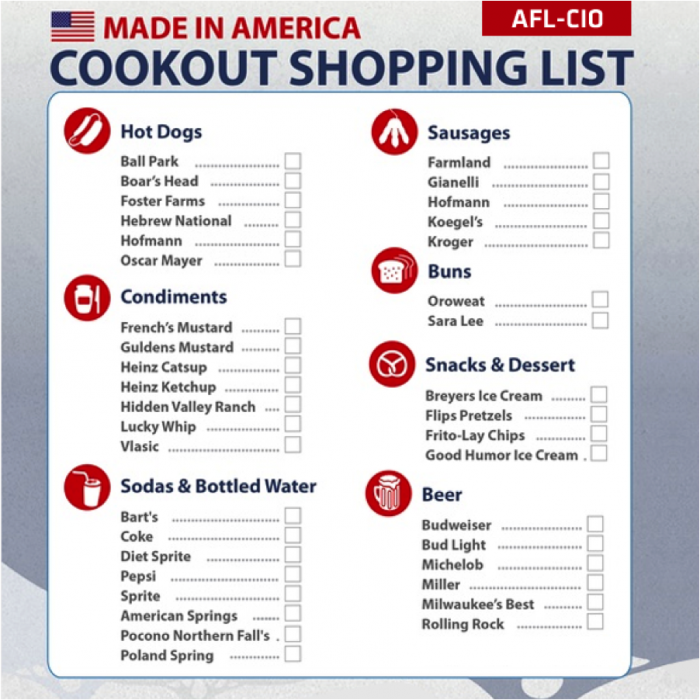
With the unofficial start of summer right around the corner, it’s time to start thinking about firing up the grill and looking forward to our favorite summer foods. This summer, make your grocery shopping mean more than just great food and support good paying American jobs. As a consumer, you can support the actions of thousands of hard working Americans by buying American-made products and union-made products. 

Check out the list below and try to serve some union-made treats this Memorial Day weekend and all summer.

Untitled

Text MADE to 235246 for more union-made-in-America product lists.
Our list comes courtesy of Union Plus, the Bakery, Confectionery, Tobacco Workers and Grain Millers (BCTGM), the United Food and Commercial Workers (UFCW) and the Los Angeles County Federation of Labor’s website Labor 411.

Raw milk is a raw deal for consumers – National Consumers League

NCL has recently signed onto a consumer group letter opposing two shocking federal bills introduced to weaken restrictions on the sale of raw milk. Raw milk – milk that hasn’t been pasteurized to kill dangerous bacteria – can kill you. NCL’s first leader, Florence Kelley, watched children get sick and die from raw milk. She was disconsolate that states were slow to require pasteurization, Louis Pasteur’s great discovery that heating milk kills pathogens.

(Pasteur also developed the rabies vaccine.) Heating milk to 161 degrees for 15 seconds, known as flash pasteurization, is all it takes to make milk safe.

The ignorance of those who champion the so-called benefits of raw milk is astounding. Its one thing if an adult wants to consume raw milk, but parents feed raw milk to their children putting their kids’ lives at risk.  The CDC reported in 2012 that unpasteurized products are 150 times more likely to cause food borne illnesses than pasteurized versions.

One of the federal bills would end the interstate ban on raw milk sales and the second would allow interstate transport between states where raw milk is legally sold. There are 40 bills to allow raw milk sales at the state level.

Bill Marler is a food lawyer in Seattle who has handled two-dozen cases involving illnesses from raw milk consumption in children or the elderly.  “It’s a high risk product and in most cases, I’m representing the most vulnerable in society,” Marler said.

In November, five-year-old Maddie Powell was one of nine children in her family, all younger than seven, who were sickened by E. coli from raw milk. Maddie, along with two of the other children, developed hemolytic uremic syndrome (HUS), a potentially fatal kidney disease that is known to coincide with E. coli infections. After this frightening and costly experience, Maddie’s mother said they would not return to drinking raw milk.

Why in the world would any parent knowingly subject their child to such a dangerous product to begin with? Because raw milk advocates are peddling a message that their product has health benefits superior to pasteurized milk. Nothing could be more misguided. We hope these federal bills will generate an informed discussion that will demonstrate the folly of consuming raw milk.